Bilingual edition: English is preserved and Chinese follows each unit. Terminology uses the confirmed v20260916 glossary; automated semantic review remains traceable.
中英双语版:英文原文完整保留,中文紧随对应单元;术语采用 v20260916 确认表,自动语义审校结果可追溯。

Thin Lens Equation

薄透镜公式

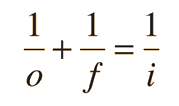
A common Gaussian form of the lens equation is shown below. This is the form used in most introductory textbooks. A form using the Cartesian sign convention is often used in more advanced texts because of advantages with multiple-lens systems and more complex optical instruments. Either form can be used with positive or negative lenses and predicts the formation of both real and virtual images. It is valid only for paraxial rays (rays close to the optic axis) and does not apply to thick lenses.
一种常见的高斯形式的透镜公式如下所示。这是大多数入门教材中使用的形式。在更高级的教材中,常常使用笛卡尔符号约定,因为这种形式在多透镜系统和更复杂的光学仪器中具有优势。无论是哪种形式,都可以用于正透镜或负透镜,并能预测实像和虚像的形成。该公式仅适用于近轴光线(接近光轴的光线),不适用于厚透镜。
Enter data below, then click on the quantity you wish to calculate in the active formula above.
For a lens of focal length f = cm,
corresponding to lens power P = diopters,
an object distance of o = cm
will produce an image at i = cm.
The linear magnification will be M = .
对于焦距为 f = 厘米的透镜,对应透镜的功率 P = 象限,当物距为 o = 厘米时,图像将出现在 i = 厘米处。线性放大率将为 M = 。
中文译文中的待填/计算数值依次对应:1:f 2:p 3:o 4:i 5:m。实际数值以上方原输入框为准。

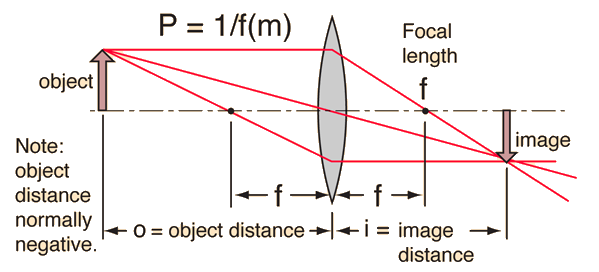
If the lens equation yields a negative image distance, then the image is a virtual image on the same side of the lens as the object. If it yields a negative focal length, then the lens is a diverging lens rather than the converging lens in the illustration. The lens equation can be used to calculate the image distance for either real or virtual images and for either positive on negative lenses. The linear magnification relationship allows you to predict the size of the image.

如果透镜公式得出负的像距,则像为虚像,位于透镜与物体同侧。如果得出负的焦距,则透镜为发散透镜,而非示意图中的会聚透镜。透镜公式可用于计算实像或虚像的像距,以及用于正透镜或负透镜。线性放大率关系允许你预测像的大小。
Form of lens equation with Cartesian sign convention
采用笛卡尔符号约定的透镜公式形式
Reversibility of object and image points: conjugate points
物体点与像点的可逆性:共轭点
在下方输入数据,然后点击活动公式中您希望计算的量。
Index

Lens concepts
棱镜概念索引
 
HyperPhysics***** Light and Vision
HyperPhysics ***** 光与视觉
R Nave
Go Back
返回


Thin-Lens Equation:Cartesian Convention

薄透镜公式:笛卡尔约定

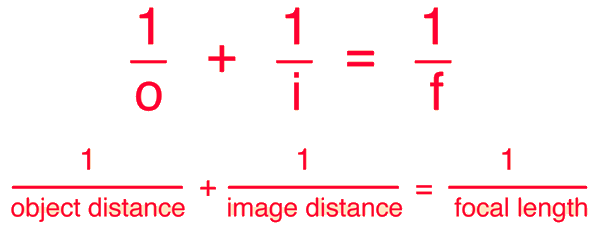
If the Cartesian sign convention is used, the Gaussian form of the lens equation becomes

如果使用笛卡尔符号约定,高斯形式的透镜公式变为
because in that convention the positive direction for a quantity is always in the direction that light is traveling. The object distance o is then a negative number because to travel from the lens to the object, you must travel in the direction opposite to light travel. The thin lens equation is also sometimes expressed in the Newtonian form. The derivation of the Gaussian form proceeds from triangle geometry. For a thin lens, the lens power P is the sum of the surface powers. For thicker lenses, Gullstrand's equation can be used to get the equivalent power.

To common form of lens equation in introductory texts
初版教材中常见的透镜公式
因为在这种惯例中,量的正方向始终是光传播的方向。物体距离 o 是一个负数,因为从透镜到物体的传播方向与光的传播方向相反。薄透镜公式也可以以牛顿形式表达。高斯形式的推导基于三角几何。对于薄透镜,透镜的功率 P 是两个表面的功率之和。对于较厚的透镜,可以使用 Gullstrand 的方程来得到等效功率。
Index

Lens concepts
棱镜概念索引
 
HyperPhysics***** Light and Vision
HyperPhysics ***** 光与视觉
R Nave
Go Back
返回


Cartesian Sign Convention

笛卡尔符号约定
  1. All figures are drawn with light traveling from left to right.
    所有图中光线均从左向右传播。
  2. All distances are measured from a reference surface, such as a wavefront or a refracting surface. Distances to the left of the surface are negative.
    所有距离都是从参考面测量的,例如波前或折射面。位于面左侧的距离为负。
  3. The refractive power of a surface that makes light rays more convergent is positive. The focal length of such a surface is positive.
    使光线更收敛的表面的折射率是正的。此类表面的焦距为正。
  4. The distance of a real object is negative.
    实际物体的距离为负。
  5. The distance of a real image is positive.
    实像的距离为正。
  6. Heights above the optic axis are positive.
    高于光学轴的高度为正。
  7. Angles measured clockwise from the optic axis are negative.
    从光轴顺时针测量的角度为负。

Because the direction of light travel is consistent and there is a consistent convention to determine the sign of all distances in a calculation, this sign convention is used in many texts. It has some advantages when dealing with multilens systems and more complex optical instruments.

由于光的传播方向一致,且在计算中确定所有距离符号的惯例一致,因此这种符号约定被许多教材采用。它在处理多透镜系统和更复杂的光学仪器时具有一些优势。
Cartesian sign convention applied to:
笛卡尔符号约定应用于:
Lens equation
透镜公式
Surface power
表功率
Index

Lens concepts

Meyer-Arendt, 2nd Ed
Sec 1.3
索引透镜概念 Meyer-Arendt,第二版第1.3节
 
HyperPhysics***** Light and Vision
HyperPhysics ***** 光与视觉
R Nave
Go Back
返回


Thin-Lens Equation:Newtonian Form

薄透镜公式(牛顿形式)

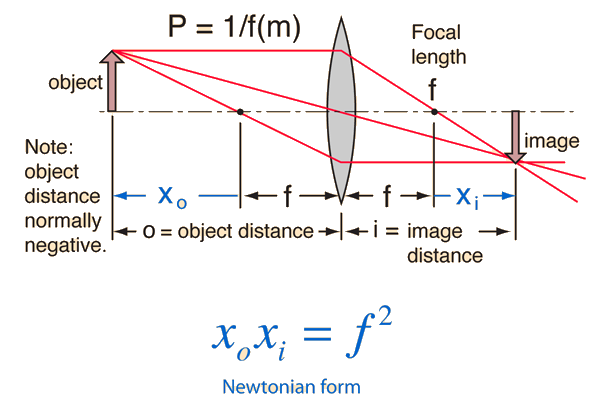
In the Newtonian form of the lens equation, the distances from the focal length points to the object and image are used rather than the distances from the lens.

在牛顿形式的透镜公式中,使用的是从焦点到物体和像的距离,而不是从透镜到物体和像的距离。

Newton used the "extrafocal distances" xo and xi in his formulation of the thin lens equation. It is an equivalent treatment, but the Gaussian form will be used in this resource.

To common form of lens equation in introductory texts
初版教材中常见的透镜公式
牛顿使用了"额外焦点距离"x o和x i来表述薄透镜公式。这是一种等效的处理方式,但本资源将采用高斯形式。
Index

Lens concepts
棱镜概念索引
 
HyperPhysics***** Light and Vision
HyperPhysics ***** 光与视觉
R Nave
Go Back
返回