Weight
重量
The weight of an object is defined as the force of gravity on the object and may be calculated as the mass times the acceleration of gravity, w = mg. Since the weight is a force, its SI unit is the newton.
物体的重量定义为重力对物体产生的力,可由质量乘以重力加速度计算,即 w = mg。重量属于力,因此 SI 单位是牛顿。
For an object in free fall, so that gravity is the only force acting on it, then the expression for weight follows from Newton's second law.
对于仅受重力作用而自由下落的物体,重量表达式可由牛顿第二定律得到。
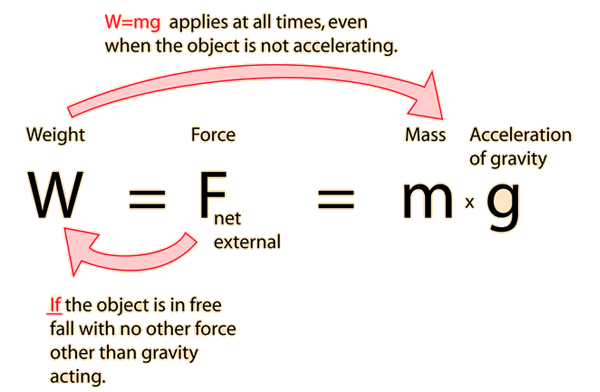
You might well ask, as many do, "Why do you multiply the mass times the freefall acceleration of gravity when the mass is sitting at rest on the table?". The value of g allows you to determine the net gravity force if it were in freefall, and that net gravity force is the weight. Another approach is to consider "g" to be the measure of the intensity of the gravity field in Newtons/kg at your location. You can view the weight as a measure of the mass in kg times the intensity of the gravity field, 9.8 Newtons/kg under standard conditions.
许多人会问:“物体明明静止在桌面上,为什么计算重量时还要把质量乘以自由落体加速度?”g 可以用来求物体自由下落时所受的合重力,而这个重力就是物体的重量。也可以把 g 理解为所在地的重力场强度,单位是牛顿/千克。因此,重量等于以千克表示的质量乘以当地的重力场强度;在地球表面的标准条件下,重力场强度约为 9.8 牛顿/千克。
Data can be entered into any of the boxes below. Then click outside the box to update the other quantities.
可在下面任意输入框中输入数据,然后在输入框外单击,即可更新其他物理量。

At the Earth's surface, where g=9.8 m/s2 :
在地球表面,g = 9.8 米/秒²:
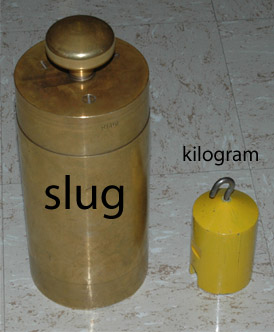 | The kilogram is the SI unit of mass and it is the almost universally used standard mass unit. The associated SI unit of force and weight is the Newton, with 1 kilogram weighing 9.8 Newtons under standard conditions on the Earth's surface. However, in the US common units, the pound is the unit of force (and therefore weight).The pound is the widely used unit for commerce. The use of the pound force constrains the mass unit to an inconveniently large measuring unit called a "slug". The use of this unit is discouraged, and the use of exclusively SI units for all scientific work is strongly encouraged.
千克是质量的 SI 单位,也是世界上通用的标准质量单位。力和重量相应的 SI 单位是牛顿;在地球表面的标准条件下,质量为 1 千克的物体重 9.8 牛顿。在美国常用单位制中,磅是力的单位,因而也是重量单位,并广泛用于商业计量。使用磅力后,质量必须采用一个很不方便的大单位——斯勒格。因此不建议使用斯勒格,科学工作应尽量统一采用 SI 单位。 |
质量为千克的重量是牛顿,质量为 Slug 的重量是磅 中文译文中的待填/计算数值依次对应:1:m1 2:f1 3:m2 4:f2。实际数值以上方原输入框为准。 |

