Vibrational Spectra of Diatomic Molecules
双原子分子的振动光谱
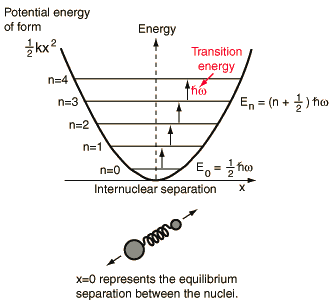
The lowest vibrational transitions of diatomic molecules approximate the quantum harmonic oscillator and can be used to imply the bond force constants for small oscillations.
 |
The following is a sampling of transition frequencies from the n=0 to n=1 vibrational level for diatomic molecules and the calculated force constants.
以下是从双原子分子n=0到n=1振动电平的跃迁频率示例以及计算出的力常数。* 从Herzberg的表格中得到的振动跃迁频率为4138.52 cm⁻¹。 |
These bond force constants were calculated from the vibrational frequency in the same way the force constant for HCl was calculated.
这些键力常数是通过与HCl力常数相同的方式从振动频率计算得到的。
| Vibration-rotation spectrum of HCl
HCl的振动-旋转光谱 | HBr |
双原子分子的最低振动跃迁近似于量子谐振子,可用于推断小振幅振动的键力常数。
Schrodinger equation concepts
Molecular spectra concepts
References
Thornton & Rex
Sec 11-1
Barrow
索引 壳多格方程概念 分子光谱概念 参考文献 Thorntan & Rex 第11-1节 Barrow
| HyperPhysics***** Quantum Physics
HyperPhysics ***** 量子物理 | R Nave |
返回