Bilingual edition: English is preserved and Chinese follows each unit. Terminology uses the confirmed v20260916 glossary; automated semantic review remains traceable.
中英双语版:英文原文完整保留,中文紧随对应单元;术语采用 v20260916 确认表,自动语义审校结果可追溯。

Vibration-Rotation Spectrum of HCl
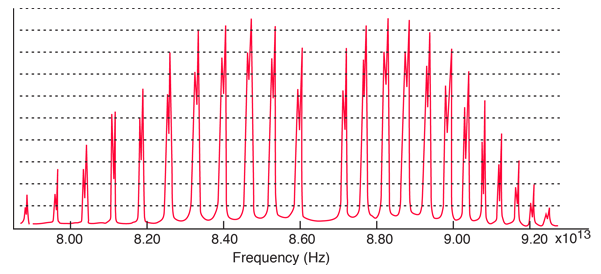
HCl的振动-旋转光谱
Add annotation to spectrum

A classic among molecular spectra, the infrared absorption spectrum of HCl can be analyzed to gain information about both rotation and vibration of the molecule.

分子光谱中经典的一个例子是HCl的红外吸收光谱,可以通过分析该光谱获得关于分子旋转和振动的信息。

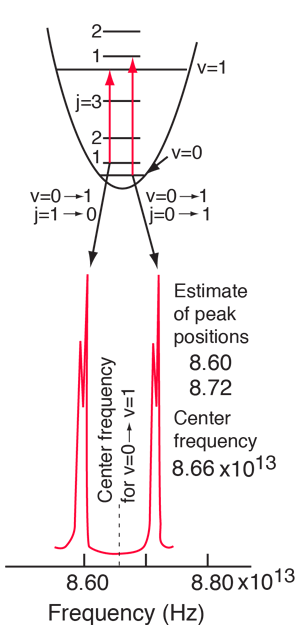
The absorption lines shown involve transitions from the ground to first excited vibrational state of HCl, but also involve changes in the rotational state. The rotational angular momentum changes by 1 during such transitions. If you had a transition from j=0 in the ground vibrational state to j=0 in the first excited state, it would produce a line at the vibrational transition energy. As observed, you get a closely spaced series of lines going upward and downward from that vibrational level difference. The splitting of the lines shows the difference in rotational inertia of the two chlorine isotopes Cl-35(75.5%) and Cl-37(24.5%).

所显示的吸收线涉及从HCl基态到第一激发振动态的跃迁,同时也涉及转动能级的变化。在这样的跃迁过程中,旋转角动量变化为1。如果有一个从基态振动态j=0到第一激发态j=0的跃迁,它会产生一个位于振动跃迁能量处的线。如观察到的,你得到的是一系列紧密排列的线,这些线向上和向下从该振动能级差处延伸。线的分裂显示了两种氯同位素Cl-35(75.5%)和Cl-37(24.5%)之间的旋转惯性差异。

From the spectrum above, you can examine details about the following:

从上述光谱中,你可以了解以下细节:
Bond force constant
键力常数
Bond length
键长
j for peak intensity
j 用于峰值强度
Relative intensities
相对强度
Pure rotational transitions in HCl
HCl的纯旋转跃迁
Vibration-rotation spectrum of HBr
HBr的振动-转动光谱
给光谱添加注释
Index

Molecular spectra concepts

Reference
Tipler & Llewellyn
Sec. 9-4
索引 分子光谱概念 参考 Tipler & Llewellyn 第9-4节
 
HyperPhysics***** Quantum Physics
HyperPhysics ***** 量子物理
R Nave
Go Back
返回


Bond Force Constant for HCl

HCl 的键力常数

By treating the vibrational transition in the HCl spectrum from its ground to first excited state as a quantum harmonic oscillator, the bond force constant can be calculated. This transition frequency is related to the molecular parameters by:

将HCl谱线中从基态到第一激发态的振动跃迁视为量子谐振子,可以计算出键力常数。这一跃迁频率与分子参数之间的关系为:

The desired transition frequency does not show up directly in the observed spectrum, because there is no j=0, v=0 to j=0, v=1 transition; the rotational quantum number must change by one unit. It can be approximated by the midpoint between the j=1,v=0->j=0,v=1 transition and the j=0,v=0->j=1,v=1 transition. This assumes that the difference between the j=0 and j=1 levels is the same for the ground and first excited state, which amounts to assuming that the first excited vibrational state does not stretch the bond. This "rigid-rotor" model can't be exactly correct, so it introduces some error.

期望的跃迁频率不会直接出现在观测到的谱中,因为没有j=0, v=0到j=0, v=1的跃迁;转动量子数必须改变一个单位。它可以近似地由j=1,v=0→j=0,v=1跃迁和j=0,v=0→j=1,v=1跃迁之间的中点来估计。这假设了基态和第一激发态之间的能量差相同,即假设第一激发振动态不会伸长键长。这种“刚性转子”模型不能完全正确,因此会引入一些误差。

For the HCl molecule, the needed reduced mass is

对于HCl分子,所需的约化质量是

Note that this is almost just the mass of the hydrogen. The chlorine is so massive that it moves very little while the hydrogen bounces back and forth like a ball on a rubber band!

请注意,这几乎只是氢气的质量。氯气质量很大,所以在反应中几乎不移动,而氢气则像在橡胶带上的球一样来回弹动!

Substituting the midpoint frequency into the expression containing the bond force constant gives:

将中点频率代入包含键力常数的表达式中得到:

Despite the approximations, this value is quite close to the value given in the table.

尽管有近似值,这个值与表中给出的值相当接近。
Pure rotational transitions in HCl
HCl的纯旋转跃迁
Example bond force constants
示例键力常数
Index

Molecular spectra concepts

Reference
Tipler & Llewellyn
Sec. 9-4
索引 分子光谱概念 参考 Tipler & Llewellyn 第9-4节
 
HyperPhysics***** Quantum Physics
HyperPhysics ***** 量子物理
R Nave
Go Back
返回


Bond Length of HCl

HCl的键长

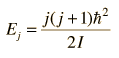
A bond length for the HCl molecule can be calculated from the HCl spectrum by assuming that it is a rigid rotor and solving the Schrodinger equation for that rotor. For a free diatomic molecule the Hamiltonian can be anticipated from the classical rotational kinetic energy

HCl分子的键长可以通过假设其为刚性转子并求解该转子的薛定谔方程来从HCl谱中计算得出。对于自由双原子分子,其哈密顿量可以从经典的旋转动能预估得出。

and the energy eigenvalues can be anticipated from the nature of angular momentum.

角动量的本征值可以从角动量的性质中预见。

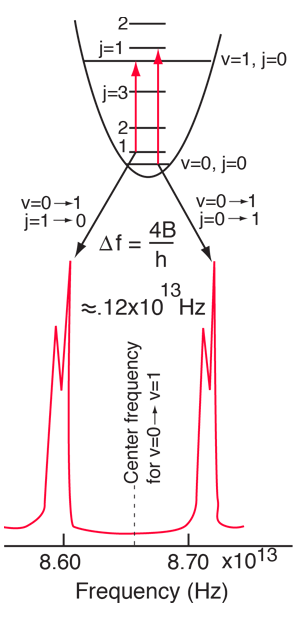
Assuming that the bond length is the same for the ground and first excited states, the difference between the j=1,v=0->j=0,v=1 transition and the j=0,v=0->j=1,v=1 transition frequencies can be used to estimate the bond length. The separation between the two illustrated vibration-rotation transitions is assumed to be twice the rotational energy change from j=0 to j=1.

假设基态和第一激发态的键长相同,可以利用j=1,v=0→j=0,v=1跃迁与j=0,v=0→j=1,v=1跃迁频率之间的差异来估计键长。假设图中所示的两个振动-转动跃迁之间的分离度为从j=0到j=1的转动能量变化的两倍。

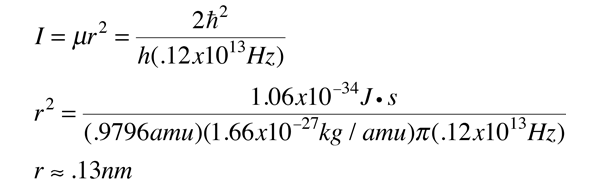
Substitution of numerical values leads to an estimate of the bond length r:

代入数值可得到键长 r 的估算:

This compares reasonably with the value r=.127 nm obtained from pure rotational spectra.

这与通过纯旋转光谱得到的r=0.127纳米的值相吻合。
Pure rotational transitions in HCl
HCl的纯旋转跃迁
Table of diatomic bond lengths
双原子键长表
Index

Molecular spectra concepts
索引 分子光谱概念
 
HyperPhysics***** Quantum Physics
HyperPhysics ***** 量子物理
R Nave
Go Back
返回