Light Measurement for Holography
One of the important parameters for transmission holography is the ratio between the light intensities of the reference beam and the object beam. It has been found that having the reference beam brighter by the ratio 4:1 to 10:1 works well for holography. You can perhaps visualize the reason for a stronger reference beam by saying that you need a strong carrier beam and a smaller modulating beam from the object to produce the image.
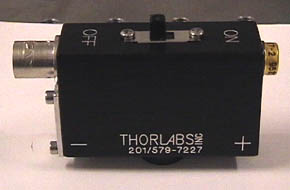 |
A Thorlabs light detector, shown at left, was used to measure light levels directly into the reference beam and toward the object. A 3.27 megohm resistor was used in parallel with the light detector and the voltage measured with a laboratory digital multimeter. 左侧显示的是Thorlabs光探测器,用于直接测量参考光束和物体方向的光强。该探测器并联了一个3.27兆欧的电阻,电压值通过实验室数字万用表测量。
|
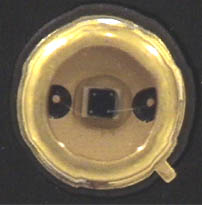 | The area of the detector was about 1 square millimeter, so that was used as a factor in determining the light power which was incident on the film.
探测器的面积约为1平方毫米,因此被用作确定入射到胶片上的光功率的因子。 |
For our holography experiments, it is important to optimize exposure for the film used. The film emulsion was Agfa 8E75HD which has optimum exposure at 25 microjoules/cm2. The Thorlabs detector shown above is rated at 0.47 amps/watt at 640 nm, so this sensitivity was used in calculating exposures. Since the detector area is 0.01 cm2, the exposure time in seconds is calculated from

When we measured the light directly from the reference beam at the film position, and then added the light from the object, we found that we got better exposures by increasing the exposure 2 stops. That is, we multiplied the calculated time by four.
Holography concepts