Transmission Hologram With Reference Beam
 实验者:Chris Cleven |
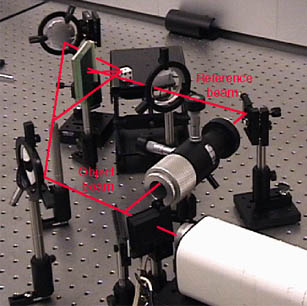
This setup was modified from the original setup by
这种设置是根据原设置修改而来的,第二根光束的长度,它在凸面镜上反射后并未被控制。
|
Having achieved a brighter, cleaner beam by focusing the first lens on the spatial filter, we were able to get much better coverage of the entire film. The light detector readings were 30 mV for the reference beam and 3.3 mV for the object beam, for a ratio of 9:1. The calculated exposure was 0.382/.033 = 12s, but based on previous experience, exposures were made at 24 and 48 seconds to go one and two exposure stops over the calculated value. Both produced clear, bright holograms, the best achieved to date.
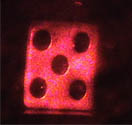
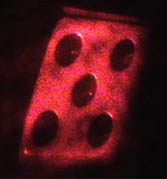
The holographic images below were for the 48 s exposure. The image on the left is the regular virtual image viewed through the film. The image on the right is the much larger image viewed from the opposite side of the film, the so-called "real image". It changed perspective drastically as you moved the film. Both were quite bright and had a much easier viewing angle than the previous setup because of the relative orientation of the reference beam. By passing the undiverged laser beam through the hologram, we were able to project two images of the die clearly on white paper.
 |  |
Holography concepts