The Central Dogma of Molecular Biology
Active graphics.
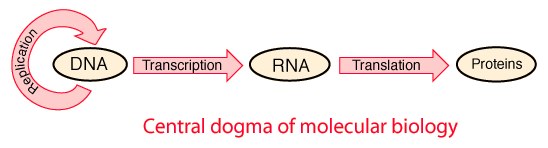
The central dogma is a framework for understanding the information transfer between the large information-carrying biological molecules. The detailed information stored in the form of the sequence of bases on DNA can be transferred by means of RNA polymerase to messenger RNA by transcription and from the mRNA to proteins by translation. Information in DNA can be transferred back to DNA by means of DNA polymerase in the process of DNA replication. However, information is not transferred backward from proteins to RNA and DNA and in the general case, information is not transferred from RNA back to DNA. However, there are exceptions of special transfers from RNA to DNA called reverse transcription. The word "dogma" was chosen by Francis Crick to describe this framework of information transfer because, as he puts it "I had already used the obvious word hypothesis in the sequence hypothesis, and in addition I wanted to suggest that this new assumption was more central and more powerful".
Though a useful organizing structure, the "central dogma" has numerous exceptions. For example, retroviruses use "reverse transcription" to construct DNA from RNA. In general, not every gene gets expressed all the way to the construction of proteins. Some RNAs have other tasks to do, such as the ribosomal RNA and other specifically tasked RNAs with specific tasks in the cell.
References:
Wiki: Central Dogma
| The structure of DNA
DNA的结构 |
Biochemical concepts
Chemistry concepts
| HyperPhysics*****Chemistry *****Biology
HyperPhysics ***** 化学 ***** 生物学 | R Nave |