DNA![]() Deoxyribonucleic acid (DNA) in a living cell contains the master blueprint for the production of proteins and for the replication of itself. It is the repository for the hereditary information. DNA accomplishes protein production by first providing a pattern for the production of mRNA, a process called transcription. The RNA then contains the information from the DNA to manufacture a protein, a process called translation. Some proteins are structural, but some are control proteins called enzymes. These enzymes are employed in the production of proteins, even copies of themselves, so enzymes are used to make other enzymes. Each protein, including enzymes, is made according to a pattern of nucleotides along a segment of the DNA called a "gene". A single living cell contains thousands of enzymes. 活细胞中的脱氧核糖核酸(DNA)包含制造蛋白质和复制自身的主蓝图。DNA是遗传信息的存储库。DNA通过首先提供制造信使RNA(mRNA)的模式来制造蛋白质,这一过程称为转录。RNA然后包含来自DNA的信息以制造蛋白质,这一过程称为翻译。有些蛋白质是结构蛋白,但有些是称为酶的控制蛋白。这些酶用于生产蛋白质,甚至复制自身,因此酶用于制造其他酶。每个蛋白质,包括酶,都是根据DNA上一段称为“基因”的核苷酸模式来制造的。一个活细胞包含数千种酶。
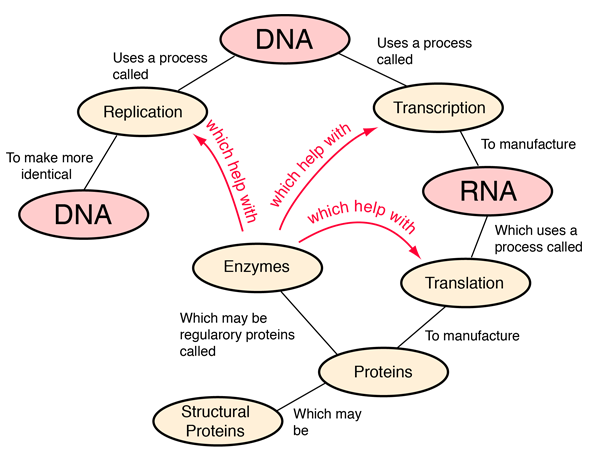
![]() Another way to organized these ideas is in terms of the "central dogma" of molecular biology. 另一种组织这些思想的方式是通过‘分子生物学的中心法则’来表述。
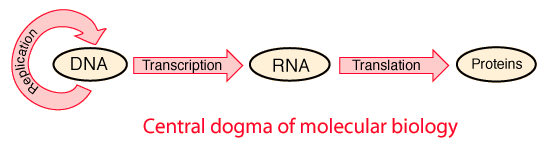
![]() Active graphics. Though a useful organizing structure, the "central dogma" has numerous exceptions. For example, retroviruses use "reverse transcription" to construct DNA from RNA. In general, not every gene gets expressed all the way to the construction of proteins. Some RNAs have other tasks to do, such as the ribosomal RNA and other specifically tasked RNAs with specific tasks in the cell. 尽管是一个有用的组织结构,‘中心法则’也有许多例外。例如,逆转录病毒利用‘逆转录’来从RNA构建DNA。一般来说,并不是每个基因都会完全表达到蛋白质的构建过程中。一些RNA有其他任务,例如核糖体RNA和其他专门承担特定任务的RNA在细胞中具有特定功能。
主动图形 |
Index Biochemical concepts Chemistry concepts 索引 生物化学概念 化学概念 | ||
|
Go Back
返回 |
DNA StructureDNA 结构
The basic structure of DNA was discovered by James Watson, Francis Crick and Maurice Wilkins, in 1953 using x-ray diffraction data produced by Rosalind Franklin. The discovery is chronicled by Watson's "The Double Helix". DNA的基本结构于1953年由詹姆斯·沃森、弗朗西斯·克里克和莫里斯·威尔金斯发现,他们利用罗莎琳德·弗兰克林产生的X射线衍射数据进行研究。这一发现被沃森在《双螺旋》一书中记录下来。
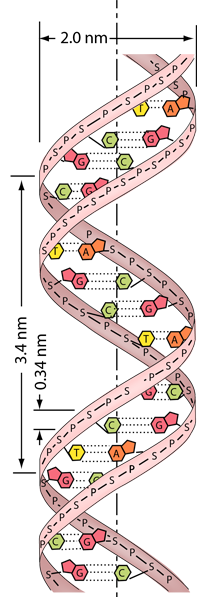
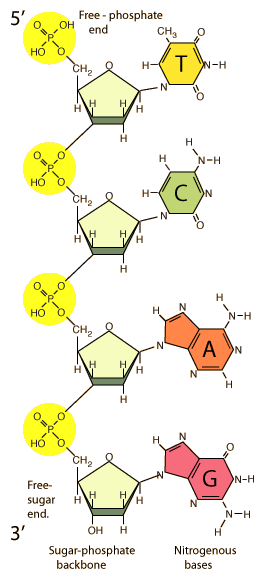
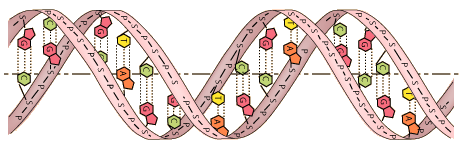
At right above is a depiction of a section of the sugar-phosphate backbone of DNA which conforms into one strand of the double helix. The bases may be attached in any order, and this gives the vast number of possibilities of arrangements which are possible in the genetic code. In the double helix, bases are only attached by hydrogen bonds to their complementary base, that is A-T and G-C. This arrangement makes possible the separation of the strands and the replication of the DNA double helix. 在右上方是一段DNA糖-磷酸骨架的示意图,其结构形成双螺旋的一条链。碱基可以以任何顺序连接,这导致了遗传密码中可能的大量排列组合。在双螺旋结构中,碱基仅通过氢键连接到其互补碱基,即A-T和G-C。这种排列使得双螺旋链能够分离并实现DNA的复制。
A remarkable feature of DNA structure is that the message written in the alphabet of the four bases is written in a true code - that is, the order of the bases is not determined by the chemistry and physics any more than the order of words in a written book is determined by the physics and chemistry of the ink and paper. DNA结构的一个显著特征是,以四个碱基的字母书写的遗传信息实际上是一种真正的代码——也就是说,碱基的顺序不再由化学和物理决定,就像书中的词语顺序并不由墨水和纸张的物理和化学性质决定一样。
One thing that these sketches do not show is that the planes of the bases are essentially perpendicular to the axis of the helix. 这些草图没有显示的是,基底平面基本上与螺旋轴垂直。
|
Index Biochemical concepts Chemistry concepts References Karp Ch 10 Audesirk & Audesirk Ch 9 索引 生物化学概念 化学概念 参考文献 Karp 第10章 Audesirk & Audesirk 第9章 | ||
|
Go Back
返回 |