Neutrino Detection at Sudbury
The Sudbury Neutrino Observatory (SNO) is designed to detect neutrinos by several means in order to shed light on such problems as the Solar Neutrino Problem. Three of the mechanisms are indicated in the table below.
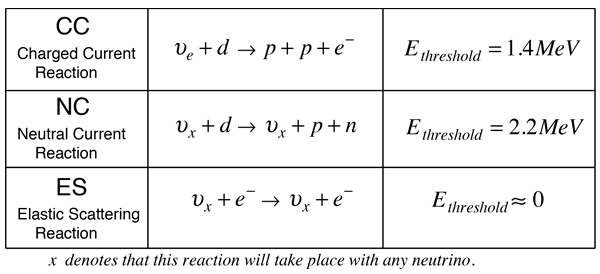
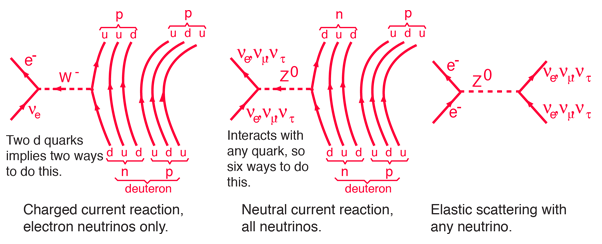
With these detection mechanisms, SNO hopes to determine the flux of all neutrinos. The CC reaction used is unique because it is an interaction with deuterium and does not happen in the other Cerenkov based detectors which use light water. The NC (neutral current) reaction will be significant because it measures the flux of all kinds of neutrinos, so it can be used in conjunction with the CC detection to measure the ratio of the two types of neutrinos. The ES detection is the same type used in other Cerenkov detectors; it can give another determination of the ratio of the electron and muon neutrinos.
The experimental plan at SNO is to operate for about a year with pure D2O as the detection medium. Then in a second phase, salt will be added to add chlorine detection to enhance the NC sensitivity. A third phase will involve mechanisms for neutron capture as an independent sensitivity for the NC process.
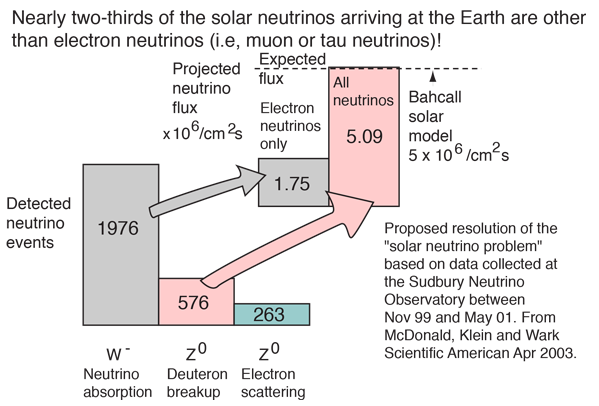
The statistical analysis of the data leading to the above graphic involves factoring in the sensitivity of the detectors to these events.
| The Sudbury Neutrino Observatory
苏布里中微子观测站 |
References
Kearns, et al.
Simpson
McDonald, Klein & Wark
| HyperPhysics***** Quantum Physics
HyperPhysics ***** 量子物理 | R Nave |