Electron Neutrinos and Antineutrinos电子中微子和反中微子
The history of a particle that appeared to have no charge and no mass is an interesting one. The electron neutrino (a lepton) was first postulated in 1930 by Wolfgang Pauli to explain why the electrons in beta decay were not emitted with the full reaction energy of the nuclear transition. The apparent violation of conservation of energy and momentum was most easily avoided by postulating another particle. Enrico Fermi called the particle a neutrino and developed a theory of beta decay based on it, but it was not experimentally observed until 1956. This elusive particle, with no charge and almost no mass, could penetrate vast thicknesses of material without interaction. The mean free path of a neutrino in water would be on the order of 10x the distance from the Earth to the Sun. In the standard Big Bang model, the neutrinos left over from the creation of the universe are the most abundant particles in the universe. This remnant neutrino density is put at 100 per cubic centimeter at an effective temperature of 2K (Simpson). The background temperature for neutrinos is lower than that for the microwave background (2.7K) because the neutrino transparency point came earlier. The sun emits vast numbers of neutrinos which can pass through the earth with little or no interaction. This leads to the statement "Solar neutrinos shine down on us during the day, and shine up on us during the night!". Bahcall's modeling of the solar neutrino flux led to the prediction of about 5 x 10⁶ neutrinos/cm2s. 一个似乎没有电荷和质量的粒子的历史是一个有趣的故事。电子中微子(一种轻子)最早于1930年由沃尔夫冈·泡利提出,以解释为什么β衰变中的电子并未以核转变的全部反应能被释放。由于能量和动量守恒的明显违反,最简单的方法是假定存在另一个粒子。费米将该粒子称为中微子,并基于此发展了β衰变的理论,但直到1956年才被实验观测到。这种难以捉摸的粒子,没有电荷且几乎没有质量,可以穿透大量材料而几乎不发生相互作用。中微子在水中的平均自由程大约是地球到太阳距离的10倍。在标准的大爆炸模型中,宇宙诞生时留下的中微子是宇宙中最丰富的粒子。这种残余的中微子密度被估计为每立方厘米100个(Simpson)。中微子的背景温度低于微波背景温度(2.7K),因为中微子透明点更早出现。太阳发射出大量中微子,这些中微子可以轻易穿透地球而几乎不发生相互作用。这导致了这样的说法:“太阳中微子在白天照耀着我们,在夜晚也照耀着我们!”巴赫尔对太阳中微子通量的建模导致预测了大约每平方厘米每秒5×10⁶个中微子。
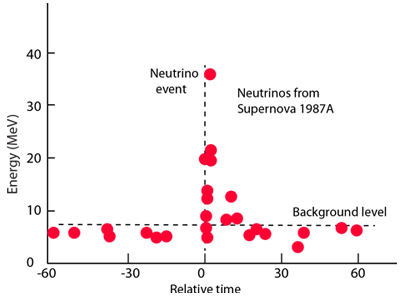
A remarkable opportunity for observing neutrinos came with Supernova 1987A when the Japanese observing team detected neutrinos almost coincident with the discovery of the light from the supernova. 当超新星1987A爆发时,观测中微子的机会出现了,日本观测团队几乎同时检测到了中微子,这与超新星发出的光的发现几乎同时发生。
Neutrinos interact only by the weak interaction. Their interactions are usually represented in terms of Feynman diagrams. 中微子只通过弱相互作用发生相互作用。它们的相互作用通常用费曼图来表示。
|
Index References Kearns, et al. Simpson Bahcall 索引 参考 Kearns, et al. Simpson Bahcall | ||||||||
|
Go Back
返回 |
Detection of Neutrinos中微子的探测
The first experimental observation of the neutrino interacting with matter was made by Frederick Reines, Clyde Cowan, Jr, and collaborators in 1956 at the Savannah River Plant in South Carolina. Their neutrino source was a nuclear reactor (it actually produced antineutrinos from beta decay). 原子反应堆中首次观察到中微子与物质相互作用的是1956年在南卡罗来纳州萨凡纳河工厂由弗雷德里克·雷恩斯、克莱德·考恩及其合作者完成的。他们的中微子源是一个原子反应堆(实际上是由β衰变产生反中微子)。
An early set of experiments with a facility called the solar neutrino telescope, measured the rate of neutrino emission from the sun at only one third of the expected flux. Often referred to as the Solar Neutrino Problem, this deficiency of neutrinos has been difficult to explain. Recent results from the Sudbury Neutrino Observatory suggest that a fraction of the electron neutrinos produced by the sun are transformed into muon neutrinos on the way to the earth. The observations at Sudbury are consistent with the solar models of neutrino flux assuming that this "neutrino oscillation" is responsible for observation of neutrinos other than electron neutrinos. 早期使用名为太阳中微子望远镜的设施进行的一系列实验,测得太阳中微子的发射率仅为预期通量的三分之一。通常称为太阳中微子问题,这种中微子的不足一直难以解释。来自苏德伯中微子观测站的最新结果表明,太阳产生的电子中微子中有一部分在到达地球的过程中转变为缪中微子。苏德伯的观测结果与假设这种“中微子振荡”导致除电子中微子以外的中微子被观测到的太阳模型是一致的。
|
Index Reference McDonald, Klein & Wark 索引参考 McDonald, Klein & Wark | |||
|
Go Back
返回 |
Sudbury Neutrino Observatory苏必利尔中微子观测站
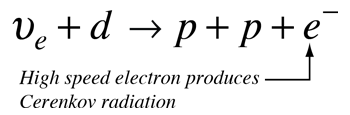
The new Sudbury Neutrino Observatory (SNO) consists of a 1000 metric ton bottle of heavy water suspended in a larger tank of light water. The apparatus is located in Sudbury, Ontario, Canada at a depth of about 2 km down in a nickel mine. A 18 m diameter geodesic array of 9,500 photomultiplier tubes surrounds the heavy water to detect Cerenkov radiation from the neutrino interaction which dissociates deuterium: 新的苏德布里 neutrino 观测站(SNO)由一个重达 1000 公吨的重水容器悬挂在更大的轻水容器中。该装置位于加拿大安大略省苏德布里市,位于镍矿深处约 2 公里处。围绕重水容器的 18 米直径的球面阵列,包含 9500 个光电倍增管,用于探测中微子相互作用时分解氘所产生的契伦科夫辐射:
The distinctive characteristic of the heavy water observatory is that it can measure both the electron neutrino flux and the total neutrino flux (electron, muon and tau neutrinos). It should allow them to determine whether neutrinos change flavors. If so, it could explain the solar neutrino problem and would show that the neutrinos have mass. 重水观测站的显著特点是能够测量电子中微子通量和总中微子通量(包括电子、缪子和tau中微子)。它将使他们能够确定中微子是否改变风味。如果是这样的话,它就能解释太阳中微子问题,并表明中微子具有质量。
SNO began operating in production mode in October, 1999, and as of Summer 2000 had collected a sizable number of neutrino events both from the sun (the main focus of the experiment) and from atmospheric events with pions and muons. The Cerenkov cones of the solar neutrinos center about the direction opposite the sun, showing about the same flux at night as during the day. This was an expected result, since the mean free path of a neutrino in matter is about 22 lightyears in lead and having the earth in the path makes little difference. A sizable number of the atmospheric neutrino events come from below, having traveled all the way through the earth and forming the Cerenkov cone in the photomultiplier tubes at the top of the spherical heavy-water ball. These Cerenkov cones are scattered all around the sphere, while the solar ones of course show a precise anti-solar direction. SNO于1999年10月开始进入生产运行模式,到2000年夏季已收集到大量中微子事件,这些事件既来自太阳(实验的主要关注点),也来自大气中的π子和μ子。太阳中微子的契伦科夫锥体围绕着地球的相反方向,白天和夜晚的通量大致相同。这是一项预期的结果,因为中微子在物质中的平均自由程约为铅中的22光年,而地球位于路径中对这一数值影响不大。大量大气中微子事件来自下方,它们穿越整个地球后,在重水球顶部的光电倍增管中形成契伦科夫锥体。这些契伦科夫锥体散落在整个球体周围,而太阳中微子的契伦科夫锥体则显然显示精确的反太阳方向。
The depth of the detector protects it from the intense bombardment of cosmic ray muons which reaches the earth's surface. The detector measures only about 70 muon events per day, and they are easily distinguished from neutrino events since the muon interacts by the electromagnetic interaction and produces a much larger signal in the detector array. 探测器的深度使其免受到达地球表面的宇宙射线缪子的强烈轰击。探测器每天只能检测到约70个缪子事件,这些事件很容易与中微子事件区分开,因为缪子通过电磁相互作用与探测器阵列相互作用,产生更大的信号。
In order to detect the ring of light which is the signature of Cerenkov radiation, the responses of all the photomultiplier tubes (PMTs) are monitored with a very short time scale. In order to be counted as an "event" in the detector, at least 20 PMTs must be triggered within an interval of 100 nanoseconds. 为了检测光环,这是契伦科夫辐射的特征,所有光电倍增管(PMTs)的响应都以极短的时间尺度进行监控。在100纳秒的时间间隔内,至少20个PMTs被触发,才能被计为探测器中的一个‘事件’。
|
Index Reference Feder Simpson McDonald, Klein & Wark 索引参考费德里克·西姆逊·麦卡洛克、克莱因 & 威尔克 | ||||
|
Go Back
返回 |
The Solar Neutrino Telescope太阳中微子望远镜
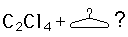
Raymond Davis of Brookhaven National Laboratory constructed a neutrino detector 1.6 km underground in the Homestake Gold Mine in Lead, South Dakota. The detector consists of a 378,000 liter tank of perchloroethylene, which is further isolated by being submerged in water. Theoretical expections were about one neutrino-chlorine interaction per day, but the measured solar neutrino events were about a third of that, raising serious questions about the abundance of solar neutrinos (the Solar Neutrino Problem). 布鲁克海文国家实验室的雷蒙德·戴维斯在南达科他州铅市的霍姆斯塔克金矿地下1.6公里处建造了一个中微子探测器。该探测器由一个378,000升的四氯乙烯罐组成,该罐被水淹没以进一步隔离。理论预测每天有大约一个中微子-氯原子相互作用,但实际观测到的太阳中微子事件仅为理论值的三分之一,这引发了关于太阳中微子数量的严重疑问(太阳中微子问题)。
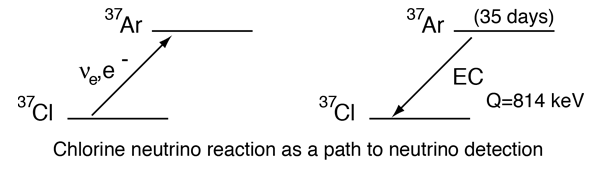
The detection of neutrinos by this instrument was based on the interaction of neutrinos with chlorine nuclei to produce argon. The argon can be removed from the tank and measured so that the number of neutrinos captured in a given time interval can be determined. 这种仪器通过中微子与氯核相互作用产生氩来检测中微子。氩可以从容器中移除并进行测量,从而确定在给定时间间隔内被捕捉的中微子数量。
![]() The argon decays back to the chlorine isotope from which it was created by the process of electron capture. The detection of this transition is aided by the definite energy of the x-ray emitted during the electron capture process. This mine experiment was able to detect about 15 argon atoms a month, according to Simpson. 氩原子通过电子俘获过程从其产生的氯同位素衰变回来。这种转变的检测得益于电子俘获过程中发出的X射线具有确定的能量。根据Simpson的说法,这项矿井实验每月能够检测到约15个氩原子。
|
Index Reference Simpson 索引参考辛普森 | ||
|
Go Back
返回 |
Detection of Supernova Neutrinos超新星中微子的探测
Since the neutrino can pass through the entire Earth without interaction, it takes specialized techniques to detect one. After being postulated by Pauli in 1930 to explain anomalies in beta decay, they were not actually detected until 1956 by Reines and Cowan. 由于中微子可以穿透整个地球而无需相互作用,要检测到一个中微子需要专门的技术。中微子在1930年由泡利提出,以解释β衰变中的异常现象,直到1956年才被Reines和Cowan实际探测到。
Detection of neutrinos is now well developed and a classic opportunity for neutrino detection occurred with Supernova 1987A. A burst of ten neutrinos was detected within a time interval of about 15 seconds at a neutrino detector deep in a mine in Japan. They had to penetrate the Earth to get to the detector. 中微子的探测现在已经得到很好的发展,1987年超新星爆发事件成为一次经典的中微子探测机会。在日本一处深埋于矿井中的中微子探测器中,大约15秒内检测到了十多个中微子。这些中微子必须穿透地球才能到达探测器。
|
Index
索引 | ||
|
Go Back
返回 |
Neutrino Mass?中微子质量?
No definite mass has been measured for the neutrino, and the standard comment about most experiments is "the results are consistent with zero mass for the neutrino". But this raises certain theoretical problems and there have been many attempts to set a range for the mass of the neutrino. Since its mass is evidently very small, if non-zero, the mass is usually stated in terms of its energy equivalent in electron volts. Most experiments conclude that the mass equivalent of the neutrino is less than 50 eV. 尚未测量出中微子的确定质量,大多数实验的常规评论是‘中微子的质量为零的结果与实验结果一致’。但这提出了某些理论问题,因此已有许多尝试对中微子的质量设定一个范围。由于中微子的质量显然非常小,如果非零的话,其质量通常以电子伏特的能量当量来表示。大多数实验得出的结论是中微子的质量当量小于50 eV。
One of the recent pieces of information about neutrino mass came from the neutrinos observed from Supernova 1987A. Ten neutrinos arrived within 15 seconds of each other after traveling 180,000 light years, and they differed by a up to factor of three in energy. This limits the neutrino rest mass energy to less than about 30 eV (Rohlf). 关于中微子质量的最新信息之一来自1987A超新星观测到的中微子。十多个中微子在相隔15秒内到达,它们在180,000光年外旅行后,能量差异可达三倍。这限制了中微子静止质量能量不超过约30 eV(Rohlf)。
New experimental evidence from the Super-Kamiokande neutrino detector in Japan represents the strongest evidence to date that the mass of the neutrino is non-zero. Models of atmospheric cosmic ray interactions suggest twice as many muon neutrinos as electron neutrinos, but the measured ratio was only 1.3:1. The interpretation of the data suggested a mass difference between electron and muon neutrinos of 0.03 to 0.1 eV. Presuming that the muon neutrino would be much more massive than the electron neutrino, then this implies a muon neutrino mass upper bound of about 0.1 eV. 日本超神冈中微子探测器的新实验证据表明,迄今为止最强的证据显示中微子的质量非零。大气宇宙射线相互作用模型预测muon中微子与electron中微子的比例为2:1,但测量得到的比例仅为1.3:1。数据的解释表明electron中微子与muon中微子之间的质量差为0.03到0.1 eV。假定muon中微子比electron中微子质量大很多,这表明muon中微子的质量上限约为0.1 eV。
The recent neutrino measurements at the Sudbury Neutrino Observatory are consistent with the modeled total neutrino flux and add evidence for neutrino oscillation, a process which can only occur if the neutrinos have mass. 在苏德伯 neutrino 实验室的最近中微子测量结果与模型预测的总中微子通量一致,并为中微子振荡提供了证据,这是一种只有在中微子具有质量时才能发生的过程。
|
Index References Rohlf Kearns, et al. 索引参考Rohlf Kearns等 | ||
|
Go Back
返回 |
Some Neutrino History中微子历史
The electron neutrino (a lepton) was first postulated in 1930 by Wolfgang Pauli to explain why the electrons in beta decay were not emitted with the full reaction energy of the nuclear transition. The apparent violation of conservation of energy and momentum was most easily avoided by postulating another particle. Enrico Fermi called the particle a neutrino and developed a theory of beta decay based on it, but it was not experimentally observed until 1956. Wolfgang Pauli introduced the neutrino to the world of physics in 1930 with a famous letter to "Liebe Radioacktive Damen und Herren" (Dear radioactive ladies and gentlemen) at the Tubingen meeting of radioactivity researchers. Pauli's first public discussion of the neutrino was at the 7th Solvay Conference in Brussels in 1933. 沃尔夫冈·泡利于1930年在图宾根的放射性研究者会议上向物理学界介绍了中微子,他在给“亲爱的放射性女士和先生们”的信中提出了这一概念。泡利首次公开讨论中微子是在1933年在布鲁塞尔举行的第7届索尔维会议 上。
References: 参考文献:沃尔夫冈·泡利与现代物理
Wiki on Wolfgang Pauli 关于沃尔夫冈·泡利的维基百科
电子中微子(一种轻子)于1930年由沃尔夫冈·泡利提出,以解释β衰变中电子为何没有以核转变的全部反应能被发射出去。能量和动量守恒的明显违反最容易通过假定另一个粒子来避免。费米将该粒子称为中微子,并基于此发展了β衰变理论,但直到1956年才被实验观测到。 |
Index References Rohlf Kearns, et al. 索引参考Rohlf Kearns等 | ||
|
Go Back
返回 |