Pauli Exclusion Principle
 |
The nature of the Pauli exclusion principle can be illustrated by supposing that electrons 1 and 2 are in states a and b respectively. The wavefunction for the two electron system would be 泡利不相容原理的性质可以通过假设电子1和电子2分别处于状态a和b来说明。两个电子系统的波函数将是
 but this wavefunction is unacceptable because the electrons are identical and indistinguishable. To account for this we must use a linear combination of the two possibilities since the determination of which electron is in which state is not possible to determine. 但这种波函数不可接受,因为电子是相同的且不可区分的。为了考虑到这一点,我们必须使用两种可能性的线性组合,因为无法确定哪一个电子处于哪个状态。
|
The wavefunction for the state in which both states "a" and "b" are occupied by the electrons can be written
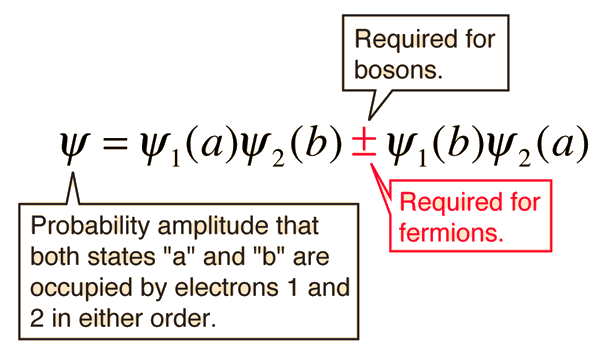
The Pauli exclusion principle is part of one of our most basic observations of nature: particles of half-integer spin must have antisymmetric wavefunctions, and particles of integer spin must have symmetric wavefunctions. The minus sign in the above relationship forces the wavefunction to vanish identically if both states are "a" or "b", implying that it is impossible for both electrons to occupy the same state.
Applications
Atomic Structure Concepts
| HyperPhysics***** Quantum Physics
HyperPhysics ***** 量子物理 | R Nave |
