Bilingual edition: English is preserved and Chinese follows each unit. Terminology uses the confirmed v20260916 glossary; automated semantic review remains traceable.
中英双语版:英文原文完整保留,中文紧随对应单元;术语采用 v20260916 确认表,自动语义审校结果可追溯。

Archimedes' Principle

阿基米德原理
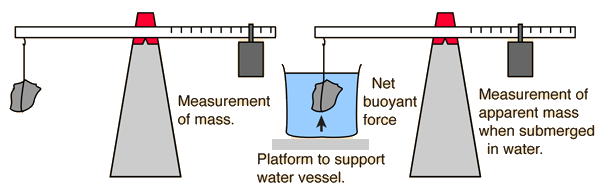
Archimedes' principle aids in the experimental determination of density by providing a convenient and accurate method for determining the volume of an irregularly shaped object, like a rock.

If an object is massed in air and found to have mass m = grams

and is then submerged in water and found to have apparent mass m' = grams

then it has displaced m - m' = grams of water. Since water has a density of 1 gram/cm3, this implies

然后它排开了 m - m' 克的水。由于水的密度为 1 克/厘米³,这说明
中文译文中的待填/计算数值依次对应:1:dm。实际数值以上方原输入框为准。
Volume of object = V = cm3.
The density of the object is then ρ = m/V = gm/cm3.
物体的密度是 ρ = m/V = 克/立方厘米。
中文译文中的待填/计算数值依次对应:1:d。实际数值以上方原输入框为准。

How many digits are significant?
有多少位是有效数字?
Note that in the experimental arrangement, the container of water in which the object is submerged is supported on a platform so that the balance scale does not include the measurement of the mass of the water and its container.

Density and buoyancy in a general fluid

流体中的密度与浮力
阿基米德原理有助于通过提供一种简便准确的方法来确定不规则形状物体(如岩石)的体积,从而实验测定密度。如果一个物体在空气中称量,发现其质量为 m = 克,然后将其浸入水中,发现其视质量为 m' = 克,物体的体积 V = 立方厘米。需要注意的是,在实验装置中,浸没物体的水容器是放在一个平台上,使得天平不包含水及其容器的质量测量。
中文译文中的待填/计算数值依次对应:1:m 2:mp 3:v。实际数值以上方原输入框为准。
Index

Buoyancy concepts
索引:浮力概念
 
HyperPhysics***** Mechanics ***** Fluids
HyperPhysics ***** 力学 ***** 流体
R Nave
Go Back
返回