Bilingual edition: English is preserved and Chinese follows each unit. Terminology uses the confirmed v20260916 glossary; automated semantic review remains traceable.
中英双语版:英文原文完整保留,中文紧随对应单元;术语采用 v20260916 确认表,自动语义审校结果可追溯。

Buoyancy

浮力

Buoyancy arises from the fact that fluid pressure increases with depth and from the fact that the increased pressure is exerted in all directions (Pascal's principle) so that there is an unbalanced upward force on the bottom of a submerged object.
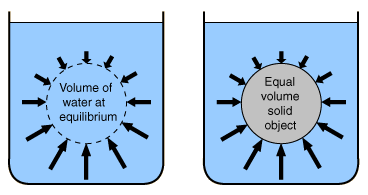
Since the "water ball" at left is exactly supported by the difference in pressure and the solid object at right experiences exactly the same pressure environment, it follows that the buoyant force on the solid object is equal to the weight of the water displaced (Archimedes' principle).
由于左边的“水球”恰好由压力差支撑,而右边的固体物体所处的压力环境完全相同,因此可以推断固体物体所受的浮力等于被排开的水的重量(阿基米德原理)。

浮力的产生源于两个事实:其一,流体的压强随深度增加而增大;其二,这种增大的压强在所有方向上都作用(帕斯卡原理),因此浸在流体中的物体底部会受到一个向上的不平衡力。

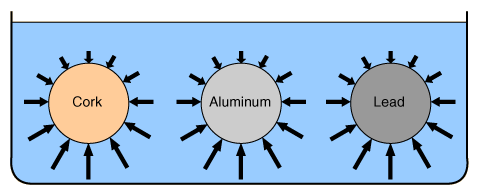
Objects of equal volume experience equal buoyant forces.

体积相等的物体受到的浮力相等。

Applications of buoyancy.

浮力的应用。
Index

Buoyancy concepts
索引:浮力概念
 
HyperPhysics***** Mechanics ***** Fluids
HyperPhysics ***** 力学 ***** 流体
R Nave
Go Back
返回


Equal Volumes Feel Equal Buoyant Forces

等体积感受等浮力
Suppose you had equal sized balls of cork, aluminum and lead, with respective specific gravities of 0.2, 2.7, and 11.3 . If the volume of each is 10 cubic centimeters then their masses are 2, 27, and 113 gm.


Each would displace 10 grams of water, yielding apparent masses of -8 (the cork would accelerate upward), 17 and 103 grams respectively.

每种情况都会排开10克水,从而产生 apparent masses 分别为-8( Cork 会向上加速)、17和103克。

The behavior of the three balls would certainly be different upon release from rest in the water. The cork would bob up, the aluminum would sink, and the lead would sink more rapidly. But the buoyant force on each is the same because of identical pressure environments and equal water displacement. The difference in behavior comes from the comparison of that buoyant force with the weight of the object.

三个球在水中从静止释放时,其行为肯定会有所不同。木塞会上浮,铝球会下沉,而铅球会更迅速地下沉。但每个球所受的浮力相同,因为它们处于相同的压力环境且排开的水量相等。行为差异来自于浮力与物体重量的比较。
Behavior of sinking objects
下沉物体的行为
假设有三个等体积的球体,分别由木头、铝和铅制成,其相应的比重分别为0.2、2.7和11.3。若每个球体的体积都是10立方厘米,则它们的质量分别为2克、27克和113克。
Index

Buoyancy

Buoyancy concepts
索引 浮力 浮力概念
 
HyperPhysics***** Mechanics ***** Fluids
HyperPhysics ***** 力学 ***** 流体
R Nave
Go Back
返回


Archimedes' Principle

阿基米德原理

Hmm! The crown seems lighter under water!

哦!皇冠在水中似乎更轻!
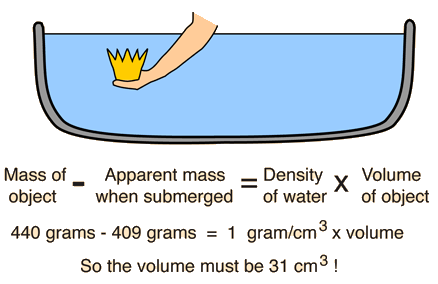
The buoyant force on a submerged object is equal to the weight of the liquid displaced by the object. For water, with a density of one gram per cubic centimeter, this provides a convenient way to determine the volume of an irregularly shaped object and then to determine its density.
浸在液体中的物体所受的浮力等于物体排开的液体的重量。对于密度为1克每立方厘米的水来说,这提供了一种方便的方法来确定不规则形状物体的体积,进而确定其密度。

What is it's density?
它的密度是多少?

Index

Archimedes discussion

Buoyancy concepts
索引阿基米德讨论浮力概念
 
HyperPhysics***** Mechanics ***** Fluids
HyperPhysics ***** 力学 ***** 流体
R Nave
Go Back
返回


Archimedes' Principle

阿基米德原理

Hmm! The crown seems lighter under water!

哦!皇冠在水中似乎更轻!
The buoyant force on a submerged object is equal to the weight of the liquid displaced by the object. For water, with a density of one gram per cubic centimeter, this provides a convenient way to determine the volume of an irregularly shaped object and then to determine its density.
浸在液体中的物体所受的浮力等于物体排开的液体的重量。对于密度为1克每立方厘米的水来说,这提供了一种方便的方法来确定不规则形状物体的体积,进而确定其密度。
Index

Archimedes discussion

Buoyancy concepts
索引阿基米德讨论浮力概念
 
HyperPhysics***** Mechanics ***** Fluids
HyperPhysics ***** 力学 ***** 流体
R Nave
Go Back
返回


Archimedes' Principle

阿基米德原理

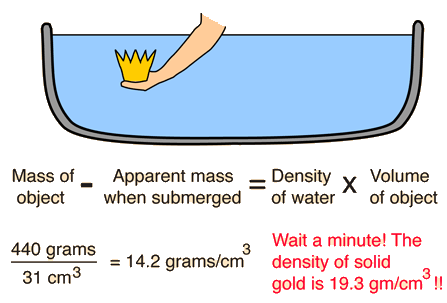
The buoyant force on a submerged object is equal to the weight of the fluid displaced. This principle is useful for determining the volume and therefore the density of an irregularly shaped object by measuring its mass in air and its effective mass when submerged in water (density = 1 gram per cubic centimeter). This effective mass under water will be its actual mass minus the mass of the fluid displaced. The difference between the real and effective mass therefore gives the mass of water displaced and allows the calculation of the volume of the irregularly shaped object (like the king's crown in the Archimedes story). The mass divided by the volume thus determined gives a measure of the average density of the object. Archimedes found that the density of the king's supposedly gold crown was actually much less than the density of gold -- implying that it was either hollow or filled with a less dense substance.

Examination of the nature of buoyancy shows that the buoyant force on a volume of water and a submerged object of the same volume is the same. Since it exactly supports the volume of water, it follows that the buoyant force on any submerged object is equal to the weight of the water displaced. This is the essence of Archimedes principle.

对浮力本质的考察表明,同一体积的水和浸没物体所受的浮力相同。由于它恰好支撑了被排开的水的重量,因此可以得出结论:任何浸没物体所受的浮力等于被排开的水的重量。这正是阿基米德原理的核心内容。

Application to determining density

密度确定的应用
浸在液体中的物体所受的浮力等于被排开的液体的重量。这一原理可用于确定不规则形状物体的体积,从而计算其密度。通过测量物体在空气中的质量以及在水中浸没时的有效质量(密度=1克/立方厘米),可以确定其体积。浸没在水中的有效质量等于实际质量减去排开的水的质量。因此,实际质量与有效质量的差值即为排开的水的质量,从而可以计算出不规则形状物体的体积(如阿基米德故事中的国王王冠)。由确定的体积与质量之比可得到物体的平均密度。阿基米德发现,国王所称的金王冠的密度实际上远小于金的密度——这表明王冠可能是中空的,或者填充了密度较低的物质。
Index

Buoyancy concepts
索引:浮力概念
 
HyperPhysics***** Mechanics ***** Fluids
HyperPhysics ***** 力学 ***** 流体
R Nave
Go Back
返回