Fresnel's Equations菲涅耳方程
Fresnel's equations describe the reflection and transmission of electromagnetic waves at an interface. That is, they give the reflection and transmission coefficients for waves parallel and perpendicular to the plane of incidence. For a dielectric medium where Snell's Law can be used to relate the incident and transmitted angles, Fresnel's Equations can be stated in terms of the angles of incidence and transmission. 菲涅耳方程描述电磁波在界面处的反射和透射。也就是说,它们给出了与入射面平行和垂直的波的反射和透射系数。对于可以利用斯涅尔定律来关联入射角和透射角的介电体介质,菲涅耳方程可以表示为入射角和透射角的函数。
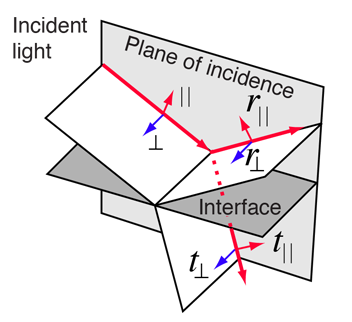
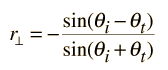
Fresnel's equations give the reflection coefficients: 菲涅耳方程给出了反射系数:
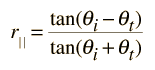
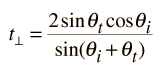
The transmission coefficients are 透射系数为
Note that these coefficients are fractional amplitudes, and must be squared to get fractional intensities for reflection and transmission. The signs of the coefficients depend on the original choices of field directions. 需要注意,这些系数是分数振幅,必须平方才能得到反射和透射的分数强度。这些系数的符号取决于原始的场方向选择。
You can choose values of parameters which will give transmission coefficients greater than 1, and that would appear to violate conservation of energy. (For example, try light incident from a medium of n1=1.5 upon a medium of n2=1.0 with an angle of incidence of 30°.) But the square of the transmission coefficient gives the transmitted energy flux per unit area (intensity), and the area of the transmitted beam is smaller in the refracted beam than in the incident beam if the index of refraction is less than that of the incident medium. When you take the intensity times the area for both the reflected and refracted beams, the total energy flux must equal that in the incident beam. For further details, see Jenkins and White. 你可以选择参数值,使得透射系数大于1,这似乎违反了能量守恒。(例如,尝试光从折射率n1=1.5的介质入射到折射率n2=1.0的介质,入射角为30°。)但透射系数的平方给出了单位面积的透射能量流(强度),如果折射率小于入射介质的折射率,则折射束的横截面积小于入射束。当计算反射束和折射束的强度乘以面积时,总能量流必须等于入射束的能量流。更多细节,请参见Jenkins和White。
Checking out conservation of energy in this situation leads to the relationship 检验这种情况下能量守恒关系得出
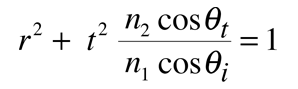
![]() which applies to both the parallel and perpendicular cases. 这适用于平行和垂直两种情况。
Parallel case: Reflected % and transmitted %. 平行情况:反射率和透射率。
中文译文中的待填/计算数值依次对应:1:rpp 2:tpp。实际数值以上方原输入框为准。 Perpendicular case: Reflected % and transmitted %. 垂直入射情况:反射率和透射率。
中文译文中的待填/计算数值依次对应:1:rnp 2:tnp。实际数值以上方原输入框为准。
|
Index Reflection concepts Incident light behavior References Hecht Ch 4 Jenkins and White Sec 25.2 索引 反射概念 入射光行为 参考文献 Hecht 第4章 Jenkins and White 第25.2节 | |||||||||||||
|
Go Back
返回 |
Reflection and Transmission反射与透射
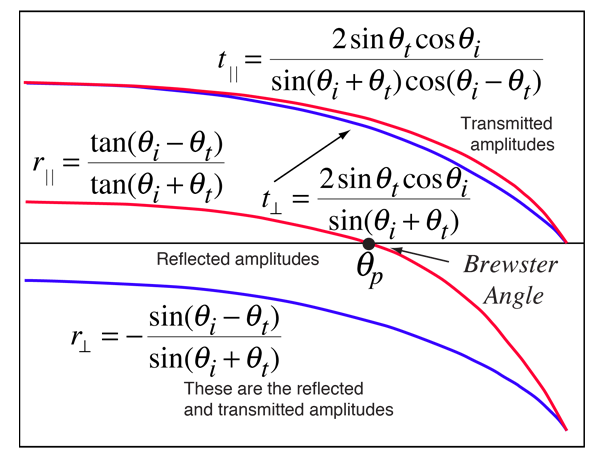
Typical reflection and transmission curves for external reflection. These curves are the graphical representation of the Fresnel equations. Note that the reflected amplitude for the light polarized parallel to the incident plane is zero for a specific angle called the Brewster angle. The reflected light is then linearly polarized in a plane perpendicular to the incident plane. This polarization by reflection is exploited in numerous optical devices. 典型外部反射的反射和透射曲线。这些曲线是菲涅尔方程的图形表示。注意,当入射角为特定角度(称为布儒斯特角)时,平行于入射平面的光的反射振幅为零。此时,反射光将垂直于入射平面线性极化。这种由反射产生的极化现象被广泛应用于多种光学器件中。
![]()
|
Index Reflection concepts Incident light behavior 索引 反射概念 入射光行为 | ||
|
Go Back
返回 |
Internal Reflection Curves内部反射曲线
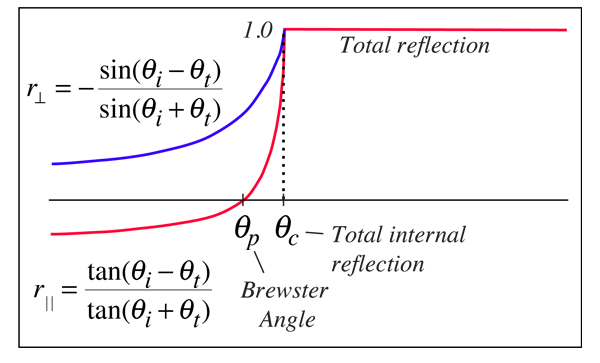
The illustration shows typical reflection curves for internal reflection. Internal reflection implies that the reflection is from an interface to a medium of lesser index of refraction, as from water to air. These curves are the graphical representation of the Fresnel equations. Note that the reflected amplitude for the light polarized parallel to the incident plane is zero for a specific angle called the Brewster angle. The reflected light is then linearly polarized in a plane perpendicular to the incident plane. This polarization by reflection is exploited in numerous optical devices. Another characteristic of internal reflection is that there is always an angle of incidence qc above which all light is reflected back into the medium. This phenomenon of total internal reflection has many practical applications in optics. 图中显示了典型的全内反射曲线。全内反射指的是从界面到折射率较低的介质的反射,例如从水到空气。这些曲线是菲涅尔方程的图形表示。请注意,当入射光的偏振方向与入射面平行时,对于一个特定的角度(称为布儒斯特角),反射振幅为零。此时反射光将垂直于入射面线性偏振。这种由反射产生的偏振现象被广泛应用于多种光学器件中。全内反射的另一个特点是,总存在一个临界入射角q_c,当入射角超过此角度时,所有光都将被反射回原介质。这种全内反射现象在光学中有许多实际应用。
![]()
|
Index Reflection concepts Incident light behavior 索引 反射概念 入射光行为 | ||
|
Go Back
返回 |