Bilingual edition: English is preserved and Chinese follows each unit. Terminology uses the confirmed v20260916 glossary; automated semantic review remains traceable.
中英双语版:英文原文完整保留,中文紧随对应单元;术语采用 v20260916 确认表,自动语义审校结果可追溯。

Refraction of Light

光的折射

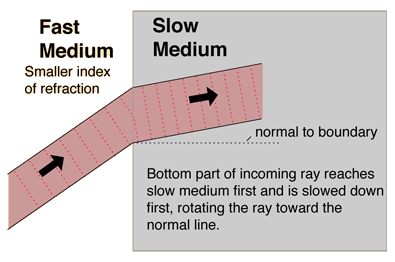
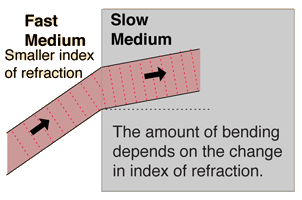
Refraction is the bending of a wave when it enters a medium where its speed is different. The refraction of light when it passes from a fast medium to a slow medium bends the light ray toward the normal to the boundary between the two media. The amount of bending depends on the indices of refraction of the two media and is described quantitatively by Snell's Law.

光的折射是波在进入速度不同的介质时发生的弯曲现象。当光从快速介质进入缓慢介质时,光的折射方向会趋向于两种介质交界处的法线。折射的程度取决于两种介质的折射率,并且定量地由斯涅尔定律描述。

Refraction is responsible for image formation by lenses and the eye.

折射是透镜和眼睛成像的原因

The bending of refraction can be visualized in terms of Huygens' principle. As the speed of light is reduced in the slower medium, the wavelength is shortened proportionately. The frequency is unchanged; it is a characteristic of the source of the light and unaffected by medium changes.

光的折射可以借助惠更斯原理来形象化理解。当光速在较慢的介质中减小时,波长会相应缩短。频率保持不变;它是光源的特性,不受介质变化的影响。
Refraction and the eye
折射与眼睛
Refraction of sound
声的折射
Refraction of light by water
光在水中的折射
Refraction and focal length
折射与焦距
Index

Lens concepts
棱镜概念索引
 
HyperPhysics***** Light and Vision
HyperPhysics ***** 光与视觉
R Nave
Go Back
返回


Index of Refraction

折射率

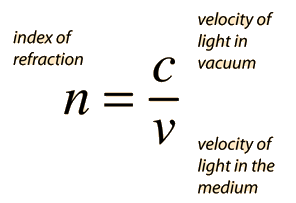
The index of refraction is defined as the speed of light in vacuum divided by the speed of light in the medium.

折射率定义为光在真空中速度与光在介质中速度的比值。

The indices of refraction of some common substances are given below with a more complete description of the indices for optical glasses given elsewhere. The values given are approximate and do not account for the small variation of index with light wavelength which is called dispersion.

一些常见物质的折射率列于下表,此外还另有更详细的关于光学玻璃折射率的说明。给出的值是近似值,未考虑折射率随光波长的微小变化,这种变化称为色散。
Material
材料
n
Material
材料
n
Vacuum
真空
1.000
Ethyl alcohol
乙醇
1.362
Air
空气
1.000277
Glycerine
甘油
1.473
Water
水
4/3
Ice
冰
1.31
Carbon disulfide
碳disulfide
1.63
Polystyrene
聚苯乙烯
1.59
Methylene iodide
甲基碘
1.74
Crown glass
王冠玻璃
1.50-1.62
Diamond
钻石
2.417
Flint glass
冕牌玻璃
1.57-1.75


Refraction and the eye
折射与眼睛
Refraction of sound
声的折射
Table of refractive indices
折射率表
Index

Lens concepts
棱镜概念索引
 
HyperPhysics***** Light and Vision
HyperPhysics ***** 光与视觉
R Nave
Go Back
返回


Snell's Law

斯涅尔定律

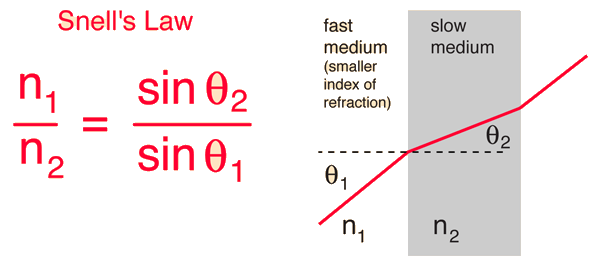
Snell's Law relates the indices of refraction n of the two media to the directions of propagation in terms of the angles to the normal. Snell's law can be derived from Fermat's Principle or from the Fresnel Equations.

斯涅尔定律将两种介质的折射率n与光在其中传播的方向联系起来,用的是入射角与法线的夹角。斯涅尔定律可以从费马原理或菲涅耳方程推导出来。
Enter data below, then click the symbol of the quantity you wish to calculate.

Indices of refraction:

折射率:
=
=

Angles with surface normal:

与表面法线成角度的:
= °
= °

Enter data and then click on the symbol for the quantity you wish to calculate in the active equation above. The numbers will not be forced to be consistent until you click on the quantity to calculate. Indices of refraction must be greater than or equal to 1, so values less than 1 do not represent a physically possible system.

输入数据,然后点击活动方程上方您希望计算的量的符号。数值不会被强制保持一致,直到您点击要计算的量。折射率必须大于或等于1,因此小于1的值不表示一个物理可能的系统。

If the incident medium has the larger index of refraction, then the angle with the normal is increased by refraction. The larger index medium is commonly called the "internal" medium, since air with n=1 is usually the surrounding or "external" medium. You can calculate the condition for total internal reflection by setting the refracted angle = 90° and calculating the incident angle. Since you can't refract the light by more than 90°, all of it will reflect for angles of incidence greater than the angle which gives refraction at 90°.

如果入射介质的折射率较大,则由于折射会使与法线的夹角增大。较大的折射率介质通常被称为"内部"介质,因为空气的折射率n=1通常被视为周围或"外部"介质。你可以通过将折射角设为90°,并计算入射角来确定全内反射的条件。由于无法将光折射超过90°,因此当入射角大于给定折射角时,所有光线都会发生全内反射。
在下方输入数据,然后点击您希望计算的量的符号。
中文译文中的待填/计算数值依次对应:1:n1 2:n2 3:th1 4:th2。实际数值以上方原输入框为准。
Index

Lens concepts
棱镜概念索引
 
HyperPhysics***** Light and Vision
HyperPhysics ***** 光与视觉
R Nave
Go Back
返回