Huygens' Principle
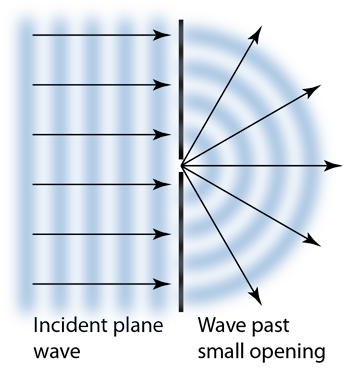 | In 1678 Huygens proposed a model where each point on a wavefront may be regarded as a source of waves expanding from that point. The expanding waves may be demonstrated in a ripple tank by sending plane waves toward a barrier with a small opening. If waves approaching a beach strike a barrier with a small opening, the waves may be seen to expand from the opening. 1678年,惠更斯提出一个模型,其中波前上的每一个点都可以视为波源,波从该点向外传播。这些向外传播的波可以在水波槽中通过将平面波朝向一个带有小孔的屏障来演示。如果接近海滩的波遇到一个带有小孔的屏障,波可能会被观察到从孔中向外扩散。 |
| Huygens' principle provides a convenient way to visualize refraction. If points on the wavefront at the boundary of a different medium serve as sources for the propagating light, one can see why the direction of the light propagation changes.
惠更斯原理提供了一种方便的方式来理解折射现象。如果波前上的边界点被视为传播光的源,就可以解释为什么光的传播方向会发生变化。 | 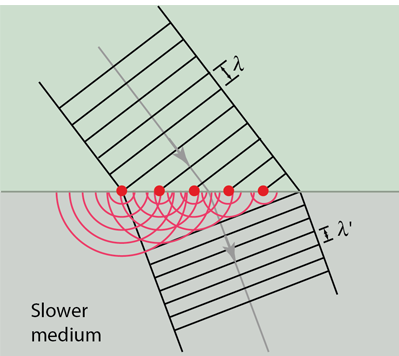 |
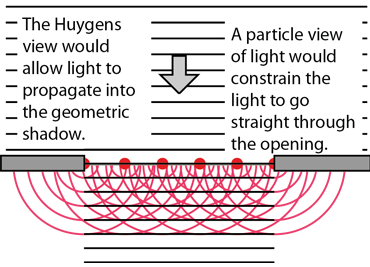 | The Huygens' principle view permitted a visualization of how light could penetrate into the geometric shadow in a way that the particle view could not. 惠更斯原理的观点使得人们能够直观地理解光如何穿透几何阴影,而这一点粒子观点无法做到。 |
Though helpful in establishing a wave view rather than a particle view of light for ordinary optics, Huygens' principle left a number of unanswered questions. For example, with its view of each point on a wavefront as a source, it gave no explanation of why it didn't propagate backward as well as forward. Miller and Fresnel further developed the theory of light propagation including diffraction. The theory of light propagation was made more rigorous by Kirchhoff.
| Huygens wiki
惠更斯维基百科 |
| HyperPhysics***** Light and Vision
HyperPhysics ***** 光与视觉 | R Nave |