Polarization and Interference Colors
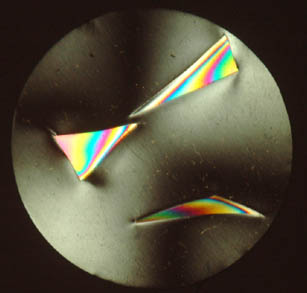
| Many common transparent materials exhibit bands of color when placed between crossed polarizers. Ordinary materials such as cellophane and polyethylene exhibit them. Natural mica and even ice chips exhibit interference colors.
许多常见的透明材料在被放置在交叉偏振器之间时会显示出颜色带。普通材料如保鲜膜和聚乙烯也会表现出这种现象。天然云母甚至冰片也会产生干涉色。 |
When light is passed through a polarizer to produced linearly polarized light and that light is then passed through a piece of birefringent material, the light is broken up into two components. Since the index of refraction of one of them is larger, that component will lag in phase. Then if the light is passed through a crossed polarizer, only that part of each of the components which is in the transmission plane will emerge. That means you have two coplanar components with a phase difference. If different colors have different indices, then for a given thickness of birefringent material, some colors will undergo destructive interference and some constructive, giving an interference pattern of varying colors reminiscent of the interference colors of a thin film.
| Crossed polarizers
交叉偏振器 |
Polarization concepts
Hecht
Optics, Sec 8.9
| HyperPhysics***** Light and Vision
HyperPhysics ***** 光与视觉 | R Nave |