Bilingual edition: English is preserved and Chinese follows each unit. Terminology uses the confirmed v20260916 glossary; automated semantic review remains traceable.
中英双语版:英文原文完整保留,中文紧随对应单元;术语采用 v20260916 确认表,自动语义审校结果可追溯。

The Baby's First Breath

婴儿的第一声呼吸
Everyone knows that it is much more difficult to blow up a balloon for the first time. Why is that? For one thing, the applied pressure does not create much tension in the walls of a small balloon to start the stretching process necessary for inflation. According to LaPlace's law, the wall tension will be twice as large for a balloon of twice the radius. If it takes a certain applied pressure to overcome the elasticity of the large balloon and cause it to expand further, it will take twice as much pressure to start to expand the smaller balloon. All this makes it difficult for the baby to take its first breath -- all the balloons are small! The alveoli of the lungs are collapsed in the fetus and must be inflated in the process of inhalation. Thus the traditional spank on the bottom of the newborn to make him/her mad enough to make the effort for the first breath. Further difficulties are encountered by premature infants because the surfactant fluid which coats the alveoli to give them the appropriate wall tensions is formed in the later stages of pregnacy. Until that point, the alveoli are coated with fluid which has essentially the surface tension of water, much higher than that of the normal surfactant.
大家都知道,第一次吹气球会 much more difficult。为什么呢?原因之一是,施加的压力在小气球的壁上不会产生足够的张力,以开始膨胀所需的拉伸过程。根据拉普拉斯定律,半径为两倍的气球其壁张力会大两倍。如果要克服大气球的弹性并使其进一步膨胀需要一定的压力,那么要开始膨胀小气球则需要两倍的压力。所有这些都使得婴儿第一次呼吸变得困难——所有的气球都很小!胎儿的肺泡是塌陷的,在吸气过程中必须被膨胀。因此,传统上会用打婴儿屁股的方法让他/她足够激动,以做出第一次呼吸的努力。早产儿还会遇到更多困难,因为覆盖在肺泡上以提供适当壁张力的表面活性物质在妊娠后期才形成。直到那时,肺泡上覆盖的液体基本上具有水的表面张力,比正常表面活性物质高得多。
Index

LaPlace's law concepts
索引拉普拉斯定律概念
 
HyperPhysics***** Mechanics ***** Fluids
HyperPhysics ***** 力学 ***** 流体
R Nave
Go Back
返回


COPD or Emphysema

慢性阻塞性肺疾病或肺气肿

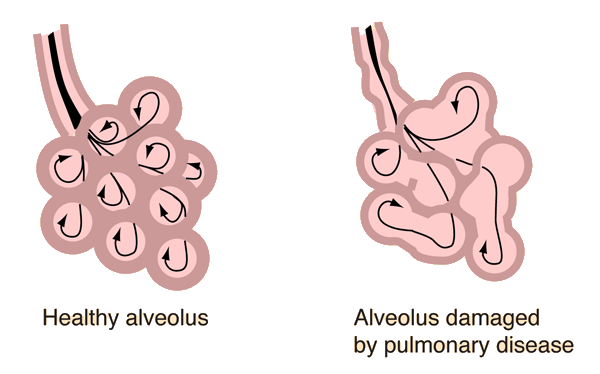
The disease of the lungs called emphysema or chronic obstructive pulmonary disease (COPD) results in the enlargement of the alveoli of the lungs as some are destroyed and others either enlarge or combine. The disease is one of the destructive effects of long-term smoking, but sometimes occurs in non-smokers. If the normal inhalation process inflates the alveoli to a larger radius, the implications of LaPlace's law are that the wall must have lost much of its elasticity. Normally it would take twice the pressure to inflate a constant tension membrane to twice its radius. Typically, the wall tension of the healthy alveoli is determined by the surface tension of the liquid which coats them, and with a uniform coating (called a surfactant), they will all inflate to a similar radius. The enlarged alveoli in the emphysema patient imply less elastic recoil during the process of exhalation. Exhalation requires effort from the diaphragm and in advanced stages of the disease, a patient will not be able to blow out a match.
肺部疾病称为肺气肿或慢性阻塞性肺病(COPD),会导致肺部的肺泡扩大,因为一些肺泡被破坏,而其他肺泡要么扩大要么融合。这种疾病是长期吸烟的破坏性影响之一,但有时也会发生在非吸烟者身上。如果正常的吸气过程将肺泡的半径扩大,根据拉普拉斯定律,这表明肺泡壁失去了大部分弹性。通常,要将一个恒定张力的膜膨胀到两倍的半径需要两倍的压力。通常,健康肺泡的壁张力由覆盖它们的液体的表面张力决定,当有均匀的覆盖层(称为表面活性物质)时,它们都会膨胀到相似的半径。肺气肿患者的肺泡扩大意味着在呼气过程中弹性回缩减少。呼气需要膈肌的用力,而在疾病晚期,患者将无法吹灭一根火柴。

Besides the loss of elasticity of the alveolar walls, the larger size of the compartments implies a smaller surface area for a given volume. Because the oxygen exchange from the air to the blood is proportional to the area of the exchange membrane, this diminishes the rate of oxygen transfer.

除了肺泡壁弹性丧失外,较大的腔体意味着给定体积下表面积更小。由于氧气从空气到血液的交换量与交换膜的面积成正比,这会降低氧气的转移速率。
Index

LaPlace's law concepts

References
Canadian Lung Association

Healthline COPD Reference
索引拉普拉斯定律概念参考加拿大肺协会健康线COPD参考
 
HyperPhysics***** Mechanics ***** Fluids
HyperPhysics ***** 力学 ***** 流体
R Nave
Go Back
返回


Tension in Arterial Walls

动脉壁张力

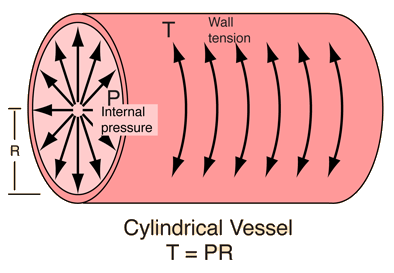
The tension in the walls of arteries and veins in the human body is a classic example of LaPlace's law. This geometrical law applied to a tube or pipe says that for a given internal fluid pressure, the wall tension will be proportional to the radius of the vessel.

人体动脉和静脉壁的张力是拉普拉斯定律的经典例子。这一几何定律应用于管或管道时指出,对于给定的内部流体压力,壁张力将与血管的半径成正比。
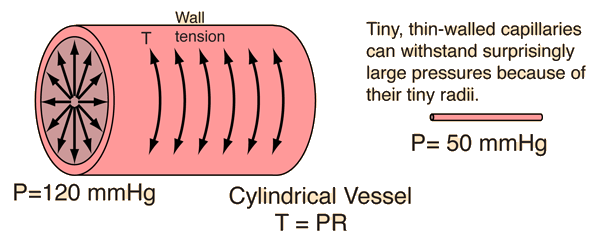
The implication of this law for the large arteries, which have comparable blood pressures, is that the larger arteries must have stronger walls since an artery of twice the radius must be able to withstand twice the wall tension. Arteries are reinforced by fibrous bands to strengthen them against the risks of an aneurysm. The tiny capillaries rely on their small size.
这一定律对大动脉的影响是,由于大动脉具有相似的血压,因此较大的动脉必须有更强的壁层,因为直径是两倍的动脉必须能够承受两倍的壁张力。动脉通过纤维束加以加固,以增强其抵抗动脉瘤风险的能力。微小的毛细血管则依靠其小尺寸来实现功能。

Demonstration with balloon

气球演示
Index

LaPlace's law concepts
索引拉普拉斯定律概念
 
HyperPhysics***** Mechanics ***** Fluids
HyperPhysics ***** 力学 ***** 流体
R Nave
Go Back
返回


Capillary Walls

毛细管壁

The walls of the capillaries of the human circulatory system are so thin as to appear transparent under a microscope, yet they withstand a pressure up to about half of the full blood pressure. LaPlace's law gives insight into how they are able to withstand such pressures: their small size implies that the wall tension for a given internal pressure is much smaller than that of the larger arteries.

人体循环系统的毛细血管壁非常薄,以至于在显微镜下显得透明,但它们能够承受约全血压一半的压力。拉普拉斯定律揭示了它们如何能够承受这样的压力:它们的尺寸较小,因此在给定的内部压力下,壁张力远小于较大动脉的张力。

Given a peak blood pressure of about 120 mmHg at the left ventricle, the pressure at the beginning of the capillary system may be on the order of 50 mmHg. The large radii of the large arteries imply that for pressures in that range they must have strong walls to withstand the large resulting wall tension. The larger arteries provide much less resistance to flow than the smaller vessels according to Poiseuille's law, and thus the drop in pressure across them is only about half the total drop. The capillaries offer large resistances to flow, but don't require much strength in their walls.

给定左心室的峰值血压约为120 mmHg,毛细血管系统的起始压力可能在50 mmHg量级。大动脉的较大半径意味着在该压力范围内,它们必须有强壁以承受较大的壁张力。根据泊肃叶定律,大动脉对流动的阻力比小血管小很多,因此它们的压强下降仅约为总下降的一半。毛细血管对流动的阻力很大,但它们的壁不需要很强的强度。
Index

LaPlace's law concepts
索引拉普拉斯定律概念
 
HyperPhysics***** Mechanics ***** Fluids
HyperPhysics ***** 力学 ***** 流体
R Nave
Go Back
返回


Danger of Aneurysms

动脉瘤的危险

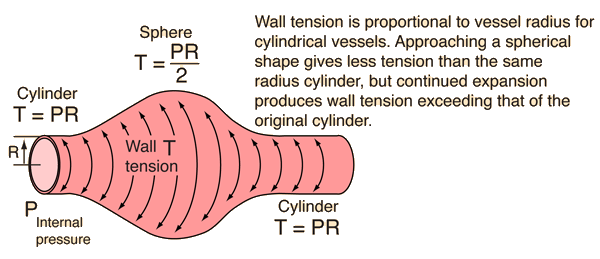
The larger arteries of the body are subject to higher wall tensions than the smaller arteries and capillaries. This wall tension follows the dictates of LaPlace's law, a geometrical relationship which shows that the wall tension is proportional to the radius for a given blood pressure. If an artery wall develops a weak spot and expands as a result, it might seem that the expansion would provide some relief, but in fact the opposite is true. In a classic "vicious cycle", the expansion subjects the weakened wall to even more tension. The weakened vessel may continue to expand in what is called an aneurysm. Unchecked, this condition will lead to rupture of the vessel, so aneurysms require prompt medical attention.

人体较大的动脉所受的壁张力比较小的动脉和毛细血管更高。这种壁张力遵循拉普拉斯定律,这是一个几何关系,表明在给定血压下,壁张力与半径成正比。如果动脉壁出现薄弱点并因此扩张,似乎扩张会带来一些缓解,但实际上情况相反。在一种典型的“恶性循环”中,扩张会使薄弱的壁受到更大的张力。这种薄弱的血管可能会继续扩张,称为动脉瘤。若未得到控制,这种状况将导致血管破裂,因此动脉瘤需要及时的医疗干预。

A localized weak spot in an artery might gain some temporary tension relief by expanding toward a spherical shape, since a spherical membrane has half the wall tension for a given radius. Minimizing membrane tension is why soap bubbles tend to form a spherical shape. But for an expanding artery, forming a near-spherical shape cannot be depended upon to give sufficient tension relief.

动脉中的一个局部薄弱区域可能通过向球形扩展来获得暂时的张力缓解,因为球形膜在给定半径下具有一半的壁张力。减少膜张力是肥皂泡倾向于形成球形的原因。但对扩张的动脉来说,形成近球形的结构无法指望提供足够的张力缓解。

Demonstration with balloon

气球演示
Index

LaPlace's law concepts
索引拉普拉斯定律概念
 
HyperPhysics***** Mechanics ***** Fluids
HyperPhysics ***** 力学 ***** 流体
R Nave
Go Back
返回