Bilingual edition: English is preserved and Chinese follows each unit. Terminology uses the confirmed v20260916 glossary; automated semantic review remains traceable.
中英双语版:英文原文完整保留,中文紧随对应单元;术语采用 v20260916 确认表,自动语义审校结果可追溯。

Alveoli of the Lungs

肺的肺泡
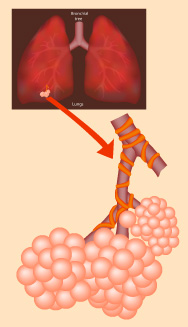
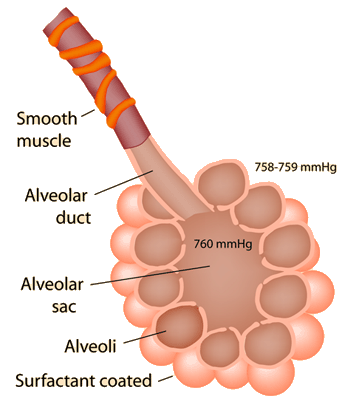
The oxygen exchange in the lungs takes place across the membranes of small balloon-like structures called alveoli attached to the branches of the bronchial passages. These alveoli inflate and deflate with inhalation and exhalation. The behavior of the alveoli is largely dictated by LaPlace's law and surface tension. It takes some effort to breathe in because these tiny balloons must be inflated, but the elastic recoil of the tiny balloons assists us in the process of exhalation. If the elastic recoil of the alveoli is compromised, as in the case of emphysema, then it is difficult to exhale forcibly.
肺部的氧气交换发生在被称为肺泡的小气囊状结构的膜上,这些肺泡连接在支气管分支上。肺泡随着吸气和呼气而膨胀和收缩。肺泡的行为主要由拉普拉斯定律和表面张力决定。吸气时由于这些小气囊需要膨胀,因此需要一定的努力,但肺泡的弹性回缩有助于呼气过程。如果肺泡的弹性回缩受损,如肺气肿的情况,那么强行呼气会变得困难。
The difficulty of inspiration during the baby's first breath is great because all the balloons must be inflated from a collapsed state.
婴儿第一次呼吸时,吸气困难是因为所有的气球都必须从塌陷状态充气。
Inflation of alveoli
肺泡扩张
Respiratory System
呼吸系统
Index

LaPlace's law concepts

Reference
Shier, et al.
Ch 19
索引 拉普拉斯定律概念 参考 Shier 等人,第19章
 
HyperPhysics***** Mechanics ***** Fluids
HyperPhysics ***** 力学 ***** 流体
R Nave
Go Back
返回


Inflating the Alveoli

扩张肺泡
Inflating the alveoli in the process of respiration requires an excess pressure inside the alveoli relative to their surroundings. This is actually accomplished by making the pressure in the thoracic cavity negative with respect to atmospheric pressure.

The amount of net pressure required for inflation is dictated by the surface tension and radii of the tiny balloon-like alveoli. During inhalation the radii of the alveoli increase from about 0.05 mm to 0.1 mm . The normal mucous tissue fluid surrounding the alveoli has a nominal surface tension of about 50 dynes/cm so the required net outward pressure is:

为了使肺泡膨胀所需的净压力量由表面张力和肺泡的半径决定。在吸气过程中,肺泡的半径从约0.05毫米增加到0.1毫米。包围肺泡的正常黏膜液体具有约50达因/厘米的表面张力,因此所需的净向外压力为:

The remarkable property of the surfactant which coats the alveoli is that it reduces the surface tension by a factor of about 15 so that the 1 mmHg pressure differential is sufficient to inflate the alveoli. Other factors affecting the remarkable efficiency of oxygen transport across the lung membranes is characterized in Fick's Law.

表面活性剂覆盖肺泡的显著特性在于,它能将表面张力降低约15倍,使得1毫米汞柱的压力差足以使肺泡扩张。影响肺泡膜氧气运输效率的其他因素在菲克定律中得到了体现。
呼吸过程中,肺泡膨胀需要肺泡内部的压力高于其周围环境。实际上,这是通过使胸腔内的压力低于大气压来实现的。
Index

LaPlace's law concepts

Reference
Shier, et al.
Ch 19
索引 拉普拉斯定律概念 参考 Shier 等人,第19章
 
HyperPhysics***** Mechanics ***** Fluids
HyperPhysics ***** 力学 ***** 流体
R Nave
Go Back
返回


Surfactant Role in Respiration

表面活性剂在呼吸中的作用
One of the remarkable phenomena in the process of respiration is the role of the fluid coating the walls of the alveoli of the lungs. This fluid, called a surfactant, lowers the surface tension of the balloon-like alveoli by about a factor of 15 compared to the normal mucous tissue fluid in which they are immersed. There appears to be a nearly constant amount of this surfactant per alveolus, so that when the alveoli are deflated it is more concentrated on the surface. Since the surface-tension-lowering effect of the surfactant depends on this concentration, it diminishes the required pressure for inflation of the alveoli at their most critical phase. For a given surface tension, the pressure to inflate a smaller bubble is greater. It is the surfactant which makes possible the inflation of the alveoli with only about 1 mmHg of pressure excess over their surroundings. The baby's first breath depends upon this surfactant and is made more difficult in premature infants by the incomplete formation of the surfactant.
呼吸过程中的一个显著现象是肺泡壁上覆盖的流体的作用。这种流体被称为表面活性物质,它使肺泡的表面张力降低约15倍,相比它们所处的正常黏膜组织流体。每肺泡中这种表面活性物质的量似乎几乎保持恒定,因此当肺泡塌陷时,它会更集中在表面。由于表面活性物质降低表面张力的效果取决于这种浓度,因此它减少了肺泡在最关键阶段的充气所需压力。对于给定的表面张力,充气较小的气泡需要更大的压力。正是这种表面活性物质使得肺泡能够在其周围压力仅高出约1 mmHg的情况下进行充气。婴儿的第一次呼吸依赖于这种表面活性物质,而早产儿由于表面活性物质未完全形成,这一过程变得更加困难。
Index

LaPlace's law concepts

Reference
Shier, et al.
Ch 19
索引 拉普拉斯定律概念 参考 Shier 等人,第19章
 
HyperPhysics***** Mechanics ***** Fluids
HyperPhysics ***** 力学 ***** 流体
R Nave
Go Back
返回


Alveoli and Exhalation

肺泡与呼气
The alveoli of the lungs act much like balloons in that there is some effort involved to inflate them, but when the inflating pressure is released, the recoil of the elastic walls provides the pressure necessary to deflate them. The lungs are suspended in the thoracic cavity which is normally at a slight negative pressure. When the diaphragm is lowered, that pressure becomes more negative and the lungs expand into the cavity. Air from the atmosphere moves into the resulting partial vacuum and inflates the alveoli. One is aware of the effort, but it is not extreme as in the case of the baby's first breath . Once the alveoli are fully inflated, exhalation can be accomplished by merely relaxing the diaphragm, since the wall tension in all the tiny alveoli will act to force the air out of them. By forcing the diaphragm upward, we can exhale forcefully by adding the diaphragm effort to the recoil of the elastic alveoli. In diseases like emphysema, the elasticity of the alveoli is lost and exhalation becomes a laborious process.
肺泡就像气球一样工作,因为要使它们充气需要一定的努力,但一旦充气压力释放,弹性壁的回弹能提供必要的压力以使肺泡塌陷。肺位于胸腔内,胸腔通常处于轻微的负压状态。当膈肌下降时,这种压力变得更负,肺就会扩张进入腔体。空气从大气中流入形成的局部真空,从而充气肺泡。人们能感受到这种努力,但不像婴儿第一次呼吸那样剧烈。一旦肺泡完全充气,只需放松膈肌即可呼气,因为所有小肺泡的壁张力会迫使空气排出。通过将膈肌向上推,可以借助膈肌的努力和肺泡弹性回弹力有力地呼气。在像肺气肿这样的疾病中,肺泡的弹性丧失,呼气变得费力。
Index

LaPlace's law concepts

Reference
Shier, et al.
Ch 19
索引 拉普拉斯定律概念 参考 Shier 等人,第19章
 
HyperPhysics***** Mechanics ***** Fluids
HyperPhysics ***** 力学 ***** 流体
R Nave
Go Back
返回