Bilingual edition: English is preserved and Chinese follows each unit. Terminology uses the confirmed v20260916 glossary; automated semantic review remains traceable.
中英双语版:英文原文完整保留,中文紧随对应单元;术语采用 v20260916 确认表,自动语义审校结果可追溯。

The Correspondence Principle and the Quantum Oscillator

对应原理与量子谐振子

Quantum mechanics is necessary for the description of nature on the atomic scale, but Newton's laws do fine for baseballs. Somewhere along the continuum from quantum to classical, the two descriptions must merge. Starting from the quantum end and noting that energies depend upon some quantum number, one would anticipate that for high enough quantum numbers, the quantum treatment should merge with the classical. This idea of the merging of the quantum and classical is called the "correspondence principle"
量子力学是描述原子尺度自然的必要工具,但牛顿运动定律对于棒球的描述已经足够。在从量子到经典的连续谱中,两种描述必须融合。从量子端开始,考虑到能量依赖于某个量子数,人们预期当量子数足够大时,量子描述应与经典描述融合。这种量子与经典融合的概念称为‘对应原理’。

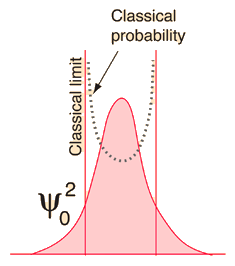
If you examine the ground state of the quantum harmonic oscillator, the correspondence principle seems far-fetched, since the classical and quantum predictions for the most probable location are in total contradiction. If the equilibrium position for the oscillator is taken to be x=0, then the quantum oscillator predicts that for the ground state, the oscillator will spend most of its time near that center point. The classical mass-on-a-spring will obviously spend very little time there because it has the maximum speed there; it will spend most of its time near the end points of its oscillation where its velocity is small.

如果考察量子谐振子的基态,对应原理似乎难以成立,因为经典力学和量子力学对最可能位置的预测存在完全矛盾。如果将谐振子的平衡位置取为x=0,那么量子谐振子预测,在基态下,谐振子将大部分时间停留在该中心点附近。而经典力学中的弹簧振子显然在那里花费很少时间,因为它在该处速度最大;它在振荡的端点附近会花费大部分时间,因为那里的速度较小。

As you go to higher and higher states of the quantum oscillator by increasing n, the most probable location shifts to the outside of the well. You still have the undulation of the probability which is characteristic of the wave solution, but at least the overall trend of the probability begins to look more like the classical probability which is shown by the dashed line.
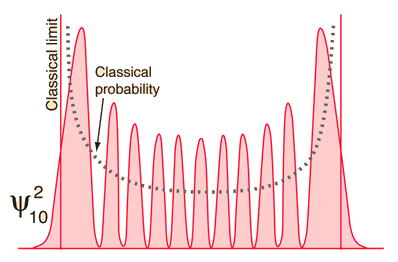
This wild oscillation of the probability has practical consequences only if it is observable, and the higher the quantum number, the smaller the distance between peaks. At high enough n, the uncertainty principle will prevent you from resolving the gaps without altering the physical state of the oscillator. The exponential tails into the classically forbidden region decrease with increasing n, so the quantum oscillator looks more and more like the classical one.
这种概率的剧烈振荡只有在可观察到时才有实际后果,而量子数越高,峰之间的距离越小。在足够大的n值下,不确定性原理将阻止你不改变振子的物理状态而分辨这些间隙。指数衰减的尾部进入经典禁止区域的幅度随着n的增加而减小,因此量子振子看起来越来越像经典振子。

当你增加n,使量子振子处于更高的能级时,概率最大的位置会移向势阱之外。你仍然能看到概率波动的特征,这与波解有关,但至少概率的整体趋势开始更接近经典概率,这由虚线所示。

Bohr used the term "correspondence principle" and expected that the radiative behavior of atoms would approach the classical radiation from accelerated charges for high enough quantum states. Certainly the observed line spectra from atoms differ radically from classical behavior. Beiser gives an example of calculating the radiation frequency of an atom for quantum number n=10,000 and states that it differs from the classical result by only 0.01%.

玻尔使用了“对应原理”这一术语,并期望当量子数足够大时,原子的辐射行为会接近于经典物理中加速电荷的辐射行为。当然,观察到的原子线光谱与经典行为有显著差异。比尔给出一个例子,计算量子数n=10,000时原子的辐射频率,并指出它与经典结果的差异仅在0.01%。
Further detail about classical and quantum probabilities
关于经典和量子概率的进一步细节
Index

Schrodinger equation concepts

References
Beiser, Perspectives
Sec 6-6
Thornton & Rex
Sec 7-6, 8-7
索引 斯涅尔方程概念 参考文献 Beiser, 视角 第6-6节 Thorntun & Rex 第7-6节,8-7节
 
HyperPhysics***** Quantum Physics
HyperPhysics ***** 量子物理
R Nave
Go Back
返回


Comparison of Classical and Quantum Probabilities for Harmonic Oscillator

谐振子的经典与量子概率比较

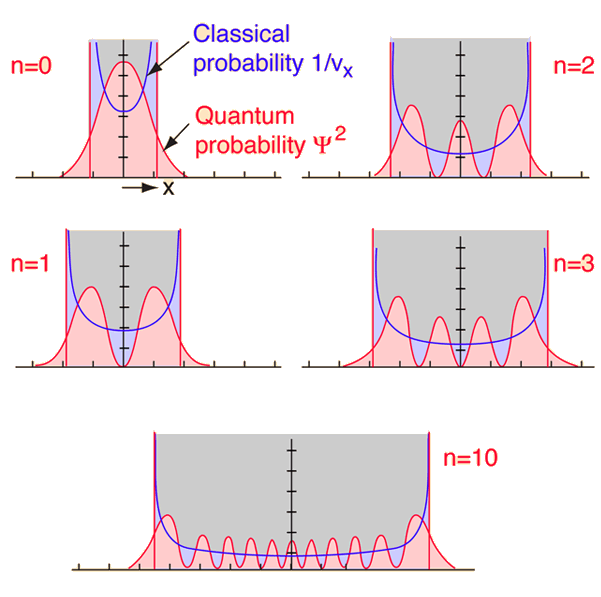
The harmonic oscillator is an important problem in both the quantum and classical realm. It is also a good example of how different quantum and classical results can be. One type of comparison is that of the probability of finding the object which is oscillating at a given distance x from the equilibrium position. For the classical case, the probability is greatest at the ends of the motion since it is moving more slowly and comes to rest instantaneously at the extremes of the motion. The relative probability of finding it in any interval Dx is just the inverse of its average velocity over that interval. For the quantum mechanical case the probability of finding the oscillator in an interval Dx is the square of the wavefunction, and that is very different for the lower energy states. Note from the diagram for the ground state (n=0) below that the maximum probability is at the equilibrium point x=0.

谐振子是量子和经典领域中一个重要问题。它也是展示不同量子和经典结果如何差异的一个良好例子。一种比较方式是物体在给定距离x处振荡时的概率。对于经典情况,概率在运动的两端最大,因为物体运动较慢并在运动的极端点瞬间停止。在任何区间Δx内的相对概率仅仅是该区间内平均速度的倒数。对于量子力学情况,发现振子在区间Δx内的概率是波函数的平方,且对于低能量态来说,这与经典情况有很大不同。注意下面图中基态(n=0)的图示,最大概率出现在平衡点x=0。

For the first few quantum energy levels, one can see little resemblance between the quantum and classical probabilities, but when you reach the value n=10 there begins to be some similarity. To be sure, they don't look the same, but they do agree that the probability is greatest near the ends of the motion. As you proceed to very high n values, they become more and more alike, and the oscillations of the quantum probability become so close together that they are practically smeared together. The fact that the overall picture of probability of finding the oscillator at a given value of x converges for the quantum and classical pictures is called the correspondence principle.

对于前几个量子能级,量子概率与经典概率之间似乎几乎没有相似之处,但当达到n=10时,开始出现一些相似性。当然,它们看起来并不完全相同,但它们都表明概率在运动的两端最大。随着n值变得非常大,它们变得越来越相似,量子概率的振荡变得如此密集,几乎被抹平了。量子和经典概率图像在整体上趋于一致这一事实被称为对应原理。

Another thing to note about the classical and quantum probabilities above is that the classical probability is strictly contained between the vertical lines which represent the classical limit. The quantum probabilities do extend into the classically forbidden region, exponentially decaying into that region.

上述经典和量子概率还有一个需要注意的地方是,经典概率严格位于由垂直线表示的经典极限之内。量子概率则会延伸到经典禁止区域,指数级地衰减到该区域。
Probabilities superimposed on oscillator potential
概率叠加在振子势能上
Index

Schrodinger equation concepts

Reference
Blatt
Ch 7
索引 斯涅尔方程概念 参考 Blatt 第7章
 
HyperPhysics***** Quantum Physics
HyperPhysics ***** 量子物理
R Nave
Go Back
返回