Radiated Energy as a Function of Energy Density
辐射能与能量密度的关系
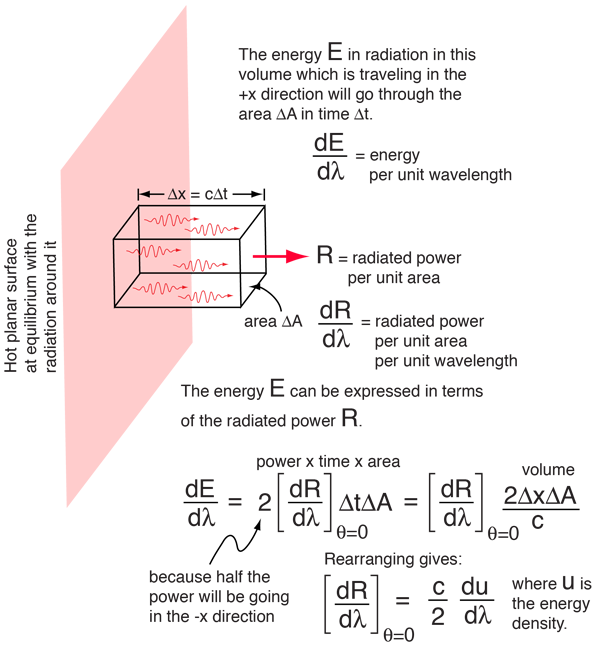
If we consider energy radiated perpendicular to a small increment of area, then it must be noted that half of the energy density in the waves is going toward the walls and half is coming out if the system is in thermal equilibrium. Evaluating the power seen at a given observation point requires a consideration of the geometry:
Other elements of area on the surface send radiation through the specified surface area, and that radiation has a component perpendicular to the surface. To evaluate that contribution, consider a surface element at an arbitrary angle as shown below.
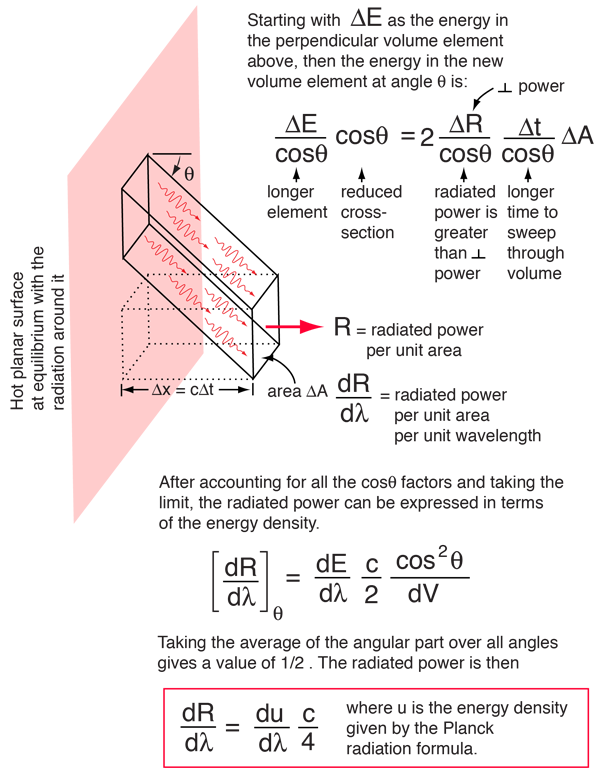
The factor c/4 developed here involves an integral over all angles. It is important because it relates the radiated energy to the energy density given by the Planck radiation formula.
这里发展的因子c/4涉及对所有角度的积分。它很重要,因为它将辐射的能与由普朗克辐射公式给出的能量密度联系起来。
Development of the Rayleigh-Jeans Law瑞利-琼斯定律的建立
|
表面其他区域的辐射通过指定的表面积传递,该辐射有一个垂直于表面的分量。为了评估这一贡献,考虑一个任意角度的表面元素,如图所示。
如果我们考虑垂直于小面积增量的辐射能量,则必须注意,在热平衡状态下,波中的能量密度有一半传向墙壁,另一半则向外传出。评估给定观测点处的功率需要考虑几何因素:
Rayleigh- Jeans references
Blackbody radiation concepts
索引:瑞利-金斯参考文献 黑体辐射概念
| HyperPhysics***** Quantum Physics
HyperPhysics ***** 量子物理 | R Nave |
返回