Blackbody Radiation黑体辐射
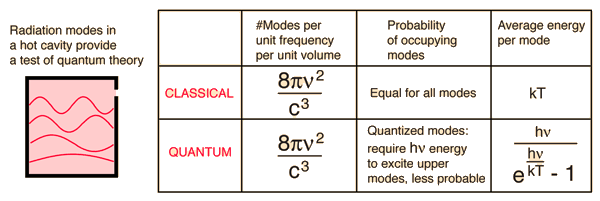
"Blackbody radiation" or "cavity radiation" refers to an object or system which absorbs all radiation incident upon it and re-radiates energy which is characteristic of this radiating system only, not dependent upon the type of radiation which is incident upon it. The radiated energy can be considered to be produced by standing wave or resonant modes of the cavity which is radiating.
![]()
‘黑体辐射’或‘腔辐射’指的是一个物体或系统,它能吸收所有照射到它上的辐射,并仅以该辐射系统特有的方式重新辐射能量,这种辐射不依赖于照射到它上的辐射类型。辐射的能量可以被认为是由辐射出的腔体的驻波或共振模式产生的。 |
Index Blackbody radiation concepts Great experiments of physics 索引 黑体辐射概念 重要的物理实验 | ||||
|
Go Back
返回 |
Cavity Modes腔体模式
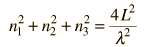
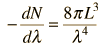
A mode for an electromagnetic wave in a cavity must satisfy the condition of zero electric field at the wall. If the mode is of shorter wavelength, there are more ways you can fit it into the cavity to meet that condition. Careful analysis by Rayleigh and Jeans showed that the number of modes was proportional to the frequency squared. ![]() 在腔体中电磁波的模式必须满足在腔壁处电场为零的条件。如果模式的波长更短,则有更多方式可以将其放入腔体以满足这一条件。雷利和詹斯的仔细分析表明,模式的数量与频率的平方成正比。对模式数量的评估 |
Index Blackbody radiation concepts 索引 黑体辐射概念 | ||
|
Go Back
返回 |
Planck Radiation Formula普朗克辐射公式
From the assumption that the electromagnetic modes in a cavity were quantized in energy with the quantum energy equal to Planck's constant times the frequency, Planck derived a radiation formula. The average energy per "mode" or "quantum" is the energy of the quantum times the probability that it will be occupied (the Einstein-Bose distribution function): 从假设腔体中的电磁波模式其能量是量子化的,且量子能量等于普朗克常数乘以频率,普朗克推导出辐射公式。每个‘模式’或‘量子’的平均能量是量子能量乘以它被占据的概率(爱因斯坦-玻色分布函数):
![]() This average energy times the density of such states, expressed in terms of either frequency or wavelength 这种状态的平均能量乘以这种状态的密度,用频率或波长来表示
![]() gives the energy density, the Planck radiation formula. 给出能量密度,普朗克辐射公式。
The Planck radiation formula is an example of the distribution of energy according to Bose-Einstein statistics. The above expressions are obtained by multiplying the density of states in terms of frequency or wavelength times the photon energy times the Bose-Einstein distribution function with normalization constant A=1. 普朗克辐射公式是根据玻色-爱因斯坦统计分布的能量分布的一个例子。上述表达式是通过将频率或波长的态密度乘以光子能量再乘以玻色-爱因斯坦分布函数,并乘以归一化常数A=1得到的。
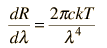
To find the radiated power per unit area from a surface at this temperature, multiply the energy density by c/4. The density above is for thermal equilibrium, so setting inward=outward gives a factor of 1/2 for the radiated power outward. Then one must average over all angles, which gives another factor of 1/2 for the angular dependence which is the square of the cosine. 为了找到该温度下表面的辐射功率密度,需将能量密度乘以c/4。上述密度是指热平衡情况,因此设定向内=向外会给出向外辐射功率的一个1/2因子。然后还需对所有角度进行平均,这会给出另一个1/2因子,用于描述角度依赖性,即余弦的平方。
|
Index Blackbody radiation concepts 索引 黑体辐射概念 | |||||
|
Go Back
返回 |
Rayleigh-Jeans vs Planck瑞利-普朗克
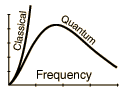
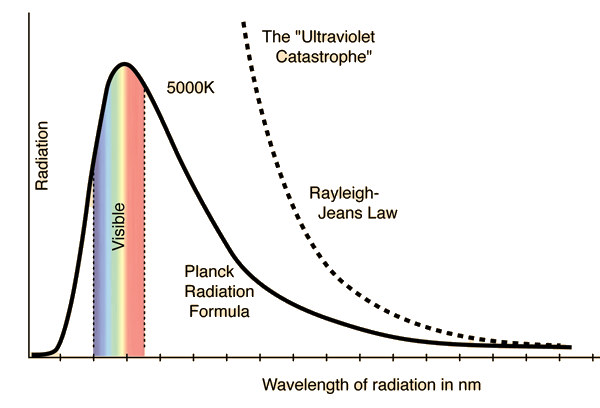
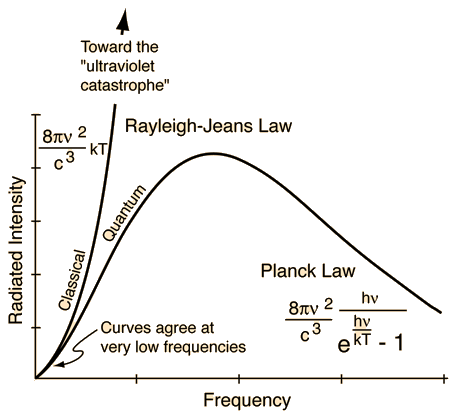
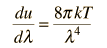
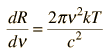
Comparison of the classical Rayleigh-Jeans Law and the quantum Planck radiation formula. Experiment confirms the Planck relationship.
![]() Comments on the development of the Rayleigh-Jeans Law关于瑞利- Jeans 定律发展的评论
经典瑞利-金斯定律与量子普朗克辐射公式对比。实验证实了普朗克关系。 |
Index Blackbody radiation concepts 索引 黑体辐射概念 | |||
|
Go Back
返回 |
Blackbody Intensity as a Function of Frequency频率的黑体强度
|
Index Blackbody radiation concepts 索引 黑体辐射概念 | ||||
|
Go Back
返回 |
Comments on the Development of the Rayleigh-Jeans Law关于瑞利-金斯定律的发展的评论
The Rayleigh-Jeans Law was an important step in our understanding of the equilibrium radiation from a hot object, even though it turned out not to be an accurate description of nature. The careful work in developing the Rayleigh-Jeans law laid the foundation for the quantum understanding expressed in the Planck radiation formula. In outline form, here are the steps which led to the Rayleigh-Jeans law.
瑞利-金斯定律是我们理解热物体平衡辐射的重要一步,尽管它后来被发现并不是对自然的准确描述。在发展瑞利-金斯定律过程中所做出的细致工作,为普朗克辐射公式所表达的量子理解奠定了基础。以下是对推导瑞利-金斯定律的主要步骤的概述。 |
Index Rayleigh- Jeans references Blackbody radiation concepts 索引:瑞利-金斯参考文献 黑体辐射概念 | ||||||||||||||||||||
|
Go Back
返回 |