Bilingual edition: English is preserved and Chinese follows each unit. Terminology uses the confirmed v20260916 glossary; automated semantic review remains traceable.
中英双语版:英文原文完整保留,中文紧随对应单元;术语采用 v20260916 确认表,自动语义审校结果可追溯。

Einstein Velocity Addition

爱因斯坦速度叠加

The Einstein velocity relationship transforms a measured velocity as seen in one inertial frame of reference (u) to the velocity as measured in a frame moving at velocity v with respect to it (u'). In problems involving more than two objects, the main difficulty is the assignment of velocity to all the objects.

爱因斯坦的速度关系将一个惯性参考系中测得的速度(u)转换为另一个以速度v相对于该参考系运动的参考系中测得的速度(u')。在涉及多个物体的问题中,主要困难在于为所有物体分配速度。
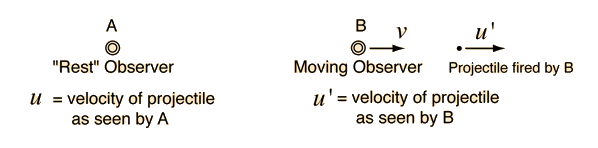

If A sees B moving at velocity v, then a velocity measured by B (u') would be seen by A as:

如果A看到B以速度v运动,那么B测量的 velocity (u') 在A看来会是:
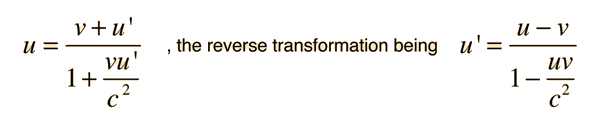
These relationships make perfect sense at low speeds where both denominators approach 1.

这些关系在低速情况下完全合理,因为两个分母都接近1。
Index
索引
 
HyperPhysics***** Relativity
HyperPhysics ***** 相对论
R Nave
Go Back
返回


Relativistic Relative Velocity

相对论性相对速度

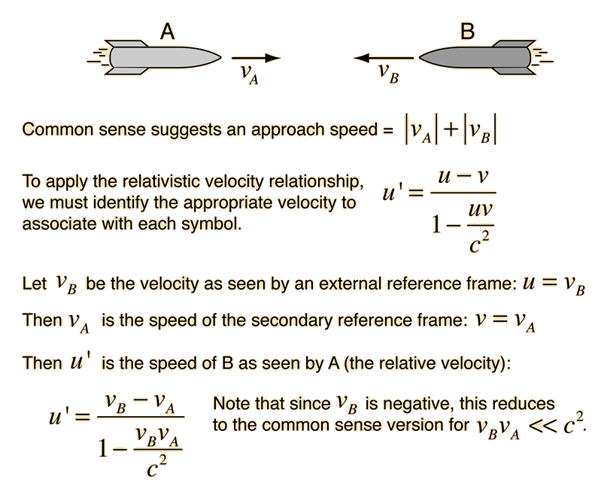
The speed of light is the speed limit of the universe, so it follows that no observer will see any other observer approaching or receding at a speed greater than c. But what if observers A and B are both moving toward each other with speeds approaching c as seen by an external observer? How will A and B measure their relative speeds? This is an example of Einstein velocity addition. In the calculation below, velocities to the right are taken as positive.

光速是宇宙中的速度极限,因此任何观察者都不会看到另一个观察者以超过c的速度接近或远离。但假设观察者A和B相对于外部观察者以接近c的速度相互接近,那么A和B会如何测量它们的相对速度?这是一个爱因斯坦速度叠加的例子。在下面的计算中,向右的 velocities 被视为正数。

If
如果
vA= c and
并且
vB= c then
然后
u'= c.

Exactly the same magnitude of velocity is obtained if you evaluate the approach velocity as observed by B.
如果从B的视角计算接近速度,得到的速率大小是相同的。
中文译文中的待填/计算数值依次对应:1:va 2:vb 3:up。实际数值以上方原输入框为准。
Index

索引
 
HyperPhysics***** Relativity
HyperPhysics ***** 相对论
R Nave
Go Back
返回


Relativistic Projectile

相对论弹体

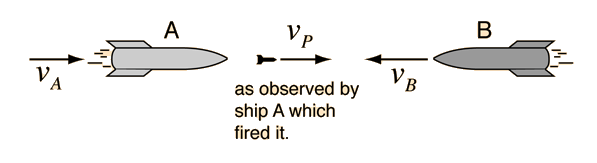
Now if spacecraft A fires a projectile at velocity Vp as measured in A's frame of reference, then the two relevant questions are:

现在如果航天器A以速度Vp发射一个弹体(该速度是相对于A的参考系测量的),那么两个相关的问题是:

1. How fast will an external observer see the projectile traveling?

外部观察者会看到弹体以多快的速度运动?

2. How fast will B see the projectile approaching?

B会以多快的速度看到弹丸接近?

This is an example of Einstein velocity addition.

这是爱因斯坦速度相加的一个例子

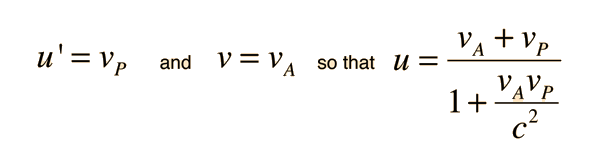
Taking question #1 first, then in the standard form:

If
如果
vA= c and
并且
vP= c then
然后
u= c.

Note that for low velocities, this is the simple sum of the velocities of the firing spacecraft and the projectile as seen by that spacecraft.

Now to calculate the approach velocity as seen by the targeted spacecraft B:

If
如果
u(above)
u(above)(专名或术语)
= c and
并且
vB= c then
然后
u'= c.

For low speeds, this expression yields a value equal to the sum of the magnitudes of the three velocities as indicated in the diagram. The Einstein velocity addition gaurantees that the resultant velocity does not exceed c, even if all three of the indicated velocities approach c!
先处理问题#1,然后以标准形式表达:需要注意的是,在低速情况下,这相当于发射航天器和弹体速度的简单相加,如该航天器所见。现在计算作为目标航天器B所见的接近速度:在低速情况下,这个表达式给出的值等于图中三个速度大小之和。爱因斯坦速度相加保证了即使所有三个指示速度接近光速,结果速度也不会超过光速!
中文译文中的待填/计算数值依次对应:1:va1 2:vp 3:u1 4:ua 5:vb1 6:up1。实际数值以上方原输入框为准。
Index

索引
 
HyperPhysics***** Relativity
HyperPhysics ***** 相对论
R Nave
Go Back
返回