Cerenkov Applications
契伦科夫效应应用
Cerenkov radiation can be used to detect the occurrence of certain nuclear interactions. Such interactions can release large amounts of energy and eject particles at highly relativistic speeds. If these interactions take place in water or another clear substance, then the Cerenkov radiation emitted as the reaction products travel through the water can be detected by photomultiplier tubes. This kind of detection is to be used in the Sudbury Neutrino Observatory to detect neutrino interactions.
切连科夫辐射可用于检测某些核相互作用的发生。这类相互作用可能释放大量能量,并以高度相对论性速度发射粒子。如果这些相互作用发生在水或其他清澈的物质中,那么作为反应产物通过水时发出的切连科夫辐射就可以被光电倍增管检测到。这种检测方法将用于苏必利盆地中微子观测站,以检测中微子相互作用。
The Super-Kamiokande neutrino detector facility in Japan has 11,000 photomuliplier tubes in place to detect Cerenkov radiation and is able to detect and distinguish electron and muon neutrinos.
日本的超神冈中微子探测器设施配备了11,000个光电倍增管,用于探测契伦科夫辐射,并能够检测和区分电子中微子和缪子中微子。
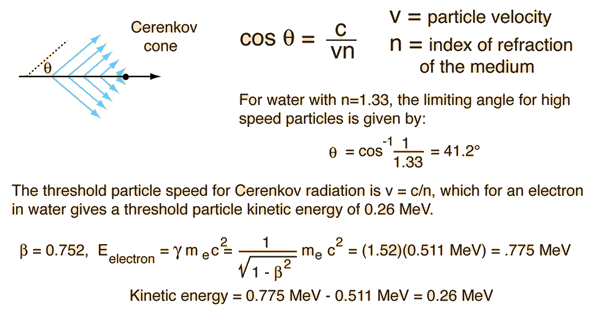
Measurements of particle speeds can be made by measuring the angle of the Cerenkov cone, like photographing ship wakes to measure ship speeds. A portion of the light emitted by the decelerated particle is coherent and is emitted at a characteristic angle
通过测量契伦科夫锥的角,可以测量粒子的速度,就像通过拍摄船尾波浪来测量船速一样。减速粒子发出的光中有一部分是相干的,并以特征角度发射。
The total amount of energy appearing in Cerenkov radiation is small compared to the total energy loss by ionization as the particle enters the medium. According to Rohlf, a relativistic particle near the speed of light will lose energy at the rate of about 200 MeV/m, and of that loss only about 40 keV/m will be in Cerenkov radiation, about 1/5000 of the total.
契伦柯夫辐射中的总能量远小于粒子进入介质时通过电离损失的总能量。根据Rohlf的说法,一个接近光速的 relativistic 粒子会以每米约200 MeV的速率损失能量,其中只有每米约40 keV的损失会以契伦柯夫辐射形式出现,这仅占总损失的约1/5000。
Although the example given here is for electrons in water, applicable to the use of Cerenkov radiation for neutrino detection, Cerenkov radiation occurs for any charged particle which enters a material medium at a speed greater than the speed of light in that medium. The Cerenkov radiation is independent of the mass of the particle, depending only upon its charge and speed. Cerenkov radiation is emitted at all frequencies in the visible if it occurs in an optically transparent medium, but the energy per unit wavelength is proportional to the inverse cube of the wavelength. Short wavelengths are then preferred, and the visible color is described by Evans as "bluish white".
尽管这里给出的例子是关于水中的电子,适用于利用契伦柯夫辐射进行中微子探测,但契伦柯夫辐射发生在任何以大于该介质中光速进入的带电粒子。契伦柯夫辐射与粒子的质量无关,仅取决于其电荷和速度。如果发生在光学透明介质中,契伦柯夫辐射会在可见光的全部频率范围内发射,但单位波长的能量与波长的三次方成反比。因此短波长更受青睐,可见颜色被Evans描述为“蓝白色。”
Early Cerenkov detectors used glass, lucite and mica as detector media. They all had indices of refraction around n=1.5, so the limiting Cerenkov angle was about 48°. Although the Cerenkov radiation can be produced at all forward angles less than the limiting angle as the particle slows down, in practice the emission is seen as a narrow cone with only a few degrees width. The particles slow down very quickly, so the radiation comes from a very short path length in the medium and a very short time interval (<10^-10 sec, Richtmyer, et al). The emission comes from discrete atoms at steps along the path, and is emitted coherently. As early as 1951, Mather reported the use of Cerenkov radiation for determining the energy of 340 MeV protons with an uncertainty of only +/- 0.8 MeV.
早期的切连科夫探测器使用玻璃、Lucite和云母作为探测介质。它们的折射率都约为n=1.5,因此限制的切连科夫角约为48°。虽然切连科夫辐射可以在粒子减速时产生于所有小于限制角的前向角度,但在实际中,辐射表现为一个狭窄的锥形,宽度仅有几度。粒子减速非常迅速,因此辐射来自介质中非常短的路径长度和非常短的时间间隔(<10^-10秒,Richtmyer等)。辐射来自路径上的离散原子,并以相干的方式发射。早在1951年,Mather就报告了利用切连科夫辐射确定340 MeV质子能量,其不确定性仅为±0.8 MeV。
Analytical treatments of Cerenkov radiation were carried out by Frank & Tam and by Fermi.
弗兰克与塔姆以及费米对契伦科夫辐射进行了解析处理。
|