Threshold for Relativistic Effects
At what energies is a particle relativistic? It is convenient to know ranges of energies at which non-relativistic approximations are good enough. The energies at which non-relativistic expressions for mechanical quantities of electrons and protons are in error by 1% is a reasonable threshold for relativistic treatments.
|
相对论动量
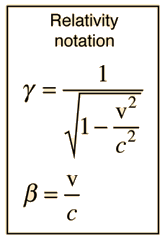
departs by 1% from the non-relativistic expression when γ = 1.01 . This occurs for β = 0.14 or v = 0.14 c. The kinetic energy at this speed is (γ - 1)m0c2 = 0.01m0c2. The 1% threshold is then 5.11 keV for electrons and 9.38 MeV for protons. For alpha particles, the 1% threshold for momentum is at 37.27 MeV. Applied to radioactive decay energies of around 1-10 MeV, this suggests that essentially all beta decay electrons are relativistic, but no alpha particles are relativistic. 当γ = 1.01时,偏离非相对论表达式1%。这发生在β = 0.14或v = 0.14c时。在此速度下的动能为(γ - 1)m₀c² = 0.01m₀c²。因此,1%的阈值对于电子是5.11 keV,对于质子是9.38 MeV。对于α粒子,动量的1%阈值出现在37.27 MeV。考虑到放射性衰变的能量大约在1-10 MeV范围内,这表明几乎所有β衰变的电子都是相对论性的,但没有α粒子是相对论性的。
动量 p 等于质量 m 与速度 v 的乘积,即 p = mv = γm₀v |
 |
The relativistic kinetic energy
differs from the non-relativistic form of kinetic energy by 1% when
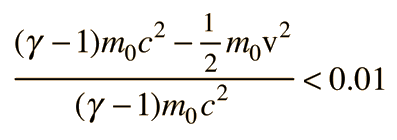
Solving this numerically gives γ = 1.00673 , so the 1% error threshold for electrons is 3.4 keV and that for protons is 6.3 MeV.
Taking another look at relativistic momentum, the exact expression for pc in terms of kinetic energy is

but for low energies, the square of the kinetic energy in this expression can be neglected, giving the simpler approximate expression

This simpler expression is accurate within 1% for electrons when KE < 20.7 keV and for protons when KE < 38 MeV.
Looking at the extreme relativistic case, the particle energy can be approximated by the photon energy expression E = hc/l = pc when the rest mass energy is negligible compared to the kinetic energy. This approximation is accurate within 1% when
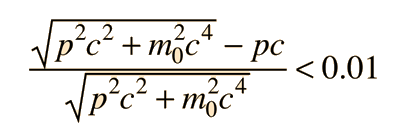
The approximation E=pc is accurate within less than 1% for electrons when pc > 3.6 MeV and for protons when pc > 6.6 GeV .
| Usefulness of quantity pc
动量乘以光速的量的有用性 | Relativistic mechanical quantities
相对论力学量 |
| HyperPhysics***** Relativity
HyperPhysics ***** 相对论 | R Nave |