Early Photoelectric Effect Data早期光电效应数据
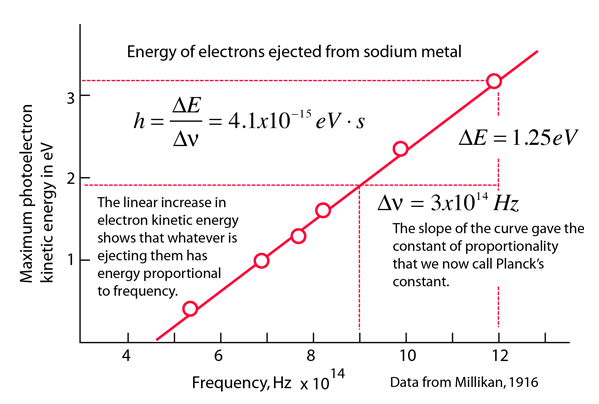
Electrons ejected from a sodium metal surface were measured as an electric current. Finding the opposing voltage it took to stop all the electrons gave a measure of the maximum kinetic energy of the electrons in electron volts. 从钠金属表面逸出的电子被测得形成一个电流。找到阻止所有电子的反向电压给出了电子最大动能的测量值,单位为电子伏特。
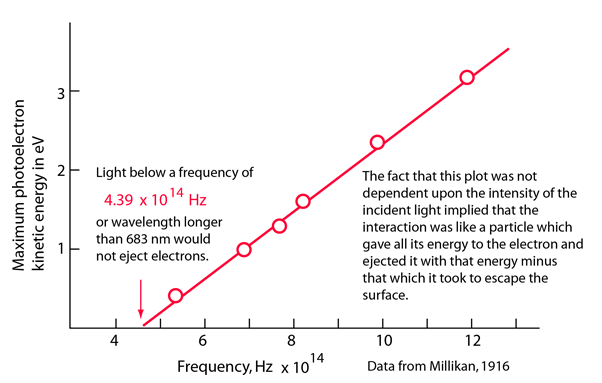
![]() The minimum energy required to eject an electron from the surface is called the photoelectric work function. The threshold for this element corresponds to a wavelength of 683 nm. Using this wavelength in the Planck relationship gives a photon energy of 1.82 eV. 从表面 eject 电子所需的最小能量称为光电工作函数。这种元素的阈值对应于波长为 683 nm。使用这个波长代入普朗克关系式,得到光子能量为 1.82 eV。
Further analysis进一步分析
|
Index Millikan reference Photoelectric effect 密立根参考光电效应 | ||
|
Go Back
返回 |
Early Photoelectric Effect Data早期光电效应数据
![]() Planck hypothesis普朗克假设 |
Index Millikan reference Photoelectric effect 密立根参考光电效应 | ||
|
Go Back
返回 |
The Planck Hypothesis普朗克假说
In order to explain the frequency distribution of radiation from a hot
cavity (blackbody radiation) Planck proposed the ad hoc assumption that the radiant energy could exist only in discrete quanta which were proportional
to the frequency. This would imply that higher modes would be less
populated and avoid the ultraviolet catastrophe of the Rayleigh-Jeans Law.![]() The quantum idea was soon seized to explain the photoelectric effect, became part of the Bohr theory of discrete atomic spectra, and quickly became part of the foundation of modern quantum theory.
为了解释热腔中辐射的频率分布(黑体辐射),普朗克提出了一个任意假设,即辐射能量只能以离散的量子形式存在,这些量子与频率成正比。这将意味着高频率模式将被较少填充,并避免了瑞利-金斯定律的紫外灾难。量子概念很快被用于解释光电效应,成为波尔原子谱线理论的一部分,并迅速成为现代量子理论基础的一部分。 |
Index Photoelectric effect 索引光电效应 | |||||
|
Go Back
返回 |
Photon Energies for EM Spectrum光子能量与电磁波谱
![]()
|
Index
索引 | ||||
|
Go Back
返回 |
Photons: The Quanta of Light光子:光的量子
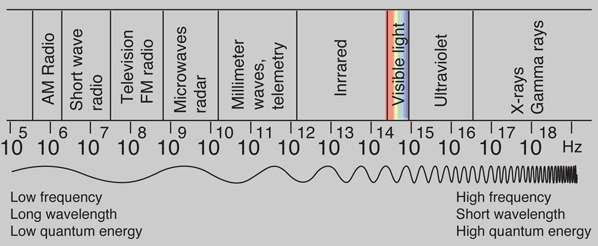
According to the Planck hypothesis, all electromagnetic radiation is quantized and occurs in finite "bundles" of energy which we call photons. The quantum of energy for a photon is not Planck's constant h itself, but the product of h and the frequency. The quantization implies that a photon of blue light of given frequency or wavelength will always have the same size quantum of energy. For example, a photon of blue light of wavelength 450 nm will always have 2.76 eV of energy. It occurs in quantized chunks of 2.76 eV, and you can't have half a photon of blue light - it always occurs in precisely the same sized energy chunks. 根据普朗克假设,所有电磁辐射都是量子化的,以有限的‘能量包’形式出现,我们称之为光子。光子的能量量子不是普朗克常数h本身,而是h与频率的乘积。量子化意味着,给定频率或波长的蓝光光子总是具有相同大小的能量量子。例如,波长为450纳米的蓝光光子总是具有2.76 eV的能量。它以2.76 eV的量子化块出现,你不能有半个蓝光光子——它总是以精确相同大小的能量块出现。
But the frequency available is continuous and has no upper or lower bound, so there is no finite lower limit or upper limit on the possible energy of a photon. On the upper side, there are practical limits because you have limited mechanisms for creating really high energy photons. Low energy photons abound, but when you get below radio frequencies, the photon energies are so tiny compared to room temperature thermal energy that you really never see them as distinct quantized entities - they are swamped in the background. Another way to say it is that in the low frequency limits, things just blend in with the classical treatment of things and a quantum treatment is not necessary. 但可用的频率是连续的,没有上限或下限,因此光子可能的能量也没有有限的下限或上限。在上限方面,存在实际限制,因为你无法通过有限的机制产生极高能量的光子。低能光子很多,但当你低于无线电频率时,光子的能量相对于室温热能来说非常小,因此你几乎看不到它们作为独立的量子实体——它们被背景噪声所淹没。另一种说法是,在低频极限下,事物只是与经典处理方式融合,因此不需要量子处理。
![]()
|
Index Photoelectric effect 索引光电效应 | ||||
|
Go Back
返回 |