Comet Giacobini-Zinner
Multiple "slingshot" propulsion manuevers place the IEEE-3 spacecraft in position to view Comet Giacobini-Zinner.
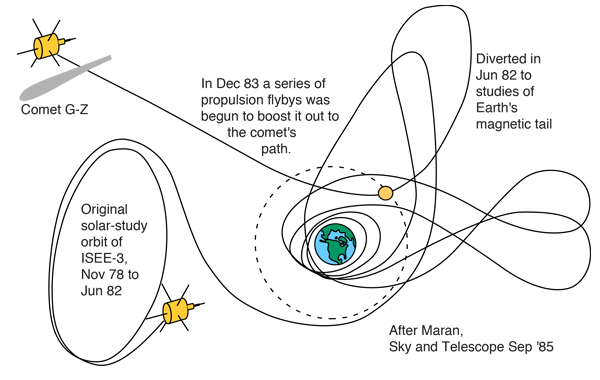
The chance to observe newly discovered Comet Giacobini-Zinner transformed an ordinary solar orbit into a dramatic series of slingshot propulsion maneuvers which converted ordinary solar-wind observation satellite ISEE-3 into "International Cometary Explorer". From an undramatic history, ICE became prominent as it was steered through 37 propulsive maneuvers,five lunar flybys, and two close passes of the Earth during an eighteen month period to send it out to intercept the orbit of Comet G-Z. Its path brought it within 120 km of the moon's surface on one pass. It reached Comet G-Z at a distance of about 70 million kilometers from the Earth, passing 8000 kilometers behind the comet's nucleus and spending about 20 minutes passing through its tail.
The close encounter enabled measurements of about 70,000 km for the diameter of the coma. The tail was well over 500,000 km. Comet G-Z had a thin, straight primarily ion tail, in contrast to the more commonly observed broad dust tails.
| Comet Discussion
彗星讨论 |
Solar System Illustration
Solar System Concepts
References
Chaisson & McMillan,
Ch 14.
Maran
| HyperPhysics********** Astrophysics
HyperPhysics ********** 天体物理学 | R Nave |