Bilingual edition: English is preserved and Chinese follows each unit. Terminology uses the confirmed v20260916 glossary; automated semantic review remains traceable.
中英双语版:英文原文完整保留,中文紧随对应单元;术语采用 v20260916 确认表,自动语义审校结果可追溯。

Double Ball Drop

双球下落
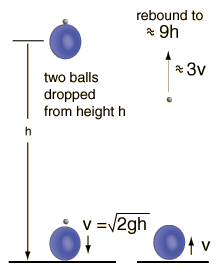
If a light ball like a ping-pong ball is dropped along with a heavy ball like a large superball, the small ball rebounds with a remarkably high velocity, theoretically approaching three times the velocity with which the balls strike the surface. The analysis involves the nature of head-on elastic collisions and in particular the case of a light projectile hitting a heavy target. Slingshot orbits used in space exploration have features in common with this situation even though the objects involved never touch each other.

The rebound velocity of 3v for the small ball implies that its kinetic energy is nine times its incoming kinetic energy since the kinetic energy is proportional to the square of the velocity. Since the gravitational potential energy is proportional to the height and the kinetic energy is all converted to potential energy at the peak of the motion, it will rise to height 9h.
如果一个轻球,比如一个乒乓球,与一个重球,比如一个大超级球同时下落,小球以惊人的速度反弹,理论上接近其撞击表面速度的三倍。这种分析涉及头对头的弹性碰撞,特别是轻弹丸撞击重目标的情况。用于空间探索的滑翔轨道具有与这种情况相似的特征,尽管所涉及的物体从未接触。小球的反弹速度为3v,意味着其动能是入射动能的九倍,因为动能与速度的平方成正比。由于重力势能与高度成正比,而动能在运动的最高点全部转化为势能,因此它将上升到高度9h。
Index

Collision concepts
索引 碰撞概念
 
HyperPhysics***** Mechanics
力学
R Nave
Go Back
返回


Analysis of Double Ball Drop

双球下落分析
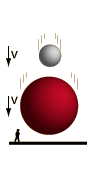
The two slightly separated balls dropped from the same height are seen by a ground observer to approach the surface with velocity v.
两个稍有分离的球从同一高度下落,被地面观察者看到以速度v接近地面。
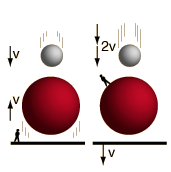
A ground observer sees the larger ball hit and bounce up with velocity v while the smaller one still approaches. An observer on the larger ball would see the smaller one approach with velocity 2v. That observer would see the surface receding with velocity v.
地面观察者看到较大的球以速度 v 碰撞并弹起,而较小的球仍继续接近。站在较大球上的观察者会看到较小的球以速度 2v 接近。该观察者会看到地面以速度 v 远离。
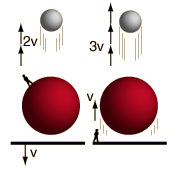
Assuming perfectly elastic collisions and that the large ball is much more massive than the small one, the observer on the large ball will see the small one bounce back with velocity 2v. A ground observer would see the velocity of the small ball as 3v.
假设碰撞是完全弹性的,并且大球的质量远大于小球,大球上的观察者会看到小球以速度2v弹回。而地面观察者会看到小球的速度为3v。

Double ball drop
双球下落
Standard collision examples
标准碰撞示例
Headon collision, massive target case
正面对撞,大质量目标情况
Index

Collision concepts
索引 碰撞概念
 
HyperPhysics***** Mechanics
力学
R Nave
Go Back
返回


Gravity-Assist or Slingshot Orbit

重力助推或飞弹轨道

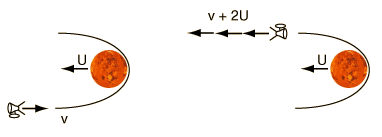
Planetary exploration vessels like Voyager I and Voyager II made use of propulsion maneuvers which gained energy from the planets and moons they passed. Such maneuvers are really elastic collisions where the objects involved never hit each other but are affected by gravity as they approach. An extreme case of such a propulsion maneuver is like the double ball drop.

像维吉尔号(Voyager I)和维吉尔二号(Voyager II)这样的行星探测器利用了从它们经过的行星和卫星获得能量的推进 maneuver。这种 maneuver 实际上是弹性碰撞,涉及的物体从未真正碰撞,但它们在接近时受到重力的影响。这种推进 maneuver 的极端情况类似于双球下落。
A famous example of the use of such maneuvers is the exploration of Comet G-Z. The Voyager missions also made several energy-boosting flybys of planets on their paths through the solar system. The spacecraft Mariner 10 made several slingshot maneuvers in its exploration of Venus and Mercury. The Messenger spacecraft used several gravity assists using the Earth, Venus and Mercury in its approach to orbit around Mercury.
More "gravity assist" maneuvers
更多‘重力辅助’机动
一个著名的此类操作例子是对彗星G-Z的探测。旅行者任务也在穿越太阳系的过程中,对多个行星进行了能量提升的飞越。航天器先驱者10号在其探索金星和水星的过程中,进行了多次弹弓操作。信使航天器在接近水星轨道时,利用地球、金星和水星进行了多次重力辅助操作。
Index

Collision concepts

Elastic collisions
索引 碰撞概念 弹性碰撞
 
HyperPhysics***** Mechanics
力学
R Nave
Go Back
返回


More Gravity-Assists

更多引力助推

The use of a gravity-assist or "slingshot" orbit has been of great benefit in the exploration of the solar system. The spacecraft Ulysses used a gravity-assist from Jupiter to swing it far out of the ecliptic plane for observation of the sun's polar regions. Galileo used a gravity-assist from Venus, two flybys of Earth, and close encounters with asteroids Gaspra and Ida on its circuitous path to Jupiter. The more recent Cassini spacecraft used two gravity assist maneuvers from Venus and one from Earth before heading out to Jupiter and Saturn. The Dawn spacecraft used a gravity assist from Mars on its way to Vesta and Ceres. The New Horizons spacecraft used a gravity assist from Jupiter on its journey to Pluto.

利用重力助推或'弹弓'轨道在太阳系探索中发挥了巨大作用。航天器“乌卢西斯”利用从木星的重力助推使其飞出黄道平面,以观测太阳的极地区域。伽利略利用从金星的重力助推,两次飞掠地球,以及与小行星Gaspra和Ida的近距离接触,沿着曲折的路径前往木星。更近期的卡西尼航天器在前往木星和土星之前,利用了两次从金星的重力助推和一次从地球的重力助推。戴恩航天器在前往维斯塔和谷神星的途中利用了从火星的重力助推。新视野航天器在前往冥王星的旅程中利用了从木星的重力助推。
Index

Collision concepts

Elastic collisions
索引 碰撞概念 弹性碰撞
 
HyperPhysics***** Mechanics
力学
R Nave
Go Back
返回