Hubble Space Telescope Instruments哈勃太空望远镜仪器
The Hubble Space Telescope carries a number of important instruments to carry out its multiple missions:
哈勃太空望远镜携带了多种重要仪器,以完成其多项任务: |
Index
索引 | ||
|
Go Back
返回 |
Advanced Camera for Surveys先进巡天相机
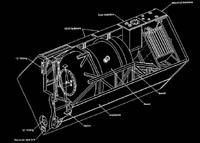
One of the Hubble Space Telescope's advanced instruments is referred to as the ACS. Hubble's newest science instrument-the Advanced Camera for Surveys - brought the telescope into the 21st century. With its wider field of view, sharper image quality, and enhanced sensitivity, the new camera doubles Hubble's field of view and expands its capabilities significantly. Upgrading the telescope with ACS's cutting-edge technology made it ten times more effective and prolonged its useful life. 哈勃太空望远镜的先进仪器之一称为ACS。哈勃最新的科学仪器——先进巡天相机——将望远镜带入了21世纪。凭借更宽的视场、更清晰的图像质量和增强的灵敏度,新相机将望远镜的视场翻倍,并显著扩展了其功能。通过升级ACS的尖端技术,望远镜变得十倍更有效,并延长了其使用寿命。
ACS is actually a team of three different cameras: the wide field camera, the high-resolution camera, and the solar blind camera. It outperforms all previous instruments flown aboard the Hubble Space Telescope, primarily because of its expanded wavelength range. Designed to study some of the earliest activity in the universe, ACS sees in wavelengths ranging from far ultraviolet to infrared. ACS实际上是由三个不同相机组成的团队:宽视场相机、高分辨率相机和太阳盲相机。它在性能上优于所有之前搭载在哈勃太空望远镜上的仪器,主要因为它扩展了波长范围。该设备旨在研究宇宙早期的一些活动,能够探测从远紫外到红外的波长。
ACS maps the distribution of dark matter, detects the most distant objects in the universe, searches for massive planets, and studies the evolution of clusters of galaxies. To accommodate these science goals, each of ACS's three cameras was designed to perform a specific function. With a field of view twice that of WFPC2, ACS's wide field camera conducts broad surveys of the universe. Astronomers use it to study the nature and distribution of galaxies, which reveal clues about how our universe evolved. The high-resolution camera takes extremely detailed pictures of the inner regions of galaxies. It searches neighboring stars for planets and planets-to be, and takes close-up images of the planets in our own solar system. The solar blind camera, which blocks visible light to enhance ultraviolet sensitivity, focuses on hot stars radiating in ultraviolet wavelengths. ACS 映射暗物质的分布,探测宇宙中最遥远的天体,搜寻大质量行星,并研究星系团的演化。为实现这些科学目标,ACS 的三个相机均被设计成执行特定功能。ACS 的宽视场相机的视场是 WFPC2 的两倍,用于对宇宙进行广泛的调查。天文学家利用它研究星系的性质和分布,这些信息揭示了我们宇宙演化的线索。高分辨率相机拍摄银河系内部区域的极其详细图像。它搜寻邻近恒星周围的行星,并拍摄太阳系内行星的近距离图像。太阳盲相机通过阻挡可见光以增强紫外灵敏度,专注于辐射紫外波长的高温恒星。
ACS was installed during Servicing Mission 3B in March 2002. The new instrument was built between 1996 and 1999 by scientists and engineers at The Johns Hopkins University, Ball Aerospace, the Space Telescope Science Institute, and NASA's Goddard Space Flight Center. (Text adapted from NASA description.) ACS是在2002年3月的第三次维修任务中安装的。该新仪器由约翰霍普金斯大学、Ball航空航天公司、空间望远镜科学研究所和NASA戈达德太空飞行中心的科学家和工程师于1996年至1999年间建造。(文本改编自NASA的描述。)
|
Index
索引 | ||
|
Go Back
返回 |
Near Infrared Camera and Multi-object Spectrometer近红外相机和多目标光谱仪
Installed on Hubble in February 1997, NICMOS used infrared vision to probe dark, dusty, never-before-seen regions of space with the optical clarity that only Hubble can provide. Its infrared detectors operated at a very cold temperature (minus 351 degrees Fahrenheit, which is minus 213 degrees Celsius or 60 degrees Kelvin). To keep the detectors cold, NICMOS was encased in a thermos- like container filled with solid nitrogen ice. It was expected that the solid nitrogen ice would last approximately four years. However, the ice evaporated about twice as fast as planned and was depleted after only 23 months of NICMOS science operations. In 1999 -- with its supply of ice exhausted -- NICMOS became dormant. Astronauts installed the a new nitrogen cooling system inside Hubble during the fifth and final spacewalk of Servicing Mission 3B on March 8, 2002. On March 18, the NCS was turned on via commands sent from the Space Telescope Operations Control Center at Goddard. It has continued to operate flawlessly ever since. The deep interior of the NICMOS reached the target temperature of 70 degrees Kelvin (minus 333 degrees Fahrenheit) on April 11. 1997年2月,NICMOS被安装在哈勃上。NICMOS利用红外成像技术,探测太空中的黑暗、尘埃密布且从未被观测到的区域,其光学清晰度只有哈勃能够提供。其红外探测器在非常低温下(-351华氏度,即-213摄氏度或60开尔文)运行。为了保持探测器的低温,NICMOS被装在一个类似保温瓶的容器中,内填有固态氮冰。预计固态氮冰可以持续大约四年。然而,冰的蒸发速度比计划快了两倍,仅在NICMOS科学运行23个月后就耗尽了。1999年,当氮冰供应耗尽时,NICMOS停止运行。宇航员在2002年3月8日的第五次也是最后一次太空行走中,将新的氮冷却系统安装到哈勃上。2002年3月18日,通过从戈达德空间望远镜操作控制中心发送的指令,NCS被开启。它一直运行良好。NICMOS的内部深处于4月11日达到目标温度60开尔文(-333华氏度)。
|
Index
索引 | ||||
|
Go Back
返回 |