Phoenix
Phoenix was a robotic spacecraft which landed on Mars on May 25, 2008. Mission scientists used instruments aboard the lander to assess the local habitability and to research the history of water there. It was launched on August 4, 2007 from Cape Canaveral. Phoenix was NASA's sixth successful landing out of seven attempts and was the first successful landing in a Martian polar region.
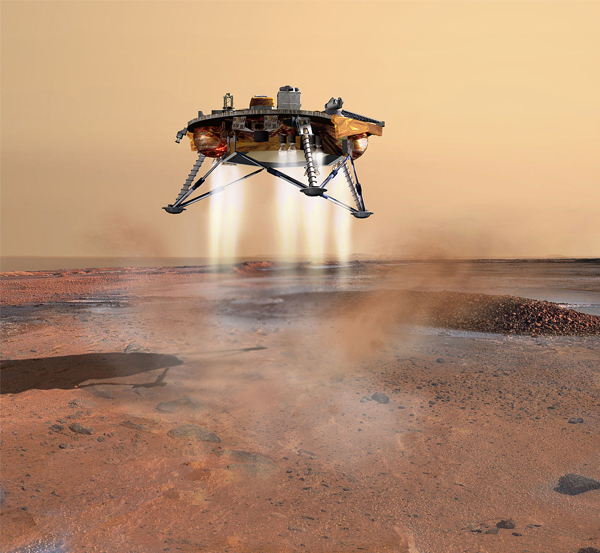
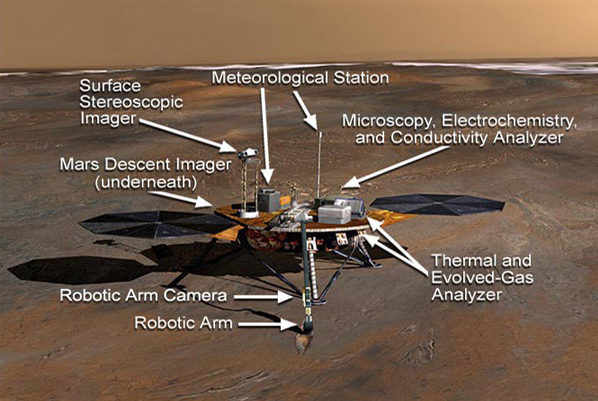
The two primary missions were to study the geological history of water and to evaluate past or potential planetary habitability in the ice-soil boundary. Phoenix's instruments were suitable for uncovering information on the geological and possibly biological history of the Martian Arctic. Phoenix was the first mission to return data from either of the poles, and contributed to NASA's main strategy for Mars exploration, "Follow the water."(Wiki)
The primary mission was anticipated to last 90 sols (Martian days) - just over 92 Earth days. However, the craft exceeded its expected operational lifetime by a little over two months before succumbing to the increasing cold and dark of an advancing Martian winter. (Wiki)
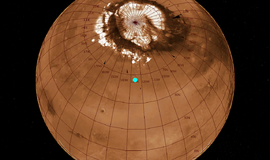 | The location of the Phoenix landing site near the Martian pole. 凤凰着陆点位于火星北极附近 | 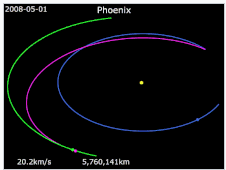 |
The polygonal cracking at the landing zone had previously been observed from orbit, and is similar to patterns seen in permafrost areas in polar and high altitude regions of Earth. Phoenix's robotic arm camera took an image underneath the lander on sol 5 that shows patches of a smooth bright surface uncovered when thruster exhaust blew off overlying loose soil. It was later shown to be water ice. On June 19, 2008 (sol 24), NASA announced that dice-sized clumps of bright material in the trench dug by the robotic arm had vaporized over the course of four days, strongly implying that they were composed of water ice which sublimed following exposure. While dry ice also sublimes, under the conditions present it would do so at a rate much faster than observed. 着陆区的多边形裂纹此前曾从轨道上观测到,其模式与地球两极和高海拔地区永久冻土区观察到的模式相似。凤凰号探测器的机械臂摄像头在第5个火星日拍摄了一张图像,显示在机械臂挖掘的沟槽下方,有块状的光滑明亮表面暴露出来,当推进器喷气吹脱上层松散土壤时显现出来。后来证实这些明亮物质是水冰。2008年6月19日(第24个火星日),NASA宣布,在机械臂挖掘的沟槽中发现的大小如骰子的明亮物质在四天内完全蒸发,强烈表明这些物质是由水冰组成,暴露于外界后发生了升华。虽然干冰也会升华,但在现有条件下,干冰的升华速率远快于观测到的速率。 | 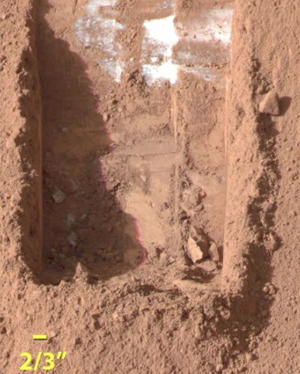 |
Mars Concepts
Solar System Illustration
Solar System Concepts
Phoenix
Wiki
| HyperPhysics********** Astrophysics
HyperPhysics ********** 天体物理学 | R Nave |