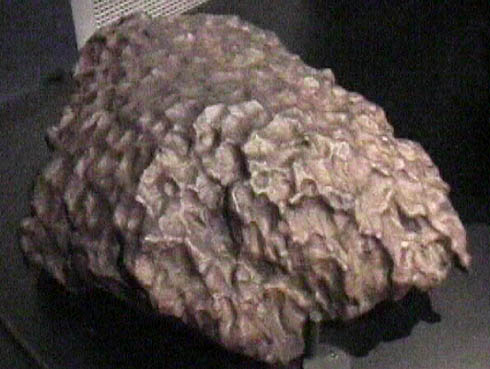
Iron Meteorites
Meteorites are traditionally classified as irons, stones, and stony-irons. The "irons" are composed of nearly pure metallic nickel-iron. This makes it easy to classify them as extraterrestrial in origin because pure metallic iron almost never occurs naturally on the Earth - it is in the form of some oxide. Fraknoi, et al. comment " if you ever come across a chunk of metallic iron, it is sure to be either man-made or a meteorite." The stony meteorites are more common but harder to identify, often requiring isotopic analysis to be sure. The stony-irons, mixtures of metallic iron and stone, are much rarer.
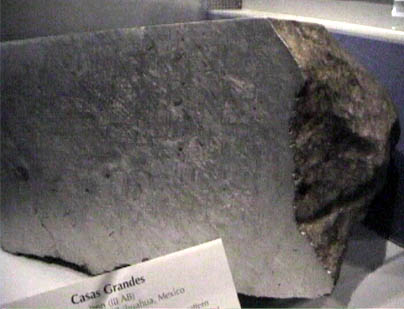
The Casas Grandes meteorite, on display at the Smithsonian Museum of Natural History, has a dimension of perhaps 1.5 meters. It was found in Chihuahua, Mexico. The sliced section here shows it to be essentially solid metal in the interior.
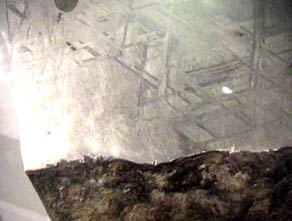 |
A closer view makes it clear that this is solid metal! There are interesting lines and striations associated with the crystal formation. 更仔细地观察可以清楚地看出,这确实是固体金属!与晶体形成有关的有趣线条和条纹显现出来。 |
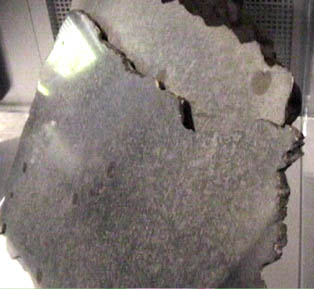 |
The metal is so solid and so pure that it can be cut into slices! These sections are perhaps a centimeter and a half thick and some 70-80 cm across. 这种金属非常坚固且纯净,可以被切成薄片!这些切片可能有大约一厘米半的厚度,直径约70至80厘米。 |
| Large Australian iron meteorites
大型澳大利亚铁陨石 |
Solar System Illustration
Solar System Concepts
Reference
Fraknoi, Morrison & Wolff.
Ch 13
| HyperPhysics********** Astrophysics
HyperPhysics ********** 天体物理学 | R Nave |