Phases of the Moon
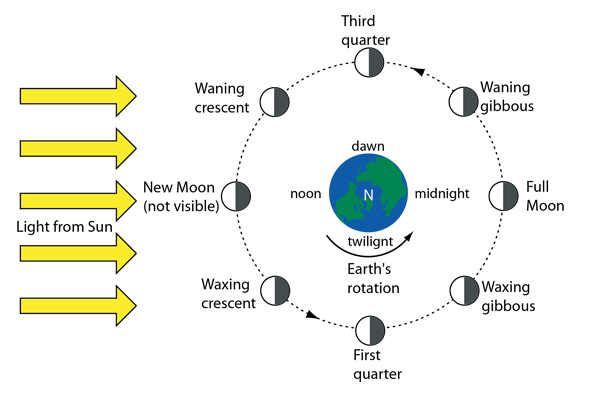
An observer on the Earth sees the Moon progress through "phases" since only that part of the moon which is illuminated by the Sun can be seen. Only that part of the moon which is inside the dashed circle in the diagram above is visible from the Earth, and therefore different fractions of the moon are visible at different times. The usual names for these phases are shown. With the diagram in mind, you can roughly tell the time of day or night from the Moon's shape and position. If a waxing gibbous moon is directly overhead, then it is about 9 PM.
The Moon orbits the Earth in 27.3 days, which is said to be its siderial period, or its period with respect to the distant stars. But the Earth is moving around the Sun during that time, so it takes 29.5 days from new moon to new moon. This 29.5 days is called its synodic period. So it takes about a month for the moon to go through its phases; the word month is derived from "moon".
Because of the Earth's rotation, the moon appears to move across the sky from east to west, even though its actual orbital direction is in the same direction as the Earth's rotation. The actual motion of the Moon about the Earth is about 12° per day, or an angular distance equal to its diameter in about an hour. It's angular diameter is about 30 arc minutes.
From the diagram above, you might think that there would be a lunar eclipse at every full moon, and a solar eclipse at every new moon. But the Moon's orbit about the Earth is tilted about 5 degrees with respect to the plane of the Earth's orbit around the Sun (the ecliptic plane). You have to catch a full moon at a time when the moon's orbit is passing through the ecliptic to get an eclipse.
Moon Concepts
Reference
Chaisson & McMillan
Ch 1
| HyperPhysics********** Astrophysics
HyperPhysics ********** 天体物理学 | R Nave |