Lunar Eclipse
A lunar eclipse occurs when the Earth's shadow falls on the Moon, and a solar eclipse occurs when the Moon's shadow falls on the Earth. A look at the geometry of Moon phases would make it appear that a lunar eclipse should happen at every full moon and a solar eclipse at every new moon. This does not occur because the plane of the Moon's orbit is tilted 5.2° with respect to the plane of the Earth's orbit around the Sun (the ecliptic plane). The conditions for eclipses occur only at the points at which the Moon's orbit passes through the ecliptic plane.
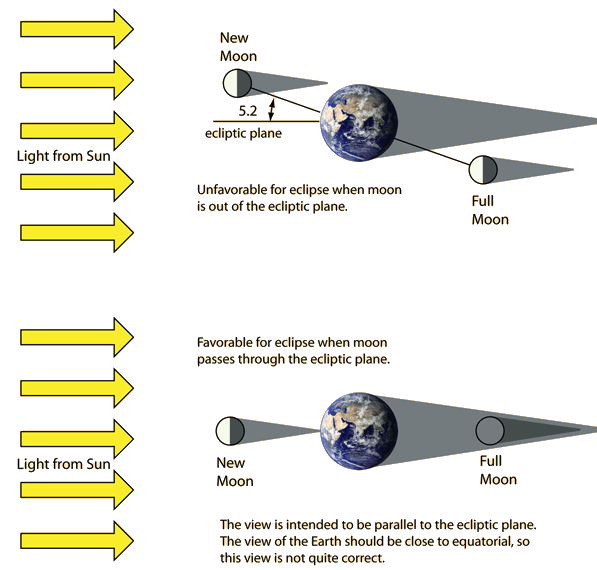
These illustrations are not to scale and of course greatly exaggerate the 5.2° angle of the Moon's orbit with the ecliptic, but conceptually they show the conditions for eclipses. They were inspired by illustrations in Chaisson and McMillan. The Earth view included is a composite view created by NASA.
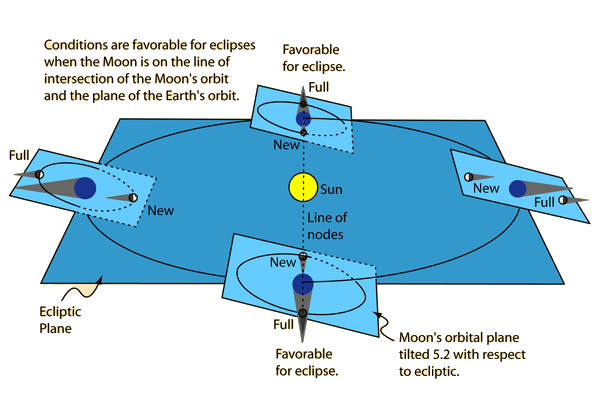
This view of the Moon's orbit helps to explain why you don't get a lunar eclipse every full moon, but only about every six months when the Earth, Moon and Sun line up on the line of nodes.
| Moon Phases
月相 |
| Eclipse on Jupiter
木星掩星 |
Solar System Illustration
Solar System Concepts
Moon Concepts
Reference
Chaisson & McMillan
Ch 1
| HyperPhysics********** Astrophysics
HyperPhysics ********** 天体物理学 | R Nave |