Bilingual edition: English is preserved and Chinese follows each unit. Terminology uses the confirmed v20260916 glossary; automated semantic review remains traceable.
中英双语版:英文原文完整保留,中文紧随对应单元;术语采用 v20260916 确认表,自动语义审校结果可追溯。

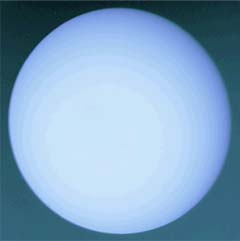
Uranus

天王星

Mass (Earth=1)
质量(地球=1)
146
Equatorial diameter (km)
赤道直径(公里)
51,800
Period (years)
周期(年)
84.0
Mean distance from Sun, 106 km
到太阳的平均距离,10 6 km
2,870
Density (water=1)
密度(水=1)
1.21
Surface gravity m/s2
表面重力 m/s²
7.77

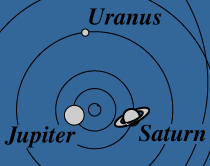
Uranus is the only planet which lies on its side as it revolves around the Sun. Because it is at the limit of naked eye visibility, Uranus was unknown until William Herschel discovered it with a telescope in 1781. The rings were revealed when they occulted a star in 1977.

天王星是唯一一个以侧向方式绕太阳公转的行星。由于它处于肉眼可见的极限,直到1781年威廉·赫歇尔用望远镜发现它之前,天王星都是未知的。当它的环遮蔽了一颗恒星时,环被揭示出来,这发生在1977年。

Uranus and Neptune are sometimes referred to as the "ice giants", their compositions being dominated by water, ammonia (NH3), methane (CH4)' and some 'rock" composed of silicates and metals. They have a hydrogen/helium atmosphere which is thought to have a mass of around 1 - 3 times the mass of the Earth.

天王星和海王星有时被称为“冰巨星”,其组成主要由水、氨(NH₃)、甲烷(CH₄)以及一些“岩石”(由硅酸盐和金属组成)构成。它们的大气层中含有氢和氦,其质量被认为约为地球质量的1到3倍。
Planetary data
行星数据
Index

Solar System Illustration

Solar System Concepts

Reference
de Pater and Lissauer
Ch 1
索引 太阳系图示 太阳系概念 参考资料 de Pater 和 Lissauer 第1章
 
HyperPhysics********** Astrophysics
HyperPhysics ********** 天体物理学
R Nave
Go Back
返回


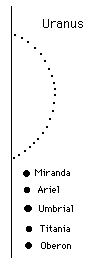
Uranus' Moons

天王星的卫星

The image of Uranus' moon Miranda is a computer-assembled mosaic of images obtained on Jan 24, 1986 by the Voyager 2 spacecraft. Miranda is the innermost and smallest of the five major Uranian satellites, just 480 km (300 mi) in diameter. Nine images were combined to obtain this full-disc, south polar view, which shows the varying geologic provinces of Miranda. Miranda's surface consists of two strikingly different major types of terrain. One is an old, heavily cratered, rolling terrain with relatively uniform albedo (reflectivity). The other is a young, complex terrain characterized by sets of bright and dark bands, scarps and ridges - features found in the regions at right and left and in the distinctive "chevron" feature below and right of center.

天王星的卫星米兰达的图像是一幅由1986年1月24日Voyager 2航天器拍摄的图像拼接而成的拼图。米兰达是五颗主要天王星卫星中最近的、最小的一颗,直径仅约480公里(300英里)。九张图像被组合起来,以获得这幅完整的全盘、南极视图,展示了米兰达表面不同地质区域的差异。米兰达的表面由两种截然不同的主要地形组成。一种是古老的、布满陨坑、起伏的地形,其反照率相对均匀。另一种是年轻的、复杂的地形,其特征包括明亮和暗色带、断层和高地——这些特征出现在图像右上和左上区域,以及中心下方和右侧的显著“V形”特征中。
Index

Solar System Illustration

Solar System Concepts
索引 太阳系示意图 太阳系概念
 
HyperPhysics********** Astrophysics
HyperPhysics ********** 天体物理学
R Nave
Go Back
返回