Voyager I
维吉尔号
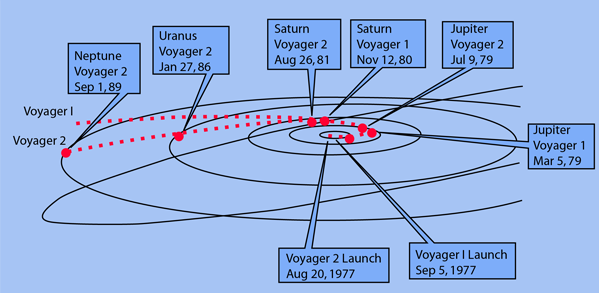
Voyager I was launched Sep 5, 1977. It explored Jupiter and its satellites and moved on to explore Saturn and others. Closest approach to Jupiter Mar 5 1979. The signal transit time to Jupiter is about 40 minutes. Its closest approach to Saturn (126,000 km) was on Nov 12, 1980. Our knowledge of the outer planets was enormously increased by Voyager I and Voyager II.
旅行者一号于1977年9月5日发射。它探索了木星及其卫星,并继续探索土星及其他天体。最接近木星的时间是1979年3月5日。信号传输到木星所需的时间约为40分钟。旅行者一号最接近土星(126,000公里)的时间是1980年11月12日。旅行者一号和旅行者二号极大地增加了我们对外行星的认识。
This era of space exploration brought us to the point of observing and photographing the Earth from space. Voyager I provided one of the iconic photos from space, the Pale Blue Dot.
这一时期的空间探索使我们能够从空间观察和拍摄地球。旅行者一号提供了从空间拍摄的标志性照片之一,即‘淡蓝色点’。 |