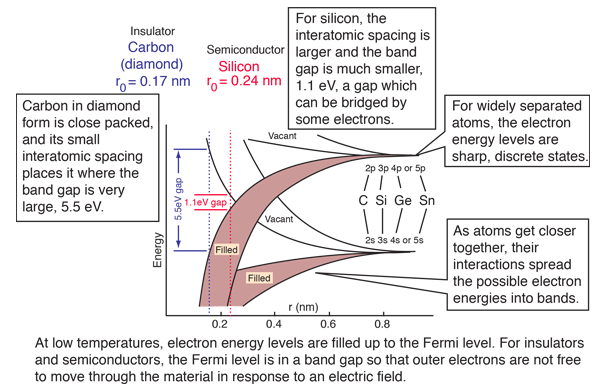
Energy Bands:Insulators and Semiconductors
能带:绝缘体和半导体
The energy bands for the outermost electrons are qualitatively similar for carbon, silicon, germanium and tin. Though they will differ in detail, the generic band diagram below can show why these materials have different electrical properties.
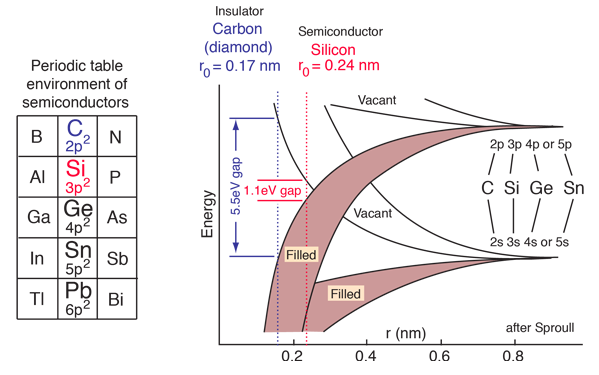
| More explanation of diagram
图的进一步解释 | Closer look at band gaps
带隙的深入探讨 | Environment in periodic table
元素周期表中的环境 |
碳、硅、锗和锡的最外层电子的能带在定性上是相似的。尽管细节会有所不同,下面的通用能带图可以说明这些材料为何具有不同的电学性质。
Semiconductor concepts
Semiconductors for electronics
References
Sproull & Phillips
Rohlf
Ch 14
索引 半导体概念 半导体在电子学中的应用 参考文献 Sproull & Phillips Rohlf 第14章
| HyperPhysics***** Condensed Matter
HyperPhysics ***** 凝聚态物理 | R Nave |
返回