Standing Waves on Slinky
Slinky上的驻波
The vibration of a slinky on the floor is an excellent way to show standing waves. The single loop pattern of the fundamental can usually be produced quickly. As you speed up the vibration to try to produce the second harmonic, it feels strange - you are feeling the tendency of the traveling waves to interfere destructively. The third and fourth harmonics can be produced with effort, but in between the resonances the motion is disorganized and awkward. The constructive interference which produces the standing wave depends upon the phase reversal upon reflection, which can also be demonstrated with the slinky.
在地板上振动一根弹簧是展示驻波的极好方式。基频的单环模式通常可以很快产生。当你加快振动以尝试产生第二谐波时,感觉会有些奇怪——你感受到行波相互 destructive 干涉的倾向。第三和第四谐波需要努力才能产生,但在共振之间,运动是杂乱无章的。产生驻波的 constructive 干涉依赖于反射时的相位反转,这也可以用弹簧来演示。
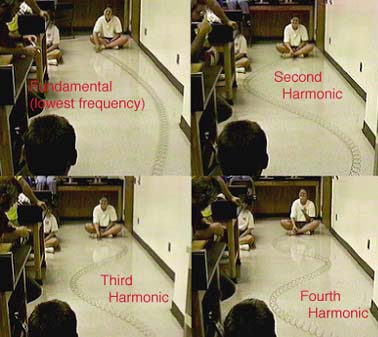
Experimenters are Kelly Jewett (right), Lisa White and Kim Wimpey.
实验者有凯莉·朱特(右)、丽莎·怀特和金·威姆佩伊。
| Show video
播放视频 |
索引
HyperPhysics ***** 声音
返回