Standing Waves驻波
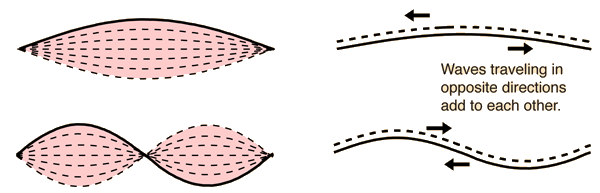
The modes of vibration associated with resonance in extended objects like strings and air columns have characteristic patterns called standing waves. These standing wave modes arise from the combination of reflection and interference such that the reflected waves interfere constructively with the incident waves. An important part of the condition for this constructive interference for stretched strings is the fact that the waves change phase upon reflection from a fixed end. Under these conditions, the medium appears to vibrate in segments or regions and the fact that these vibrations are made up of traveling waves is not apparent - hence the term "standing wave". 与弦和空气柱等扩展物体中的共振相关的振动模式具有称为驻波的特征模式。这些驻波模式源于反射和干涉的结合,使得反射波与入射波发生相 constructive 的干涉。对于拉直的弦来说,这种 constructive 干涉的一个重要条件是,波在固定端反射时会发生相位变化。在这些条件下,介质似乎在段或区域中振动,而这些振动是由传播波组成的这一事实并不明显——因此称为“驻波”。
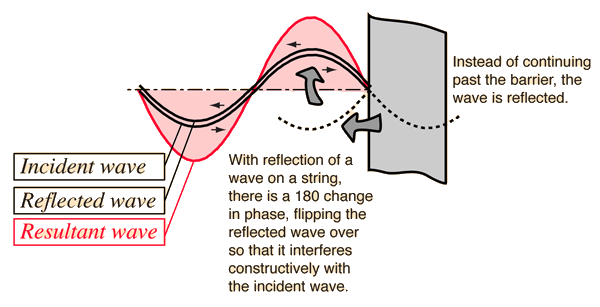
![]() The behavior of the waves at the points of minimum and maximum vibrations (nodes and antinodes) contributes to the constructive interference which forms the resonant standing waves. The illustration above involves the transverse waves on a string, but standing waves also occur with the longitudinal waves in an air column. Standing waves in air columns also form nodes and antinodes, but the phase changes involved must be separately examined for the case of air columns. 波在最小和最大振动点(节点和抗节点)的行为有助于形成共振驻波的构造性干涉。上图展示的是弦上横波的情况,但驻波也出现在空气柱中的纵波中。空气柱中的驻波也形成节点和抗节点,但涉及的相位变化必须分别考察空气柱的情况。
![]()
|
Index Wave concepts Resonance concepts 索引 波的概念 共振概念 | |||||
|
Go Back
返回 |
Standing Waves驻波
The term standing wave is often applied to a resonant mode of an extended vibrating object. The resonance is created by constructive interference of two waves which travel in opposite directions in the medium, but the visual effect is that of an entire system moving in simple harmonic motion. The sketches illustrate the fundamental and second harmonic standing waves for a stretched string. ![]()
驻波一词通常用于描述延展振动物体的共振模式。共振是由两个在介质中相向传播的波的相位叠加产生的。但视觉效果是整个系统在简谐运动中运动。图示展示了弦的基频和第一谐波驻波。 |
Index Wave concepts Resonance concepts 索引 波的概念 共振概念 | ||
|
Go Back
返回 |
Displacement and Pressure位移与压力
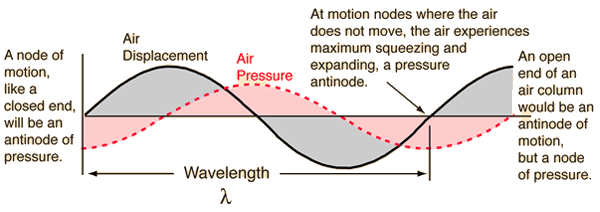
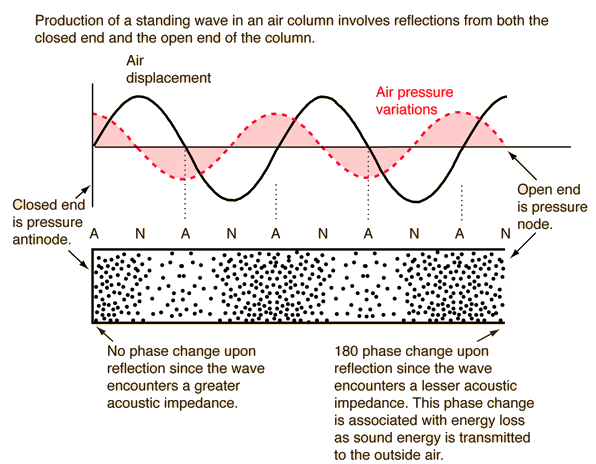
The standing waves associated with resonance in air columns have been discussed mainly in terms of the displacement of air in the columns. They can also be visualized in terms of the pressure variations in the column. A node for displacement is always an antinode for pressure and vice versa, as illustrated below. When the air is constrained to a node, the air motion will be alternately squeezing toward that point and expanding away from it, causing the pressure variation to be at a maximum. This view of resonant modes in terms of pressure waves makes it easier to see why the mouthpiece end of a wind instrument is a node for the resonances. For example, the clarinet is acoustically a closed-end cylindrical air column because the mouthpiece end acts as a pressure antinode. An oboe is induced to produce its upper register by opening a hole near the mouthpiece, releasing pressure to make that point a pressure node and therefore a displacement antinode. 与空气柱中共振相关的驻波主要以柱内空气的位移来讨论。它们也可以通过柱内的压力变化来可视化。位移的节点总是压力的抗节点,反之亦然,如下面所示。当空气被限制在节点时,空气的运动会交替地向该点挤压和远离它,导致压力变化达到最大。这种以压力波来理解共振模式的观点,有助于理解为什么风乐器的嘴孔端是共振的节点。例如,萨克斯管在声学上是一个封闭端的圆柱形空气柱,因为嘴孔端起到压力抗节点的作用。双簧管则通过在嘴孔附近开孔,释放压力使该点成为压力节点,因此成为位移的抗节点。
![]()
|
Index Wave concepts Resonance concepts 索引 波的概念 共振概念 | ||
|
Go Back
返回 |
Pressure and Displacement, Air Column压力与位移,空气柱
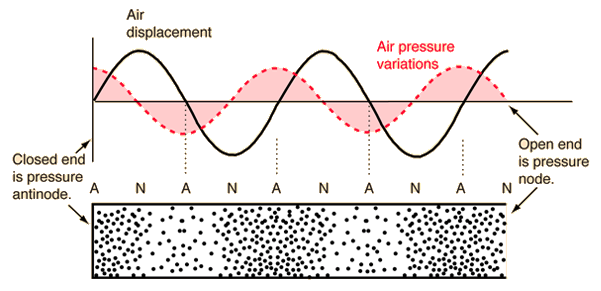
The standing waves associated with resonance in air columns have been discussed mainly in terms of the displacement of air in the columns. They can also be visualized in terms of the pressure variations in the column. A node for displacement is always an antinode for pressure and vice versa, as illustrated below. When the air is constrained to a node, the air motion will be alternately squeezing toward that point and expanding away from it, causing the pressure variation to be at a maximum. This view of resonant modes in terms of pressure waves makes it easier to see why the mouthpiece end of a wind instrument is a node for the resonances. For example, the clarinet is acoustically a closed-end cylindrical air column because the mouthpiece end acts as a pressure antinode. 与空气柱中共振相关的驻波主要以柱内空气的位移来讨论。它们也可以通过柱内的压力变化来可视化。位移的节点总是压力的抗节点,反之亦然,如下面所示。当空气被限制在节点时,空气运动会交替地向该点挤压和远离它,导致压力变化达到最大。以压力波来理解共振模式,使我们更容易理解为什么风乐器的嘴孔端是共振的节点。例如,萨克斯管在声学上是一个封闭端的圆柱形空气柱,因为嘴孔端起到压力抗节点的作用。 .
![]()
|
Index Wave concepts Resonance concepts 索引 波的概念 共振概念 | ||||
|
Go Back
返回 |