61 Cygni61 Cygni(专名或术语)
61 Cygni was christened the "Flying Star" in 1792 by Giuseppe Piazzi (1746-1826) for its unusually large proper motion. Its apparent position would shift by an amount equal to the width of the full moon in only 150 years. 61 Cygni于1792年由Giuseppe Piazzi(1746-1826)因其异常大的自行而被命名为‘飞星’。其视位置在150年内仅会移动相当于满月直径的幅度。
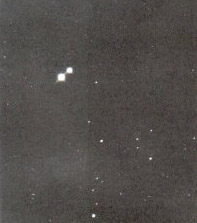
This visual binary system is located about 11.4 light-years (ly) away from our Sun, Sol, in the south central part (21:08:52.1+38:56:51:D~, ICRS 2000.0) of Constellation Cygnus, the Swan -- southeast of Sadr (Gamma Cygni) and east of the open star clusters M 29 and NGC 6871, and the Crescent Nebula (NGC 6888). It is the title member of the 61 Cygni group.(Solstation) 这个视觉双星系统距离我们的太阳系约11.4光年(ly),位于天鹅座(Cygnus)的南中部(21:08:52.1+38:56:51:D,ICRS 2000.0),位于Sadr(Gamma Cygni)东南方向,NGC 6871星团和开放星团M 29以东,以及 Crescent Nebula(NGC 6888)附近。它是61 Cygni星团的成员星。
In 1830, Friedrich Georg Wilhelm von Struve (1793-1864) made the first measurements of the star as a binary system. It is now known that 61 Cygni A and B orbit each other at an "average" distance (semi-major axis) of 86.4 times the Earth-Sun distance, or about 86 astronomical units (AUs) -- which is more than twice Pluto's orbital distance in the Solar System. 61 Cygni was the first star system (other than the Sun) to have its distance to Earth successfully calculated by Friedrich Wilhelm Bessel (1784-1846) using trigonometric parallax and the diameter of the Earth's orbit around the Sun in 1838. Smaller and dimmer than the Sun, the stars are barely visible with the naked eye.(Solstation) 1830年,Friedrich Georg Wilhelm von Struve(1793-1864)首次测量了该星作为双星系统的特性。现在已知61 Cygni A和B之间的平均距离(半长轴)为86.4个地球-太阳距离,或约86天文单位(AUs)——这比太阳系中冥王星的轨道距离大一倍多。61 Cygni是首个(除太阳外)成功利用三角视差和地球绕太阳公转直径计算出距离的恒星系统,这一成果由Friedrich Wilhelm Bessel(1784-1846)于1838年取得。这些恒星比太阳小、暗, barely visible with the naked eye。
61 Cygni-A is an orange-red main-sequence dwarf star of spectral type K3.5-5.0Ve. It has about 70 percent of a solar mass, 72 percent of its diameter and about 8.5 percent of its luminosity. It appears to have about 79 percent of the Sun's metallicity. It appears to be a variable star. It orbits 61 Cygni-B with a highly elliptical orbit (e=0.40) that gives distance extremes 51.7 and 121.0 AUs in an orbit of period about 722 years. 61 Cygni B is and orange-red main sequence dwarf of spectral type K4.7-7.0 Ve. It has about 63 percent of of a solar mass, 67 percent of its diameter, and 3.9 percent of its luminosity. 61 Cygni-A 是一颗橙红色的主序矮星,光谱类型为 K3.5-5.0Ve。它的质量约为太阳的70%,直径约为太阳的72%,光度约为太阳的8.5%。它似乎具有太阳金属度的约79%。它似乎是一颗变星。它与61 Cygni-B 有高度椭圆的轨道(e=0.40),轨道周期约为722年,轨道的远点和近点距离分别为51.7和121.0天文单位。61 Cygni-B 是一颗橙红色的主序矮星,光谱类型为 K4.7-7.0Ve。它的质量约为太阳的63%,直径约为太阳的67%,光度约为太阳的3.9%。
Sources: 源:
洛威尔天文台图片 |
Index Nearby Stars Star Concepts 索引 邻近恒星 恒星概念 | ||
|
Go Back
返回 |
Sigma 2398西格马 2398
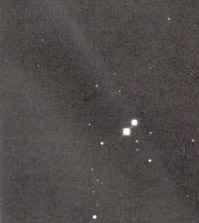
This system is located about 11.4 light-years (ly) away from our Sun, Sol. It lies in the northeastern part (18:42:46.69+59:37:49.42, ICRS 2000.0) in Constellation Draco, the Dragon -- northeast of Grumium (Xi Draconis) and southwest of Altais or Nodus Secundus (Delta Draconis). Struve 2398 is too dim to be seen with the naked eye. 这个系统距离我们的太阳系约11.4光年(ly),位于龙座(Dragon)的东北部(18:42:46.69+59:37:49.42,ICRS 2000.0),位于Grumium(Xi Draconis)东北方和Altais或Nodus Secundus(Delta Draconis)西南方。Struve 2398太暗,无法用肉眼看到。
There are two stars, Struve 2398 A and B, that orbit each other at an "average" distance of about 56 times the Earth-Sun distance -- 42 astronomical unit (AUs) of an orbital semi-major axis -- which is roughly Pluto's orbital distance in the Solar System. The separation of the two components was first measured in 1832 by Friedrich Georg Wilhelm von Struve (1793-1864), who became director of Russia's Dorpat Observatory in 1817 and founded and directed the Pulkovo Observatory in 1837, surveyed 120,000 stars from 1819 to 1827, published an extensive monograph of Halley's Comet based on observations in 1835 and his findings on 2,640 double stars in 1837, and measured the parallax of Vega from 1835 to 1838. While now often named in his honor, Struve's stars were originally numbered after the Greek letter "Sigma," so that this binary pair was designated as Sigma 2398.(Solstation) 有两个恒星,Struve 2398 A和B,它们之间的平均距离约为56个地球-太阳距离——即42个天文单位(AUs)的轨道半长轴——这大致相当于太阳系中冥王星的轨道距离。这两颗星体的分离度最早于1832年由Friedrich Georg Wilhelm von Struve(1793-1864)测量,他于1817年成为俄罗斯多尔帕特天文台的主任,并于1837年创立并主持普尔科沃天文台。从1819年到1827年,他观测了120,000颗恒星,基于1835年的观测发表了关于哈雷彗星的详尽专著,并于1837年发表了关于2,640个双星系统的研究成果,还从1835年到1838年测量了Vega的视差。尽管现在常以他的名字命名,Struve的恒星最初是按照希腊字母“Sigma”来编号的,因此这对双星被指定为Sigma 2398。
Sources: 源:
|
Index Nearby Stars Star Concepts 索引 邻近恒星 恒星概念 | ||
|
Go Back
返回 |