Bilingual edition: English is preserved and Chinese follows each unit. Terminology uses the confirmed v20260916 glossary; automated semantic review remains traceable.
中英双语版:英文原文完整保留,中文紧随对应单元;术语采用 v20260916 确认表,自动语义审校结果可追溯。

Binary Stars

双星系统

A surprisingly large fraction of the stars are in binary or multiple star systems. Sometimes the binary stars are obviously separated, like 61-Cygni in the close neighborhood of the Sun. Binary stars which can be resolved by a telescope are called "visual binaries". Others can be detected from periodic variations in luminosity associated with the eclipsing of one star by the other ("eclipsing binaries"). Still other can be detected from the overlapping of different kinds of spectra ("spectral binaries"). Modern interferometric measurements have added to our ability to distinguish and study binary stars. Sometimes a binary companion can be implied by a periodic change in the position of a star even if the companion is not visible. This is called an astrometric binary, and a famous example is the discovery of the white dwarf star which is the binary companion of Sirius.

令人惊讶的是,大量恒星存在于双星或多重星系统中。有时双星系统显然可以分辨,例如61-天琴座的恒星就在太阳的近邻。可以用望远镜分辨的双星被称为'视觉双星'。其他双星则可以通过两颗恒星相互遮蔽引起的周期性光度变化来检测,称为'食双星'。还有些双星则可以通过不同光谱的重叠来检测,称为'光谱双星'。现代干涉测量技术增强了我们区分和研究双星的能力。有时即使伴星不可见,也可以通过某颗恒星位置的周期性变化来推断其存在,这种双星被称为'天体测量双星',著名的例子是发现Sirius的白矮星伴星。

Binary orbits can contribute to the measurement of the masses of different kinds of stars that appear in such systems.

二体轨道可以用于测量不同类型的恒星质量。
Index

Star Concepts

Star Classification

Reference

Australia National Telescope
索引星概念 星体分类 参考 澳大利亚 国家望远镜
 
HyperPhysics***** Astrophysics
HyperPhysics ***** 天体物理学
R Nave
Go Back
返回


Visual Binary Stars

视觉双星

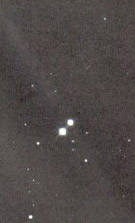
Binary stars that can be visually resolved with the use of a telescope are called visual binaries. Clearly this designation depends upon the resolving power of the telescope used, but provides a useful classification. This class includes the dramatic example of 61-Cygni in the close neighborhood of the Sun.

可以用望远镜分辨的双星被称为视觉双星。显然,这种分类取决于所使用的望远镜的分辨能力,但提供了一个有用的分类。这一类包括了太阳附近著名的例子——61-天琴座。

Binary orbits can contribute to the measurement of the masses of different kinds of stars that appear in such systems. From the measurement of the period and semi-major axis of the binary stars' orbit, the sum of the masses of the stars can be obtained if the distance to the pair is known. In addition, if the orbit of each of the stars can be measured, the individual star masses can be deduced. Kepler's Law of Periods is used in this analysis.
双星轨道可以用来测量不同类型的恒星质量。如果知道双星系统的距离,通过测量轨道的周期和半长轴,可以得到两颗恒星质量之和。此外,如果能测量每颗恒星的轨道,就可以推断出它们的个体质量。开普勒定律在此分析中被使用。
If a binary star's orbital period is observed to be
T = years = days,
and its semimajor axis a = astronomical units,
then the sum of the masses of the stars is m1 + m2 = solar masses. If the individual semi-major axes are found to be
a1 = AU
a2 = AU
Then the individual star masses are
m1 = solar masses
m2 = solar masses.

1951

The case of 61-Cygni can be used as an example of the above calculation. 61-Cygni was one of the first stars for which the distance was determined by parallax. It is about 11.4 light years (3.48 pc) from the solar system. Its period is 722 years and with the use of the distance and the changes in angular position, its semi-major axis was determined to be 86.4 AU. The above calculation gives a mass sum for the two stars to be 1.24 solar masses. The reported masses for the two stars are 0.63 and 0.70 solar masses, which doesn't quite agree with the above. To get 1.33 solar masses with a period of 722 years would require a semi-major axis of 88.5 AU.

61-天琴座可以作为上述计算的例子。61-天琴座是最早被用视差法确定距离的恒星之一。它距离太阳系约11.4光年(3.48 pc)。其轨道周期为722年,利用距离和角位置的变化,确定其半长轴为86.4天文单位。上述计算得出两颗恒星的总质量为1.24个太阳质量。但两颗恒星的实际质量分别为0.63和0.70个太阳质量,这与上述结果不完全一致。要得到1.33个太阳质量的总质量,需要半长轴为88.5天文单位。

One interesting example of a visual binary star is Mizar in the constellation Ursae Majoris, known as a visual binary in 1889. Spectroscopic analysis showed Mizar-A to be a spectroscopic binary. Later observations showed that Mizar-B to is also a spectroscopic binary, so it is a four-star system. Then recent advances in optical interferometry and imaging has allowed Mizar-A to be resolved to image the orbit of that binary pair.

一个有趣的视觉双星例子是大熊座中的Mizar,它在1889年被确认为视觉双星。光谱分析显示Mizar-A是一个光谱双星。后来的观测表明Mizar-B也是一个光谱双星,因此它是一个四星系统。最近光学干涉测量和成像技术的进步使得能够分辨Mizar-A,并拍摄到该双星对的轨道图像。
如果观测到双星系统的轨道周期为 T = 年 = 天,其半长轴 a = 天文单位,则两星质量之和为 m₁ + m₂ = 太阳质量。若分别测得其半长轴为 a₁ = 天文单位,a₂ = 天文单位,则其个体质量分别为 m₁ = 太阳质量,m₂ = 太阳质量。
中文译文中的待填/计算数值依次对应:1:t 2:td 3:a 4:mt 5:a1 6:a2 7:m1 8:m2。实际数值以上方原输入框为准。
Index

Star Concepts

Star Classification

Reference

Australia National Telescope
索引星概念 星体分类 参考 澳大利亚 国家望远镜
 
HyperPhysics***** Astrophysics
HyperPhysics ***** 天体物理学
R Nave
Go Back
返回