Bilingual edition: English is preserved and Chinese follows each unit. Terminology uses the confirmed v20260916 glossary; automated semantic review remains traceable.
中英双语版:英文原文完整保留,中文紧随对应单元;术语采用 v20260916 确认表,自动语义审校结果可追溯。

Radiative Cooling Time

辐射冷却时间

The rate of radiative energy emission from a hot surface is given by the Stefan-Boltzmann law .

热表面的辐射能发射率由斯特藩-玻尔兹曼定律给出。

Here P is the power emitted from the area, and E is the energy contained by the object. For very hot objects, the role of the ambient temperature can be neglected. If the hot temperature is more than 3.16 times the ambient, then the contribution of ambient terms is less than 1%. For example, for 300K ambient on the earth, an object of temperature higher than 1000K can be treated like a pure radiator into space. If the heat loss is purely radiative and not limited by heat transfer to the radiating surface, then the cooling time can be modeled for a hot object.

这里P是从面积发出的功率,E是物体所含的能量。对于非常热的物体,环境温度的影响可以忽略不计。如果热温度是环境温度的3.16倍以上,那么环境项的贡献将小于1%。例如,对于地球上的300K环境,温度高于1000K的物体可以视为纯辐射体进入空间。如果散热 purely 是辐射性的,并且不受到向辐射表面传热的限制,那么可以对热物体的冷却时间进行建模。

If the energy of the object can be characterized by pure translational kinetic energy according to equipartition of energy, then

如果根据能量均分定理,物体的能量可以仅由平动动能来表征,那么

Using the chain rule for differentiation

使用链式法则进行微分

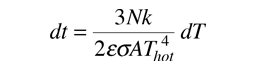
Rearranging gives us

整理得

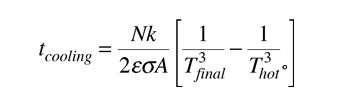
and integrating gives the cooling time
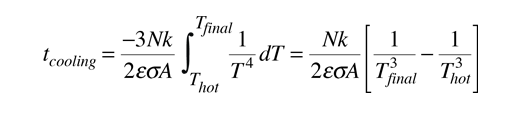
并积分得到冷却时间

It must be kept in mind that for macroscopic objects, the calculated cooling time for the object as a whole will always be shorter than the real cooling time, so that it gives a lower bound. The above relationship assumes infinite thermal conductivity so that the temperature of the whole object is equal to the surface temperature. In the real world, the surface will cool faster than the interior. The rate of heat transfer from the interior will be expected to limit the rate of radiative loss from the surface.

Modeling the Radiative Cooling of a Hot Sphere
对热球的辐射冷却建模
Modeling the radiative cooling of a volcanic fragment
建模火山碎屑的辐射冷却
Kelvin Cooling Time for the Earth
地球的凯尔文冷却时间
必须记住,对于宏观物体,计算出的整个物体冷却时间总是比实际冷却时间短,因此它给出一个下限。上述关系假设热导率无限大,因此整个物体的温度等于表面温度。在现实世界中,表面会比内部冷却得更快。从内部传热的速率预计会限制从表面的辐射损失速率。
Index
索引
 
HyperPhysics***** Thermodynamics
HyperPhysics ***** 热力学
R Nave
Go Back
返回


Modeling the Radiative Cooling of a Hot Sphere

对热球的辐射冷却建模

The modeling of the radiative cooling time of a hot sphere can give some insights into the role of radiation in cooling hot objects. Radiation is definitely not the only mechanism involved; the cooling of real macroscopic objects is a multifaceted topic including heat transfer from the interior of the object to the surface. With this caution about the applicability of these results to the real world, a model for the radiative cooling of a sphere will be developed. The model of the cooling time is given by

对热球的辐射冷却时间进行建模可以提供一些关于辐射在冷却热物体中作用的见解。辐射显然不是唯一的机制;实际宏观物体的冷却是一个多方面的话题,包括从物体内部到表面的热传递。鉴于这些结果在现实世界中的适用性存在谨慎,将建立一个关于球体辐射冷却的模型。该冷却时间的模型由

For a sphere of radius r = cm = m = x 10^m,

对于半径为 r = cm = m = x 10^ m,
中文译文中的待填/计算数值依次对应:1:rc 2:r 3:rb 4:rp。实际数值以上方原输入框为准。

the surface area is A = cm2 = x 10^ m2.

表面积是 A = cm² = x 10^ m²。
中文译文中的待填/计算数值依次对应:1:ac 2:ab 3:ap。实际数值以上方原输入框为准。

the volume is V = cm3 = x 10^ m3.

体积是 V = cm³ = x 10^ m³。
中文译文中的待填/计算数值依次对应:1:vc 2:vb 3:vp。实际数值以上方原输入框为准。

If the density is gm/cm3 = kg/m3, then

如果密度是 gm/cm 3 = kg/m 3 ,则
中文译文中的待填/计算数值依次对应:1:rho 2:rho2。实际数值以上方原输入框为准。

the mass will be gm = kg = x10^ kg.

质量将为 gm = kg = x10^ kg。
中文译文中的待填/计算数值依次对应:1:mg 2:mk 3:mb 4:mp。实际数值以上方原输入框为准。

If the molar mass is known to be M = gm, then we can determine the number of atoms or molecules contained in the sphere. (Caution! These are assumed to be experimental numbers. Molar mass and density are not independent, and it is easy to choose values which are incompatible. Neither is the density precisely determined by the molar mass because of different crystal structures, etc. ). With these assumptions, the number of particles is modeled to be

如果已知摩尔质量为 M = 克/摩尔,则可以确定球体内所含的原子或分子数目。(注意!这些数值是实验测定的。摩尔质量和密度并非独立,容易选择出不一致的值。此外,由于不同的晶体结构等因素,密度也不能精确由摩尔质量确定。)在此假设下,粒子数目被建模为
中文译文中的待填/计算数值依次对应:1:mol。实际数值以上方原输入框为准。
= x10^

If the original high temperature is = K

如果原始高温是 = K
中文译文中的待填/计算数值依次对应:1:th。实际数值以上方原输入框为准。

then a cooling time of sec = x10^ sec

然后是秒量级的冷却时间。
中文译文中的待填/计算数值依次对应:1:t 2:tb 3:tp。实际数值以上方原输入框为准。

for an object with emissivity

对于发射率的物体
中文译文中的待填/计算数值依次对应:1:em。实际数值以上方原输入框为准。

corresponds to a final temperature K

对应最终温度 K
中文译文中的待填/计算数值依次对应:1:tfinal。实际数值以上方原输入框为准。
In this calculation, the value of any parameter may be changed, and the default calculation will be the final temperature. However, if the final temperature is changed, the corresponding cooling time will be calculated.

While perhaps instructive as an exploration, this calculation is unrealistic because of several simplifying assumptions:

  • The entire mass is presumed to be at the same temperature, whereas in any real object the surface will cool faster and you will have a lag in the transfer of heat from the interior of the object to the surface to be radiated.
    整个质量被认为处于同一温度,而在任何实际物体中,表面会冷却得更快,因此从物体内部传到表面的热量传递会滞后,从而影响辐射。
  • The effect of the ambient temperature is neglected. This may be justified. If the hot temperature is more than about three times the ambient, then the error from this assumption is down to 1%
    环境温度的影响被忽略。这可能是合理的。如果高温是环境温度的三倍以上,那么由此假设产生的误差将降至1%。
  • Other heat transfer processes are neglected, namely conduction and convection. For temperatures over 1000K, this is probably justified. Conduction and convection depend linearly upon temperature, while radiation goes up according to the fourth power.
    其他热传递过程被忽略,即传导和对流。对于超过1000K的温度,这可能是合理的。传导和对流与温度成线性关系,而辐射则与温度的四次方成正比。
  • The derivative of energy with respect to temperature above is highly simplified. This derivative is really the specific heat of the object, and it is more involved than this simple expression.
    能量对温度的导数在上面是高度简化的。这个导数实际上是物体的比热容,比这个简单的表达式更复杂。
尽管作为探索可能具有启发性,这种计算由于以下几个简化假设而不切实际:
在此次计算中,任何参数的值可能被更改,而默认的计算结果将是最终温度。然而,如果最终温度被更改,相应的冷却时间将被计算。
中文译文中的待填/计算数值依次对应:1:nb 2:np。实际数值以上方原输入框为准。
Index
索引
 
HyperPhysics***** Thermodynamics
HyperPhysics ***** 热力学
R Nave
Go Back
返回