Subtractive Color Mixing: Filters
Subtractive color mixing is employed with paints and pigments, in contrast with additive color mixing with colored lights for spotlighting and theatrical lighting. Subtractive color mixing can be demonstrated with colored filters, which may be constructed with colored glass or plastics in which a suitable dye has been dissolved. Such filters absorb a range of light wavelengths, and the color of the filter is the color of light that is transmitted by the filter. The most frequently used primary colors for subtractive color mixing are cyan, magenta and yellow. The illustration below follows the conception of Williamson and Cummins and summarizes the action of primary color filters both singly and in pairs.
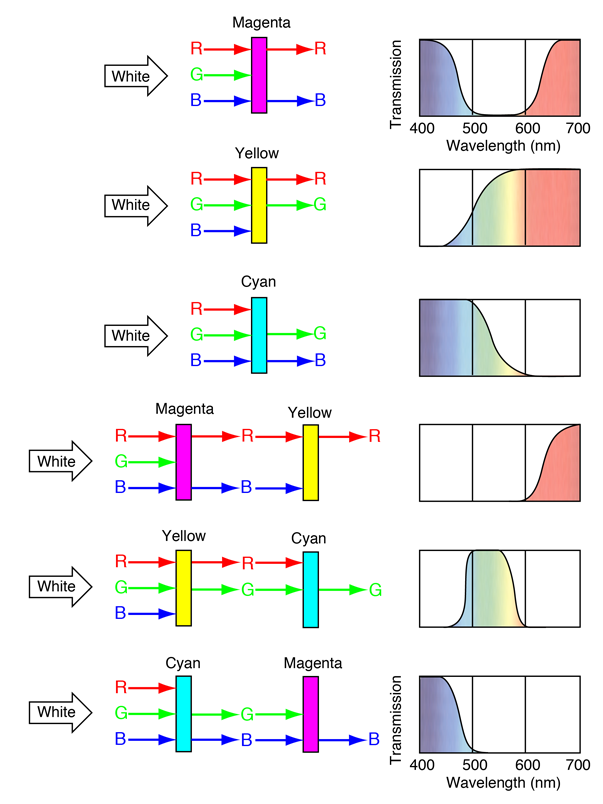
Filters act by selective absorption, and the action of the idealized primary filters above is illustrated in terms of the filter's effect on white light composed of the additive primary colors red, green and blue. Note that two primary filters in succession can be used to produce each of the additive primary colors.
| Subtractive color mixing
减色混合 |
Vision concepts
Color vision
Color measurement
Reference
Williamson & Cummins
Ch 2
| HyperPhysics***** Light and Vision
HyperPhysics ***** 光与视觉 | R Nave |