Bilingual edition: English is preserved and Chinese follows each unit. Terminology uses the confirmed v20260916 glossary; automated semantic review remains traceable.
中英双语版:英文原文完整保留,中文紧随对应单元;术语采用 v20260916 确认表,自动语义审校结果可追溯。

Scalar Product of Vectors

向量的标量积

The scalar product and the vector product are the two ways of multiplying vectors which see the most application in physics and astronomy. The scalar product of two vectors can be constructed by taking the component of one vector in the direction of the other and multiplying it times the magnitude of the other vector. This can be expressed in the form:

矢量的标量积和矢量积是向量相乘的两种方式,在物理和天文学中应用最为广泛。两个矢量的标量积可以通过取一个矢量在另一个矢量方向上的分量,再乘以另一个矢量的大小来构造。这可以表示为:

If the vectors are expressed in terms of unit vectors i, j, and k along the x, y, and z directions, the scalar product can also be expressed in the form:

如果向量用沿x、y和z方向的单位向量i、j和k表示,标量积也可以表示为以下形式:

The scalar product is also called the "inner product" or the "dot product" in some mathematics texts.

Matrix approach to scalar product
标量积的矩阵方法
标量积也被称为“内积”或“点积”。
Index

Vector concepts
索引矢量概念
 
HyperPhysics***** Mechanics
力学
R Nave
Go Back
返回


Scalar Product Calculation

标量积计算

You may enter values in any of the boxes below. Then click on the symbol for either the scalar product or the angle. The vectors A and B cannot be unambiguously calculated from the scalar product and the angle. If the angle is changed, then B will be placed along the x-axis and A in the xy plane.

您可以在下面的任何框中输入值。然后点击标量积或角度的符号。向量 A 和 B 无法从标量积和角度唯一确定。如果角度发生变化,那么 B 将沿 x 轴放置,而 A 则位于 xy 平面内。
Active formula: please click on the scalar product or the angle to update calculation.

The scalar product = ( )( )(cos ) degrees.

标量积 = ( )( )(cos ) 度。
中文译文中的待填/计算数值依次对应:1:ab 2:a 3:b 4:cosa。实际数值以上方原输入框为准。

()()+()()+()() =

Note: The numbers above will not be forced to be consistent until you click on either the scalar product or the angle in the active formula above.

注意:上面的数字将在您点击交互式公式中的标量积或角度之前,不会被强制保持一致。
交互式公式:请点击标量积或角度以更新计算。
中文译文中的待填/计算数值依次对应:1:ax 2:ay 3:az 4:bx 5:by 6:bz 7:ax2 8:bx2 9:ay2 10:by2 11:az2 12:bz2 13:ab2。实际数值以上方原输入框为准。
Index

Vector concepts
索引矢量概念
 
HyperPhysics***** Mechanics
力学
R Nave
Go Back
返回


Scalar Product Applications

标量积应用

Geometrically, the scalar product is useful for finding the direction between arbitrary vectors in space. Since the two expressions for the product:

几何上,标量积对于确定空间中任意向量之间的方向是有用的。由于两种表达式:

involve the components of the two vectors and since the magnitudes A and B can be calculated from the components using:

涉及两个向量的分量,由于向量A和B的大小可以利用分量计算得出:

then the cosine of the angle can be calculated and the angle determined.

One important physical application of the scalar product is the calculation of work:

标量积的一个重要物理应用是计算功:

The scalar product is used for the expression of magnetic potential energy and the potential of an electric dipole.

标量积用于表达磁势能和电偶极子的势。
然后可以计算出角度的余弦值并确定该角度。
Index

Vector concepts
索引矢量概念
 
HyperPhysics***** Mechanics
力学
R Nave
Go Back
返回


Matrix Representation of Scalar Product

标量乘积的矩阵表示

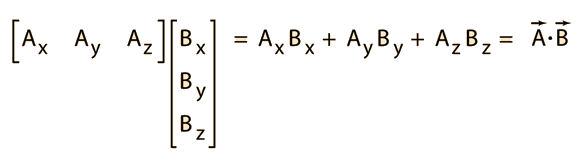
It is sometimes convenient to represent vectors as row or column matrices, rather than in terms of unit vectors as was done in the scalar product treatment above. If we treat ordinary spatial vectors as column matrices of their x, y and z components, then the transposes of these vectors would be row matrices. We could then write for vectors A and B:

有时将向量表示为行矩阵或列矩阵会更方便,而不是像上面标量积处理中那样用单位向量来表示。如果我们把普通的空间向量视为其x、y和z分量的列矩阵,那么这些向量的转置就是行矩阵。我们就可以为向量A和B写成:

Then the matrix product of these two matrices would give just a single number, which is the sum of the products of the corresponding spatial components of the two vectors. This number is then the scalar product of the two vectors.

然后这两个矩阵的乘积将得到一个单一的数,这是两个向量对应空间分量乘积之和。这个数就是两个向量的标量积。

When represented this way, the scalar product of two vectors illustrates the process which is used in matrix multiplication, where the sum of the products of the elements of a row and column give a single number.

当以这种方式表示时,两个向量的标量积展示了矩阵乘法中所用的过程,即行元素与列元素的乘积之和得到一个数。
Index

Vector concepts
索引矢量概念
 
HyperPhysics***** Mechanics
力学
R Nave
Go Back
返回