Seismic Waves
Since the Earth or any other planetary body can be considered to be an elastic object, it will support the propagation of traveling waves. A disturbance like an earthquake at any point on the Earth will produce energetic waves called seismic waves.
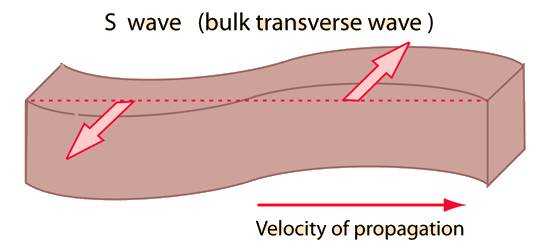
The Earth's crust as a solid object will support waves through the crust called body waves and on the surface (surface waves). In a solid material these waves can be either longitudinal waves or transverse waves. For seismic waves through the bulk material the longitudinal or compressional waves are called P waves (for "primary" waves) whereas the transverse waves are callled S waves ("secondary" waves). Since any material, solid or liquid (fluid) is subject to compression, the P waves can travel through any kind of material. However, S waves depend upon a resistance to transverse or "shear" force which does not exist in a liquid or gas medium, so they can only travel in the solid parts of the Earth (see geologic example).
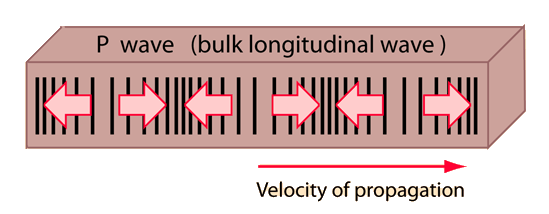
P waves in air are simply sound waves and the speed of sound is around 340 m/s for ordinary temperatures. Water can support P waves but not S waves, and the speed of these P waves (speed of sound) in water is about 1450 m/s. P waves depend upon the bulk modulus of elasticity for the material as well as its density, and the wave speed in a solid material like granite can be about 5000 m/s. The P waves from an earthquake arrive first, but because of their small amplitudes don't do as much damage as the S waves and surface waves which follow.
S waves are transverse waves which involve movement of the ground perpendicular to the velocity of propagation. They travel only through solids, and the absence of detected S waves at large distances from earthquakes was the first indication that the Earth has a liquid core. S waves travel typically 60% of the speed of P waves. They are typically more damaging than the P waves because they are several times higher in amplitude.
Earthquakes also produce surface waves which may cause motion perpendicular to the surface or parallel to the surface. The waves which move the surface up and down are called Rayleigh waves and are sometimes described as "ground roll". Waves whose amplitude of moton is parallel to the surface are called Love waves (named after the mathematician A. E. H. Love who modeled them - definitely not an indication that anyone is fond of them).
Rayleigh waves or ground roll waves cause the surface of the ground to move up and down. They travel at roughly 90% of the speed of the S waves. Love waves involve the motion of the ground side-to-side, perpendicular to the propagation velocity. They usually travel slightly faster than the Rayleigh waves.
References:
Wiki: Seismic waves
Wave concepts
Reference:
Marshak
Ch. 8
Lutgens & Tarbuck
Ch. 15
| HyperPhysics***** Sound
HyperPhysics ***** 声音 | R Nave |