Geologic Example: Longitudinal and Transverse Waves
Longitudinal waves can propagate through either solid or fluid media, but transverse or "shear" waves cannot propagate in a fluid. This can be used to advantage in geological studies as depicted in the illustration below.
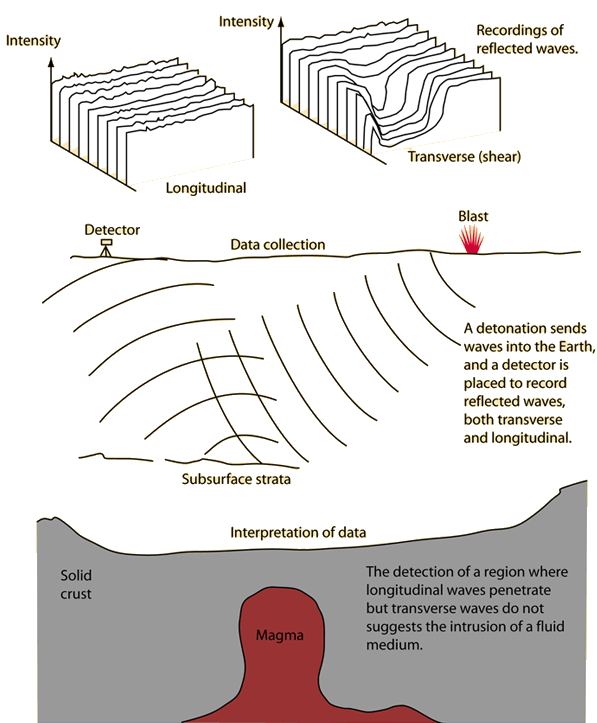
Since the longitudinal waves travel through both solid and liquid, the longitudinal data can be used as a reference for mapping the transverse wave data. Collecting seismic data from both longitudinal waves and transverse waves and taking the difference allows the experimenters to map the underground liquified region.
Both types of waves in the material of the Earth are known as seismic waves. The longitudinal waves are called P waves and the transverse waves S waves. P waves typically travel almost twice as fast as S waves.
When ground movement like that recorded in the Mammoth Lakes region of California is discovered, then this kind of study can give some idea about the intrusion of magma underneath the surface.
Traveling wave concepts
Sound propagation concepts
| HyperPhysics***** Sound
HyperPhysics ***** 声音 | R Nave |