When a force does no work
当力不做功
A force with no motion or a force perpendicular to the motion does no work
作用力没有运动或与运动垂直时,不做功
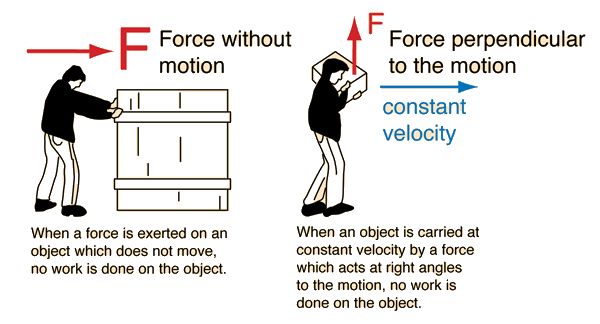
These two examples of forces which do no work are paradoxical. You can certainly feel fatigued when doing either of these, so how can you say that no work is done?
这两个不做功的力的例子似乎有些矛盾。当你做其中任何一件时,你确实会感到疲劳,那么怎么可以说没有做功呢?
In the case at left, no matter how hard or how long you have pushed, if the crate does not move, then you have done no work on the crate. It is sitting still in the same place! Why then do you feel fatigued (as well as frustrated, etc. ). The resolution to this dilemma comes in considering that when your muscles are used to exert a force on something, the individual muscle fibers are in a continual process of contracting and releasing to maintain the net collective result of a steady force on an external object. That contracting and releasing involves force and motion, and constitutes internal work in your body. The energy shows up as warming in your muscle tissue, but if the crate doesn't move, there is still no net work on the crate.
在左边的情况中,无论你多么努力或推了多长时间,如果货箱没有移动,那么你对货箱所做的功就是零。它仍然静止在原地!那么为什么你还会感到疲劳(以及沮丧等)呢?解决这个矛盾的关键在于考虑当你用肌肉施力于某物时,肌肉纤维会持续收缩和放松以维持对外部物体的恒定力。这种收缩和放松涉及力和运动,构成了身体内部的功。能量以肌肉组织的热量形式表现出来,但如果货箱没有移动,对货箱来说仍然没有净功。
The example at right is another standard paradox in the definition of work. If the box is being carried at constant velocity, then no net force is necessary to keep it in motion. The force exerted by the person is an upward force equal to the weight of the box, and that force is perpendicular to the motion. If there is no motion in the direction of the force, then no work is done by that force. Yet you certainly feel like you are doing work if you carry a heavy box. The resolution of the paradox is similar to the first example - your muscles must maintain an extra tension to stay upright under the load. This requires a greater amount of internal contraction and release of our muscle fibers, and hence internal work in our bodies. But the work done on the box is zero since by moving in a straight line at constant speed, its energy is remaining the same.
右边的例子是工作中定义的一个标准悖论。如果箱子以恒定速度被携带,那么不需要净力来保持其运动。人施加的力是一个向上的力,等于箱子的重量,且该力与运动方向垂直。如果力的方向没有运动,那么该力对箱子不做功。然而,如果你搬运一个重箱子,你确实会感觉在做功。这个悖论的解决方式与第一个例子类似——你的肌肉必须维持额外的张力以在负载下保持直立。这需要肌肉纤维更多的内部收缩和释放,因此体内有额外的内部工作。但对箱子做的功为零,因为箱子在直线上以恒定速度移动,其能量保持不变。
There are many important examples of forces which do no work because they act perpendicular to the motion. For circular motion, the centripetal force always acts at right angles to the motion. It changes the direction of the motion, but it does no work on the object. This can be applied to any circular orbit.
有许多重要的力的例子是不做功的,因为它们作用方向与运动垂直。对于圆周运动,向心力始终垂直于运动方向作用。它改变了物体的运动方向,但不对物体做功。这一原理也适用于任何圆周轨道。
|