Force力
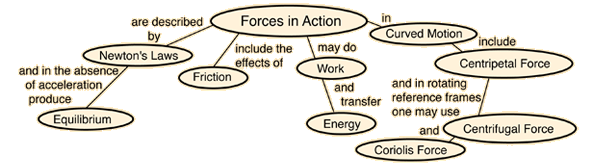
One of the foundation concepts of physics, a force may be thought of as any influence which tends to change the motion of an object. Our present understanding is that there are four fundamental forces in the universe, the gravity force, the nuclear weak force, the electromagnetic force, and the nuclear strong force in ascending order of strength. In mechanics, forces are seen as the causes of linear motion, whereas the causes of rotational motion are called torques. The action of forces in causing motion is described by Newton's Laws under ordinary conditions, although there are notable exceptions. 力是物理学的基础概念之一,可以把它理解为任何倾向于改变物体运动状态的作用。按目前的认识,宇宙中有四种基本相互作用;按强度由弱到强依次为引力相互作用、弱核相互作用、电磁相互作用和强核相互作用。在力学中,力被视为引起直线运动的原因,而引起转动的作用称为转矩。在通常条件下,力引起运动的规律由牛顿运动定律描述,但也存在重要例外。
Forces are inherently vector quantities, requiring vector addition to combine them. 力是矢量,多个力必须按照矢量加法进行合成。
The SI unit for force is the Newton, which is defined by Newton = kg m/s2 as may be seen from Newton's second law. 力的 SI 单位是牛顿。由牛顿第二定律可知,1 牛顿等于 1 千克·米/秒²。
|
Index
索引 | ||
|
Go Back
返回 |
Causes of Motion运动的原因
The influences which cause changes in the motion of objects are forces and torques. The effects of forces on objects are described by Newton's Laws. A force may be defined as any influence which tends to change the motion of an object. The relationship between force, mass, and acceleration is given by Newton's Second Law: 使物体运动状态发生改变的作用是力和转矩。力对物体的作用由牛顿运动定律描述。力可以定义为任何倾向于改变物体运动状态的作用。力、质量和加速度之间的关系由牛顿第二定律给出:
![]() Newton's First Law states that an object will continue at rest or in motion in a straight line at constant velocity unless acted upon by an external force. Newton's Third Law states that all forces in nature occur in pairs of forces which are equal in magnitude and opposite in direction. 牛顿第一定律指出:物体将保持静止或沿直线做匀速运动,除非受到外力作用。牛顿第三定律指出:自然界中的力总是成对出现,两者大小相等、方向相反。
|
Index Newton's laws concepts 牛顿运动定律的概念 | ||
|
Go Back
返回 |
