Einstein Ring
An important example of the gravitational lens effect is the Einstein ring phenomenon illustrated at right. According to general relativity, gravity causes a deflection of light by the gravitational field of a massive body. In this case a galaxy bends the light emanating from a galaxy that is directly behind it, focusing the otherwise divergent light into a visible ring. 引力透镜效应的一个重要例子是图中所示的爱因斯坦环现象。根据广义相对论,重力会使光因 massive body 的引力场而发生偏折。在这种情况下,一个星系会弯曲来自其后方另一个星系的光,将原本发散的光聚焦成一个可见的环。 This image was made by the Hubble Space Telescope and is credited to L. J. King (U. Manchester, NICMOS, HST, NASA). The formal designation of the more distant galaxy is B1938+666. The ring is described as being 1 arcsecond across as observed from Earth's vicinity, but tens of thousands of light years across in size. The foreground galaxy must be almost perfectly aligned to provide a circular ring of light like this example. 这张图像由哈勃太空望远镜制作,版权归属于L. J. King(曼彻斯特大学,NICMOS,HST,NASA)。更遥远的星系正式名称为B1938+666。环的直径在地球附近观测时为1角秒,但在实际尺寸上却达到数万光年。前景星系必须几乎完美对齐,才能产生如本例所示的圆形光环。
| 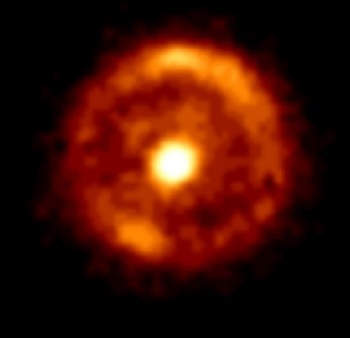 |

Image Credit: ESA/Hubble & NASA
One of the most dramatic examples of the Einstein ring phenomenon was photographed in the visible and infrared by the Wide Field Camera 3 of the Hubble Space Telescope around luminous red galaxy LRG 3-757.This galaxy was discovered in 2007 in the Sloan Digital Sky Survey (SDSS). From its horseshoe shape it has been called "Lensshoe" or "the cosmic horseshoe". The blue galaxy's redshift is approximately 2.4 爱因斯坦环现象最戏剧性的例子之一是由哈勃太空望远镜的宽场相机3在可见光和红外波段拍摄的,拍摄对象是明亮的红色星系LRG 3-757。该星系于2007年在斯隆数字天空调查(SDSS)中被发现。由于其马蹄形外观,它被称作“透镜马蹄”或“宇宙马蹄”。该蓝星系的红移大约为2.4。
|  |
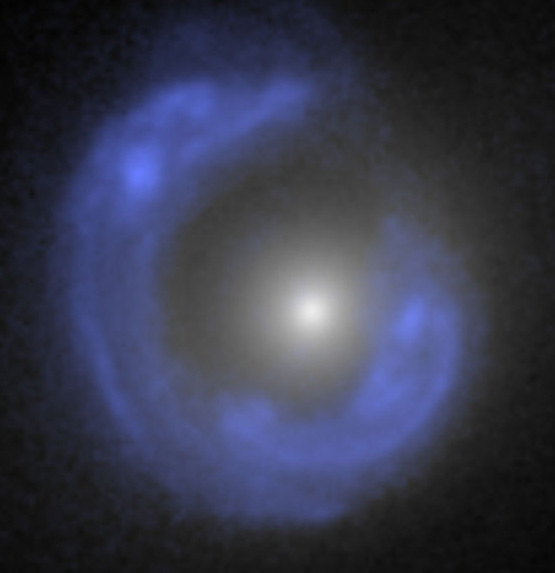 |
The background galaxy identified as SDSSJ1430 forms an Einstein ring "mirage" around the foreground normal white galaxy. This image is credited to A.Bolton (UH/IfA) for SLACS and NASA/ESA.
背景星系SDSSJ1430形成一个爱因斯坦环‘海市蜃楼’,围绕着前景的正常白矮星系。这张图像由A.Bolton(UH/IfA)为SLACS和NASA/ESA提供。 |
Online references:
Einstein ring on Astronomy Picture of the Day.
Einstein ring of a galaxy.
References
| HyperPhysics***** Astrophysics
HyperPhysics ***** 天体物理学 | R Nave |