Red Shift红移
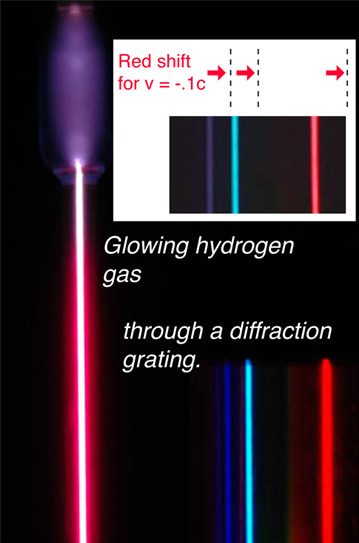
The light from distant stars and more distant galaxies is not featureless, but has distinct spectral features characteristic of the atoms in the gases around the stars. When these spectra are examined, they are found to be shifted toward the red end of the spectrum. This shift is apparently a Doppler shift and indicates that essentially all of the galaxies are moving away from us. Using the results from the nearer ones, it becomes evident that the more distant galaxies are moving away from us faster. This is the kind of result one would expect for an expanding universe. The red line of the spectrum below is the transition from n=3 to n=2 of hydrogen and is famous as the H-alpha line seen throughout all the universe. 来自遥远恒星和更遥远星系的光并非毫无特征,而是具有与恒星周围气体中原子特征相符的明显光谱特征。当这些光谱被检查时,发现它们向光谱的红色端移动。这种移动显然是一种多普勒效应,表明几乎所有星系都在远离我们。利用较近星系的结果,可以明显看出更遥远的星系正以更快的速度远离我们。这种结果正是一个膨胀宇宙所预期的。光谱下图中红色线是氢原子从n=3跃迁到n=2的跃迁线,被称为H-α线,并在整个宇宙中都能观测到。
|
Index
索引 | ||||||
|
Go Back
返回 |
Measured Red Shifts测量红移
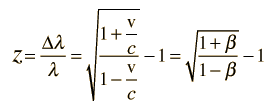
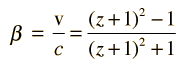
Measured Doppler red shifts give the recession velocity of stars or galaxies, presuming that the Hubble law is valid. It is common practice to express this velocity as a fraction of the speed of light and to use a parameter z defined by:
where λ is understood to be λemitted = λrest, in the rest frame of the emitter.
The largest red shifts measured are those of the quasars. Measurements of >100 quasars have given a range of 0.16 to 3.53, corresponding to recession speeds of 0.15c to 0.91c. 其中,λ 被理解为发射态的 λ 等于静止参考系中的 λ。目前测量到的最大红移来自类星体。对超过100个类星体的测量给出了0.16到3.53的范围,对应于退行速度为0.15c到0.91c。
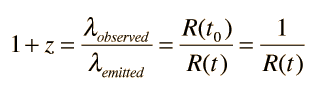
Another application of the z parameter is to imply the scale factor R of the universe at the time that light was emitted from a given observed object. The z parameter is related to R by the expression ![]() 另一个应用z参数的是暗示在某个观测物体发出光的时候宇宙的尺度因子R。z参数与R的关系由下式给出,其中尺度被取为现在的时间R0=1。例如,如果某个物体的红移被发现对应z=3,则R=1/4,我们暗示自光离开该物体以来宇宙膨胀了四倍。接收到的辐射的波长也因空间的膨胀而扩大了四倍。在这样的大z值下,红移主要是宇宙学红移,而不是该物体相对于我们的实际退行速度的可靠度量。
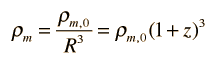
The z parameter can also be used to assess the mass density compared to the mass density ρ0 at the present time. ![]() z 参数也可以用来评估与当前时间的密度ρ₀相比的密度。当z=3时,密度是当前密度的64倍。
测得的多普勒红移给出了恒星或星系的退行速度,假定哈勃定律成立。通常的做法是将这个速度表示为光速的分数,并使用一个参数 z 定义为: |
Index Reference:Carroll & Ostlie Sec 4.3 索引参考:Carroll & Ostlie 第4.3节 | |||||||
|
Go Back
返回 |
Red Shift of Galaxy 8C1435+6358C1435+635星系的红移
Reported in November 1994 in Monthly Notices of the Royal Astronomical Society is a galaxy with a measured red shift of z=4.25 , a new record. This value for the z parameter corresponds to a recession speed of .93c. The galaxy 8C1435+635 was observed in a systematic search for faint, radio-emitting galaxies carried out by a team at Leiden Observatory led by George Miley. After discovery, the optical spectra was observed by the William Hershel Telescope in La Palma, Canary Islands. Two emission lines of ionized carbon and hydrogen were measured to obtain the red shift. This red shift corresponds to a distance of about 13 billion light years if one uses the current WMAP value of 71km/s/mpc for the Hubble parameter is used. 1994年11月发表在《皇家天文学学会月报》上的一项研究报道了一个红移量为z=4.25的星系,创下了新的记录。这个z参数的值对应于退行速度为0.93c。星系8C1435+635是在莱顿天文台团队(由George Miley领导)进行的系统性搜索中发现的,该搜索旨在寻找微弱的无线电发射星系。发现后,该星系的光学光谱在加那利群岛的威廉·赫歇尔望远镜上进行了观测。通过测量离子化碳和氢的两条发射线来获得红移量。这个红移量对应的距离约为130亿光年,如果使用当前WMAP给出的哈勃常数值71km/s/Mpc。
|
Index
索引 | ||
|
Go Back
返回 |