Bilingual edition: English is preserved and Chinese follows each unit. Terminology uses the confirmed v20260916 glossary; automated semantic review remains traceable.
中英双语版:英文原文完整保留,中文紧随对应单元;术语采用 v20260916 确认表,自动语义审校结果可追溯。

Principle of Equivalence

等效原理
Experiments performed in a uniformly accelerating reference frame with acceleration a are indistinguishable from the same experiments performed in a non-accelerating reference frame which is situated in a gravitational field where the acceleration of gravity = g = -a = intensity of gravity field. One way of stating this fundamental principle of general relativity is to say that gravitational mass is equal (or at least proportional) to inertial mass. One of the implications of the principle of equivalence is that since photons have momentum and therefore can be attributed an inertial mass, they must also have a gravitational mass. It is observed that photons are deflected by gravity. They should also be impeded in their escape from a gravity field, leading to the gravitational red shift and the concept of a black hole. It also leads to gravitational lens effects.

While attributing a kind of "effective mass" to the photon is one way to describe why the path of light is bent by a gravity field, Einstein's approach in general relativity is to associate a mass with a curvature of space-time, i.e. the existence of a mass will produce a curvature in space-time around it. From the point of view that light will follow the shortest path, or follows a geodesic of space-time, then if the Sun curves the space around it then light passing the Sun will follow that curvature.

虽然将一种“有效质量”赋予光子是一种描述为什么光的路径会被引力场弯曲的方式,但爱因斯坦在广义相对论中的方法是将质量与时空的曲率联系起来,即质量的存在会在其周围产生时空的曲率。从光会沿着最短路径,或者说沿着时空的测地线这一观点来看,如果太阳会弯曲其周围的时空,那么经过太阳的光就会沿着这种曲率传播。
在均匀加速的参考系中进行的实验,与在非加速参考系中进行的相同实验不可区分,该非加速参考系处于一个重力场中,其中重力加速度 = g = -a = 重力场的强度。用一种方式表述广义相对论的基本原理是说引力质量等于(或至少与惯性质量成比例)。等效原理的一个推论是,由于光子具有动量,因此可以赋予它们惯性质量,它们也必须具有引力质量。观察到光子被引力偏转。它们也应被阻碍逃离重力场,导致引力红移和黑洞的概念。这也导致了引力透镜效应。
Index

General relativity ideas

Rohlf
Sec 19-4


Fraknoi, Morrison, Wolff
Ch 23


Carroll & Ostlie
Sec 17-1
索引 广义相对论思想 Rohlf 第19-4节 Fraknoi, Morrison, Wolff 第23章 Carroll & Ostlie 第17-1节
 
HyperPhysics***** Relativity
HyperPhysics ***** 相对论
R Nave
Go Back
返回


Advance of Mercury's Perihelion

水星近日点进动

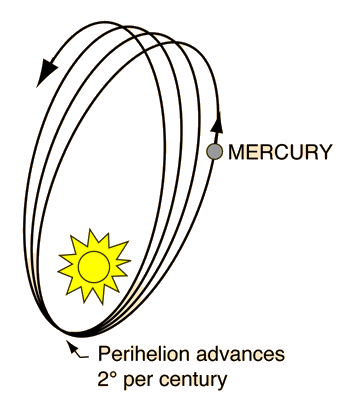
The perihelion of the orbit of the planet Mercury advances 2 degrees per century. 80 seconds of that advance was accounted for by perturbations from the other planets, etc., but the last 40 seconds of arc were unaccounted for. General relativity predicts an additional 43 seconds of arc and was one of the first triumphs of Einstein's theory.

水星轨道近日点每世纪前进2度。其中80秒的进动是由其他行星的摄动等解释的,但最后的40秒弧度却无法解释。广义相对论预测了额外的43秒弧度,并成为爱因斯坦理论的第一个重大胜利。

The eccentricity of Mercury's orbit is exaggerated here to emphasize the effect.

水星轨道的偏心率在此被夸大以突出其影响。

More numerical detail

更多数值细节
Index

General relativity ideas

Reference Ohanian
索引 广义相对论思想 参考 Ohanian
 
HyperPhysics***** Relativity
HyperPhysics ***** 相对论
R Nave
Go Back
返回


Advance of Mercury's Perihelion

水星近日点进动
According to Roy D. North, more precise numbers are as follows (in arcsec per Julian century):
5599 total advance with respect to to geocenter (our reference frame.)
相对于地心的总进动(我们的参考系)
5025 contribution of precession of Earth's equinoxes.
地球岁差的贡献
531 Classical or Newtonian contribution of the other planets.
其他行星的经典或牛顿贡献
43 General relativity correction (modern theory: 42.98)
广义相对论修正(现代理论:42.98)
根据罗伊·D·诺思的说法,更精确的数值如下(以弧秒每儒略世纪为单位):
Greater perihelion advances with binary pulsars.
双星脉冲星的近日点进动更显著。
Index

General relativity ideas

Reference North
索引 广义相对论思想 参考 北极
 
HyperPhysics***** Relativity
HyperPhysics ***** 相对论
R Nave
Go Back
返回


Gravitational Deflection of Light

光的引力偏折
Einstein's calculations in his newly developed general relativity indicated that the light from a star which just grazed the sun should be deflected by 1.75 seconds of arc. It was tested during the total eclipse of 1919 and during most of those which have occurred since.
爱因斯坦在刚发展的广义相对论中的计算表明,一颗刚刚掠过太阳的恒星发出的光应当被偏转1.75秒差距。这一现象在1919年日全食以及此后大多数日全食期间得到了检验。

This bending of light can produce a gravitational lensing effect if a distant galaxy or quasar is closely aligned with a massive galaxy closer to us. If one galaxy is directly behind another, the result can be a circle of light called an Einstein ring.

这种光的弯曲效应,如果远处的星系或类星体与我们附近的巨大星系几乎成直线排列,就能产生引力透镜效应。如果一个星系直接位于另一个星系之后,结果会形成一个称为爱因斯坦环的光圈。
Light Deflection and Space-time Curvature
光的偏折和时空弯曲
Index

General relativity ideas

Reference Kaufmann
索引 广义相对论思想 参考卡弗曼
 
HyperPhysics***** Relativity
HyperPhysics ***** 相对论
R Nave
Go Back
返回


Light Deflection and Space-time Curvature

光的偏折和时空弯曲

This is a common approach to try to gain some visualization of the curvature of space-time by a gravitational mass. It starts by depicting space as a two-dimensional elastic sheet. If a massive ball is placed on this sheet, it will produce an indentation or curvature. If a smaller ball is rolled by the larger one, its path will be deflected by the indentation of the larger ball. While not adequate to depict the curvature of 4-dimensional space-time, it at least is a start. The bending of light above is greatly exaggerated.

这是一种尝试通过引力质量来获得时空曲率可视化理解的常见方法。它首先将空间描绘成一个二维弹性薄板。如果在上面放一个引力质量较大的球,它会产生凹陷或曲率。如果较小的球被较大的球推动,其路径将被较大的球造成的凹陷所偏折。虽然这种方法不足以描绘四维时空的曲率,但至少是一个起点。上面的光的弯曲被大大夸大了。

Einstein's calculations in his newly developed general relativity indicated that the light from a star which just grazed the sun should be deflected by 1.75 seconds of arc. It was measured by Eddington during the total eclipse of 1919 and has been reaffirmed during most of those which have occurred since.

This bending of light can produce a gravitational lensing effect if a distant galaxy or quasar is closely aligned with a massive galaxy closer to us. If one galaxy is directly behind another, the result can be a circle of light called an Einstein ring.

这种光的弯曲效应,如果远处的星系或类星体与我们附近的巨大星系几乎成直线排列,就能产生引力透镜效应。如果一个星系直接位于另一个星系之后,结果会形成一个称为爱因斯坦环的光圈。
爱因斯坦在新发展的广义相对论中的计算表明,一颗刚刚擦过太阳的恒星发出的光应当被偏转1.75秒差距。这一现象在1919年日全食时由埃德蒙顿测量,并在之后发生的大多数日全食中得到了证实。
Index

General relativity ideas

Fraknoi, Morrison, Wolff
Ch 23
索引 广义相对论思想 Fraknoi, Morrison, Wolff 第23章
 
HyperPhysics***** Relativity
HyperPhysics ***** 相对论
R Nave
Go Back
返回


Eddington's Measurement of Light Deflection

爱丁顿的光偏折测量

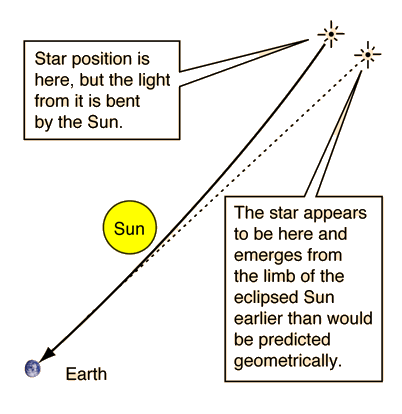
Einstein's calculations in his newly developed general relativity indicated that the light from a star which just grazed the sun should be deflected by 1.75 seconds of arc. The depiction of this bending is greatly exaggerated in the illustration above.

爱因斯坦在刚发展的广义相对论中的计算表明,一颗刚刚擦过太阳的恒星发出的光应当被偏转1.75秒差距。上述插图中对这种弯曲的描绘被大大夸大了。

Einstein, writing in a German journal during World War I, suggested that during a total solar eclipse the deflection should be observable in terms of the time of emergence of a star from behind the Sun. Fraknoi, et al. comment that a copy of that paper came through neutral Holland and reached British astronomer Arthur S. Eddington. An expedition was organized to attempt to measure this deflection during the next total solar eclipse on May 29, 1919 at two locations: the island of Principe off the west coast of Africa and Sobral, Brazil. Photographs were obtained in both locations and confirmed the predicted deflection to about 20% accuracy.

爱因斯坦在第一次世界大战期间为一份德文期刊撰文,建议在日全食期间,应能通过星体从太阳后方出现的时间来观测到光线偏折。Fraknoi等人指出,该论文副本经中立的荷兰传送到英国天文学家阿瑟·S·爱丁顿手中。为尝试测量这一效应,组织了一次考察,计划在1919年5月29日的日全食期间,在两个地点进行测量:非洲西海岸的普林西比岛和巴西的索布拉尔。在两个地点均获得了照片,并确认了预测的光线偏折,精度约为20%。

Measurements during total solar eclipses have been made several times, notably by the Yerkes Observatory in 1953 and by the University of Texas in 1973. More accurate radio frequency measurements after that time became the standard approach to gravitational deflection of electromagnetic waves.

在日全食期间的测量多次被进行,特别是1953年由耶鲁天文台和1973年由德克萨斯大学进行的测量。此后更精确的无线电频率测量成为测定电磁波引力偏折的标准方法。
Index

General relativity ideas

Fraknoi, Morrison, Wolff
Ch 23
索引 广义相对论思想 Fraknoi, Morrison, Wolff 第23章
 
HyperPhysics***** Relativity
HyperPhysics ***** 相对论
R Nave
Go Back
返回